Samaritan Sanctuary on Mount Gerizim: Rivaling the Jerusalem Temple
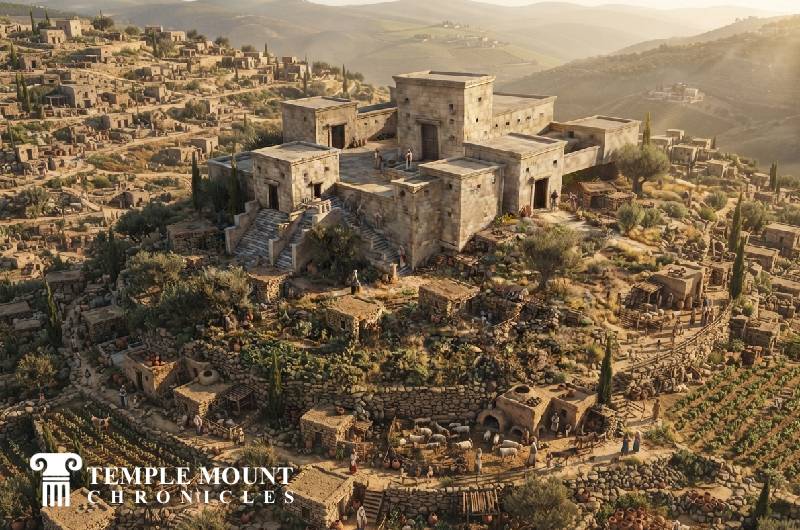
Artistic reconstruction of the Samaritan sacred precinct on Mount Gerizim, incorporating archaeological evidence and scholarly reconstruction.
Mount Gerizim represents a competing claim to one of the most fundamental questions in the Torah: Where did the Holy One choose to place His sanctuary? The Torah commands that the blessings be pronounced on Mount Gerizim and the curses on Mount Ebal (Deuteronomy 11:29; 27:12–13), and Joshua records the ceremony carried out near Shechem (Joshua 8:30–35). Yet the Jewish biblical tradition ultimately identifies Jerusalem as the chosen place, while the Samaritan tradition came to regard Gerizim itself as the mountain chosen by God. The resulting rivalry was therefore not merely political. It concerned the location of the Mikdash, the priesthood, sacrifice, and the interpretation of the Torah itself.
The Samaritan claim rested upon a reading of the Pentateuch that diverged from the Jewish textual tradition. The Samaritan Pentateuch, whose surviving textual tradition is considerably later than the biblical period even though it preserves ancient readings, explicitly associates the chosen sanctuary with Mount Gerizim. In the Samaritan version of the Decalogue, the command concerning the chosen place is connected to an altar on Gerizim. The Jewish Masoretic tradition contains no such command. This distinction is crucial: Gerizim was not merely a mountain that the Samaritans happened to prefer. Their claim rested upon a competing interpretation of the Torah, one that placed their sanctuary within the biblical story of Israel.
Jewish tradition, however, understood the biblical geography differently. The Mishnah's discussion of the ceremony of the blessings and curses takes Mount Gerizim and Mount Ebal (which also contained an altar) to be the mountains near Shechem, and the Jerusalem Talmud records a disagreement between Rabbi Yehudah and Rabbi Eliezer over precisely how the biblical geographical descriptions should be understood. Rabbi Yehudah identifies the mountains with the Gerizim and Ebal inhabited by the Samaritans; Rabbi Eliezer challenges that identification and proposes that the biblical mountains were two artificial elevations constructed by Israel for the ceremony. The discussion is revealing because the rabbis were not unaware of the Samaritan claim. They were actively interpreting the Torah's account of Gerizim and Ebal in a world in which another community was claiming those mountains as its sacred center. Mishnah Sotah 7:5; Jerusalem Talmud Sotah 7:3.
The Jewish-Samaritan divide becomes still more visible in Mishnah Nedarim 3:10. The Mishnah observes that the Samaritans, or Kutim, observed Shabbat, but when discussing those who "ascend to Jerusalem", it makes the distinction explicit: a Jew who vows not to benefit from those who ascend to Jerusalem is prohibited from benefiting from Jews, but not from Samaritans, because the Samaritans ascend to Mount Gerizim rather than Jerusalem. This brief halakhic passage is one of the clearest rabbinic witnesses to the competing sanctuaries. The issue was not theoretical. By the time of the Mishnah, the rabbis understood Samaritan religious practice as centered upon a mountain that stood in deliberate opposition to Jerusalem's sanctuary.
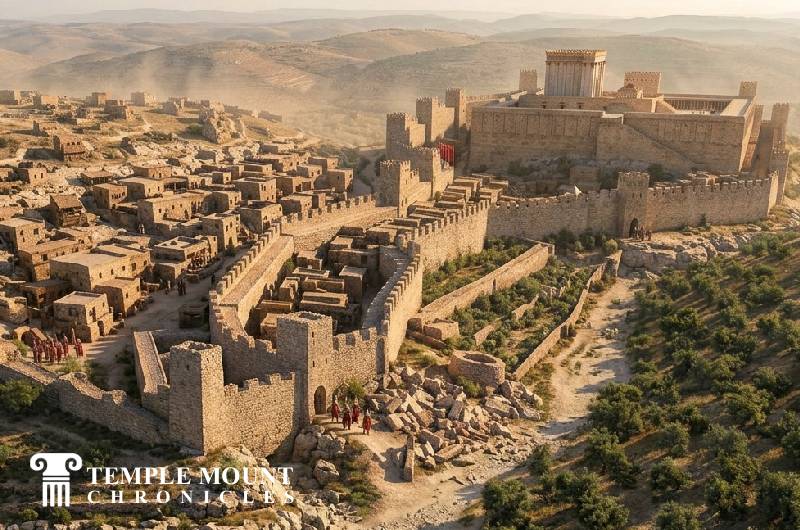
Jerusalem during the time of Nehemiah, circa 450 BCE.
The origins of the sanctuary are more difficult to establish. Josephus tells a dramatic story in Antiquities 11.302–312 in which Sanballat, the governor of Samaria, offers his son-in-law Manasseh—connected to the Jerusalem priestly family—a high priesthood at a new temple on Mount Gerizim. Josephus places this episode in the Persian period as part of the struggle surrounding the rebuilding of the Jerusalem Temple, although elsewhere his chronology connects the Samaritan temple with the age of Alexander. The biblical book of Nehemiah independently records that a grandson of the high priest Eliashib had married a daughter of Sanballat and was expelled from Jerusalem (Nehemiah 13:28). Whether these traditions preserve the same historical episode is uncertain, and Josephus' chronology cannot simply be accepted over the archaeological evidence. But the Jewish sources preserve an important memory: the conflict over Gerizim was bound up with the priesthood as well as with the sanctuary itself.
Archaeology has made the story considerably older than Josephus' account might suggest. Excavations directed by Yitzhak Magen uncovered a large sacred precinct on the summit of Mount Gerizim whose earliest substantial phase dates to approximately the middle of the fifth century BCE, during the Persian period. The enclosure measured roughly 98 by 96 meters, and excavators found monumental gates, carefully worked stone, inscriptions, and enormous quantities of animal bones from sacrificial activity. More than 400 inscriptions were recovered, including references to priests and formulas such as "before God in this place"; one inscription refers to a house of sacrifice, while another appears to preserve the expression "house of YHWH". These discoveries make the existence of a Samaritan sanctuary on Gerizim extremely difficult to dismiss as a late literary invention.
For the rabbis, however, the central issue was not whether Gerizim was impressive, ancient, or populated by people who worshipped the God of Israel. The issue was which sanctuary possessed the legitimate sanctity commanded by the Torah. Rabbinic literature consequently preserves a polemical memory of the Samaritans as Kutim, a community whose practices could resemble those of Israel while nevertheless departing from the rabbinic understanding of Jewish worship. That distinction is particularly important in Yoma 69a, where the Gemara relates the story of Alexander's encounter with Shimon HaTzaddik and the Jewish confrontation with the Samaritans. The account culminates in the Samaritans being dragged to Mount Gerizim, where, the Talmud says, their temple was plowed under and the ground sown with leeks. Whatever historical kernel lies behind the story, its rabbinic presentation is unmistakable: the sanctuary on Gerizim was regarded as a rival to the House of God in Jerusalem.
That memory becomes especially significant when viewed against the later history of the Second Temple. The Hasmonean ruler John Hyrcanus I destroyed the Gerizim sanctuary toward the end of the second century BCE. Josephus places the destruction around 128 BCE, but the archaeological evidence points closer to 110 BCE, when the sanctuary and the surrounding city were destroyed. The discrepancy is a useful reminder that Josephus is an indispensable source but not an infallible chronological authority. The archaeological destruction layer, coins, pottery, and other evidence provide a different chronology. The sanctuary disappeared, but Mount Gerizim did not cease to be sacred to the Samaritans; its importance survived the destruction of the temple itself.
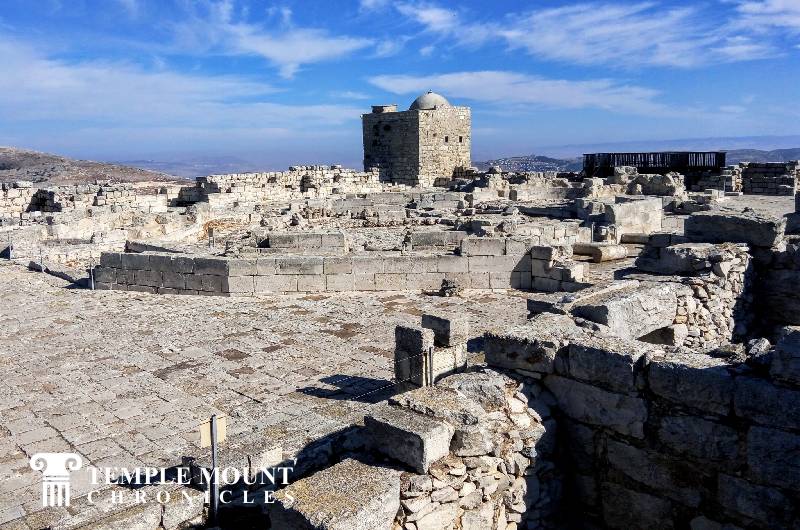
Ruins of the Byzantine period (circa 484 CE) Octagonal Church of Mary Theotokos.
The physical remains also complicate any attempt to create a precise reconstruction such as the accompanying illustration. We can confidently reconstruct a monumental sacred precinct, gates, courtyards, sacrificial installations, priestly activity, and a substantial built environment. What is much less certain is the precise appearance of the central temple building. Archaeologists have found architectural fragments and inscriptions strongly supporting the existence of a sanctuary, but the surviving remains do not permit every architectural detail to be drawn with confidence. The image should therefore be understood as an artistic reconstruction based on the archaeological evidence and scholarly proposals, rather than as a literal representation of a building whose complete plan is known. The evidence is nevertheless substantial: more than 400,000 burnt animal bones, hundreds of inscriptions, monumental masonry, and remains dating the sacred complex to the Persian and Hellenistic periods all point to Mount Gerizim having been a genuine center of sacrifice and worship—one whose very existence forced the ancient Jewish world to define, ever more sharply, why the sanctuary of Israel was Jerusalem.