Antonia Fortress
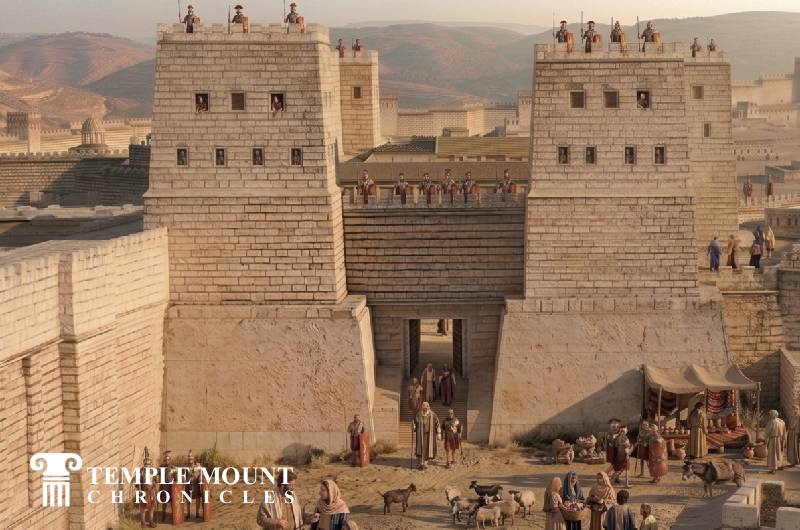
Eastern facade of the Tower Antonia, first century CE, Roman period.
The Antonia Fortress was a massive fortified complex built by Herod the Great beside the northern side of the Temple Mount in Jerusalem. Named in honor of the Roman statesman Mark Antony, Herod’s former patron, it occupied a strategic position overlooking the Temple precincts. From this elevated stronghold, Roman troops could observe activity on the Temple Mount and respond quickly if unrest broke out.
The fortress stood at the northwestern corner of Herod’s expanded Temple Mount, where the northern side was particularly vulnerable to attack. Herod dramatically enlarged the Temple platform beginning in the late first century BC, extending it north, south, and west. The Antonia was constructed on a prominent rocky elevation at the northwest corner, giving it commanding views over the Temple courts.
Herod did not build the fortress on an untouched site. An earlier Hasmonean citadel known as the Baris stood in this area, and Josephus describes Herod as rebuilding and enlarging the fortress before giving it the name Antonia. The exact chronology of its various stages is complicated, but the Antonia that stood during the time of Jesus was fundamentally a Herodian fortress associated with Roman rule.
According to the Jewish historian Josephus, the Antonia was an imposing structure built upon a rock approximately fifty cubits high. He describes walls, courtyards, living quarters, baths, and broad spaces suitable for troops, saying that its interior was so elaborate that it resembled a palace. The fortress had four prominent corner towers in Josephus’s account: three were fifty cubits high, while the southeastern tower rose to seventy cubits and commanded a view of the entire Temple area.
The Antonia was more than a defensive structure. A Roman garrison was stationed there, and the soldiers could move from the fortress toward the Temple courts. Josephus describes passages connecting the fortress with the surrounding colonnades and explains that the troops were positioned to watch the crowds during Jewish festivals, when Jerusalem could become especially tense. The fortress therefore represented the visible military presence of Rome directly beside the Jewish Temple.
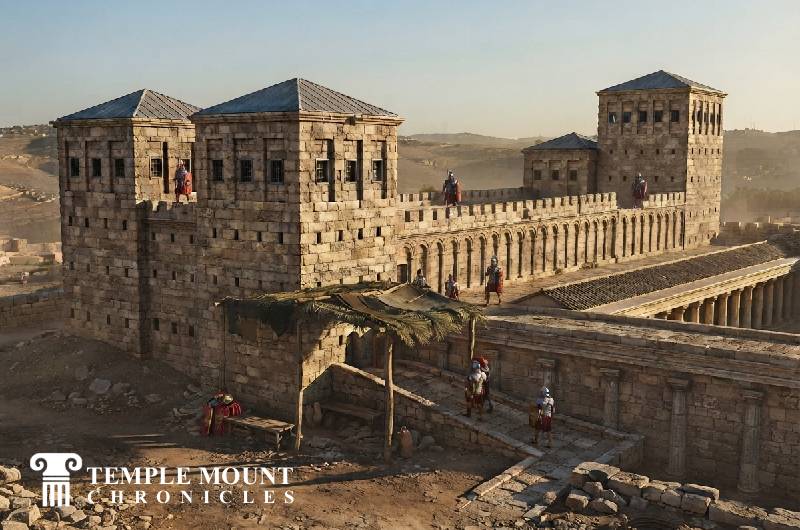
Conceptual illustration of "Tower Antonia", as seen from the south-west.
This role becomes especially significant in the New Testament. In Acts 21, when a crowd in Jerusalem attacks Paul, Roman soldiers intervene and take him into the fortress. Acts 21:34 records the commander ordering Paul to be brought into the barracks, while Acts 21:37–40 describes Paul speaking from the steps to the assembled crowd. The account provides a vivid glimpse of the Antonia functioning as a Roman military headquarters overlooking the Temple precincts.
The fortress also played a role in the final catastrophe of the Second Temple. During the Roman siege of Jerusalem in 70 CE, the Antonia became one of the strongpoints involved in the fighting around the Temple Mount. Josephus describes the Roman assault on the fortress and the subsequent fighting in the Temple area. The destruction of the Antonia formed part of the wider destruction of Jerusalem and the Second Temple by the forces of Titus.
The exact appearance of the Antonia remains uncertain. Josephus’s description is the principal ancient account, and later reconstructions commonly depict a large rectangular fortress with four corner towers. However, archaeologists have debated the precise form and extent of the complex, and there is no surviving structure that can simply be identified as the entire Antonia Fortress. Reconstructions should therefore be understood as informed interpretations rather than exact architectural portraits.