Joshua's Altar: From Mount Ebal to Jerusalem
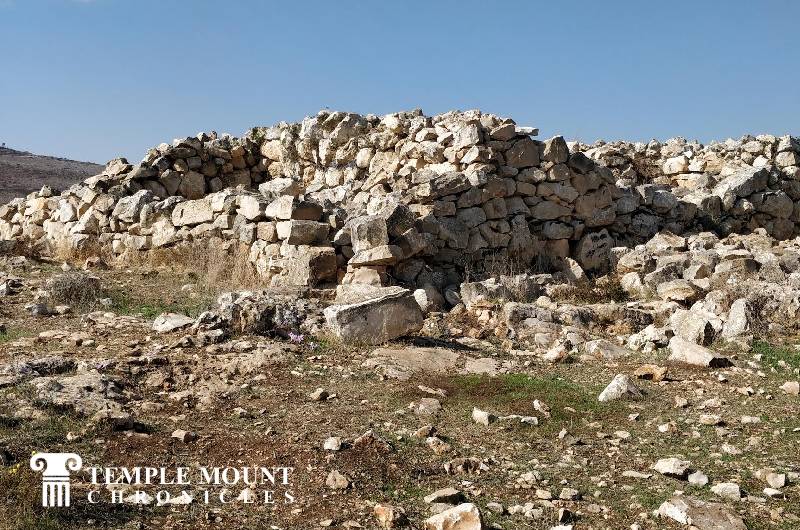
Ruins of the Iron Age I Israelite Altar on Mount Ebal.
Deuteronomy 27:4–8 instructs Israel that, after crossing the Jordan, they are to set up stones on Mount Ebal, build an altar of stones upon which no iron has been wielded, and offer ʿolot (עֹלוֹת, burnt offerings) and shelamim (שְׁלָמִים, well-being or fellowship offerings) there. Joshua 8:30–35 presents the fulfillment of that command: Joshua builds the altar on Mount Ebal, using whole stones, offers burnt offerings and shelamim, writes a copy of the Torah upon stones, and gathers Israel before Mount Ebal and Mount Gerizim. The location is significant within the biblical narrative. Ebal stands opposite Gerizim near Shechem, the ancient center of the central hill country, and the ceremony combines sacrifice, inscription, blessing, curse, and public reading of the Torah. The altar therefore belongs to a larger covenant ceremony rather than functioning merely as a place where animals were killed. Its biblical significance lies precisely in the combination of altar, Torah, sacrifice, and covenant.
The archaeological structure on Mount Ebal makes this passage unusually difficult to dismiss as a purely abstract description, although identifying it specifically as Joshua's altar remains disputed. Adam Zertal discovered the site during his survey of the Manasseh Hill Country in 1980 and excavated it between 1982 and 1989. At el-Burnat, on the mountain's eastern side, he exposed a substantial rectangular stone structure within a larger enclosed complex. The principal structure measured approximately 9 by 7 meters and stood roughly 4 meters high in its preserved state; its walls were built of large, unhewn fieldstones and were laid directly on bedrock. There was no conventional entrance or domestic floor, and the structure contained deliberate layers of stones, earth, and ash. Excavators also recovered pottery, including large collar-rim storage jars, jugs, chalices, and smaller vessels that Zertal regarded as associated with cultic activity. More significantly, animal bones and ash occurred at the site, while numerous installations contained evidence that he interpreted as sacrificial remains. The larger archaeological complex itself occupies a distinctive foot-shaped enclosure on a terrace of Mount Ebal. Zertal consequently identified the central structure as an altar and the entire installation as an early Israelite cultic center, proposing a connection with the altar of Joshua 8. Other archaeologists have accepted the site's broadly cultic character while rejecting or questioning the identification of the central structure as Joshua's altar. The question is therefore not whether the site is interesting because it happens to resemble a biblical story; it is whether the location, date, architecture, associated remains, and biblical description together provide sufficient evidence for the more specific identification.
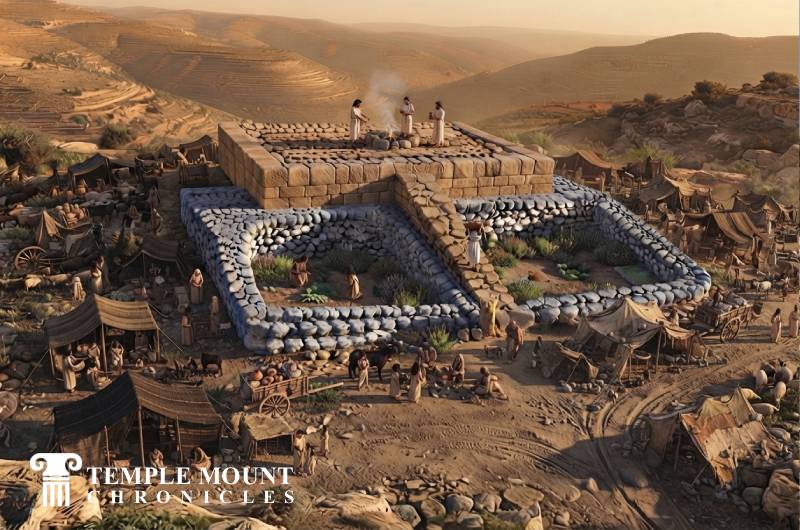
Illustration of the Joshua's Altar on Mount Ebal.
The physical form of the structure also makes the comparison with the biblical altar more interesting. Deuteronomy specifies an altar made from stones over which no iron tool had been wielded, and the Mount Ebal structure is composed predominantly of large, unhewn stones rather than carefully dressed masonry. Zertal argued that its dimensions and construction were compatible with the biblical tradition, while later analysis has continued to debate its chronology and function. The commonly assigned date for the principal structure is in the late thirteenth or early twelfth century BCE, although proposals have varied, and recent scholarship has revisited the chronology of the site. A 2023 study in npj Heritage Science describes the excavated complex as containing a later, larger rectangular structure associated with the late thirteenth century BCE and an earlier round structure beneath it, while also reporting the controversial identification of a folded lead object recovered from the excavation dump through later wet-sifting. That object has been interpreted by some researchers as bearing an early Hebrew curse formula, but the reading and interpretation have themselves been challenged; it should therefore not be used as uncomplicated proof that the Mount Ebal structure belonged to Joshua.
The archaeological evidence is strongest when treated in layers: the existence of an unusual installation, its apparent cultic character, its location on Mount Ebal, and its date are archaeological questions; its identification with the altar described in Joshua is an interpretive conclusion. That distinction is especially important because the biblical text itself supplies the reason Mount Ebal matters before archaeology enters the discussion.
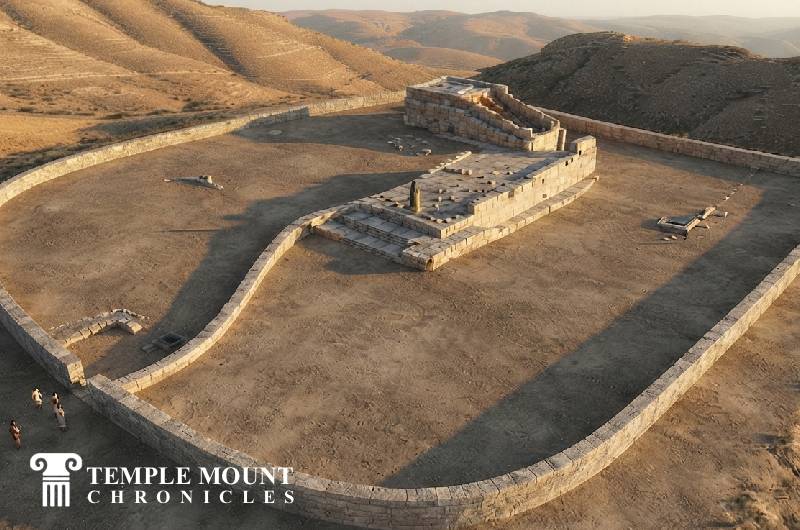
Architectural/archaeological reconstruction of the Israelite complex on Mount Ebal.
The connection between Mount Ebal and Jerusalem emerges from the Torah's treatment of sacrifice rather than from any claim that Joshua's altar was physically a predecessor of the Jerusalem Temple altar. Deuteronomy 12 commands Israel, once settled in the land, not to offer burnt offerings wherever they choose, but at the maqom asher yivchar Hashem—“the place that the LORD will choose” to establish His name (Deuteronomy 12:5, 11, 13–14). The Torah does not name Jerusalem in these verses. The Jerusalem identification develops through the later biblical narrative, particularly as David establishes Jerusalem as the political center and Solomon constructs the Temple there; the Temple thus becomes the permanent national sanctuary toward which the Deuteronomic language points. Jewish tradition subsequently gives this development a precise legal framework. Mishnah Zevahim 14:4–8 distinguishes several stages in the history of sacrifice: before the establishment of the Tabernacle, bamot—private or local altars—were permitted; after the Tabernacle was established, their use was restricted; after the destruction of Shiloh, worship continued at Nob and Gibeon; and once Israel came to Jerusalem and the Temple was built under Solomon, the bamot were permanently prohibited. The Mishnah consequently preserves a specifically Jewish understanding of sacred history in which the sacrificial system moved through successive legitimate settings before Jerusalem acquired its final status.
Mount Ebal should therefore be understood not as the first step of a simple archaeological “road to Jerusalem,” but as evidence within the biblical and rabbinic conception of how Israelite sacrificial worship was ordered before the Jerusalem Temple assumed its unique status. Joshua's altar stands within a ceremony explicitly grounded in the Torah: stones, altar, burnt offerings, shelamim, the written Torah, and the assembled tribes are brought together at Ebal. Later Jewish sources make the transition to Jerusalem more explicit.
The Mishnah's account in Zevahim treats the period of legitimate bamot as historically bounded: Shiloh, Nob, and Gibeon belong to earlier stages, while Jerusalem becomes the nachalah, the enduring inheritance, after Solomon's Temple is established. This provides the appropriate framework for considering the Mount Ebal structure in relation to the Temple Mount. The archaeological remains do not demonstrate that Joshua personally built the excavated structure, nor do they establish an architectural line of descent from that structure to the altar of Solomon's Temple. What they do provide is a rare physical example of an ancient highland installation that has been interpreted as an Israelite cultic site and that stands at a location explicitly associated by the biblical text with sacrifice and covenant. The significance of Mount Ebal for the history of the Temple is therefore found in the development and eventual restriction of Israelite sacrificial worship: before Jerusalem became the unique center of Temple worship, the biblical record preserves a sacred landscape in which altar, sacrifice, covenant, and the people of Israel could converge at places such as Ebal.