
Arch of Titus: Rome Remembering Jerusalem
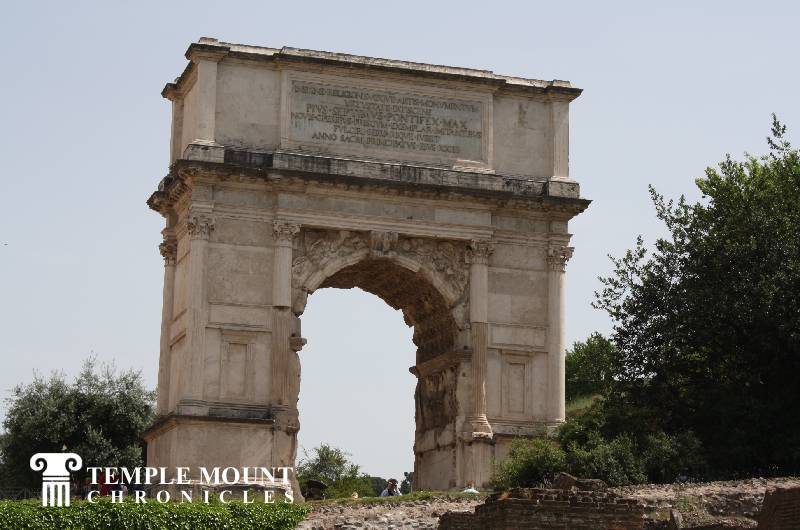
Illustration of the "Temple loot" plaque from the Arch of Titus in Rome.
The Arch of Titus stands on the Via Sacra in Rome, where the road rises from the Roman Forum toward the Palatine Hill. It commemorates the victory of Titus and his father, the emperor Vespasian, in the Jewish War and the destruction of Jerusalem in 70 CE. The arch itself was built after Titus's death in 81 CE, probably during the early reign of his brother Domitian (81–96 CE). Its original inscription identifies Titus as divus, meaning that he had already been deified when the monument was completed. The Senate and People of Rome dedicated the arch to him, turning the destruction of Jerusalem into a permanent monument of the Flavian dynasty.
The event being celebrated had begun more than a decade earlier, with the Jewish revolt against Rome in 66 CE. Titus took command of the Roman campaign in 67 CE, eventually bringing the war to Jerusalem. After a siege lasting several months, the city fell in the summer of 70 CE, and the Temple was burned and destroyed. Josephus, who had participated in the war before becoming a client of the Flavian court, describes the catastrophe in The Jewish War, including the fighting around the Temple and its final destruction. The following year, in 71 CE, Titus and Vespasian celebrated their triumph in Rome. The arch was therefore not simply commemorating a military victory in the abstract: its imagery deliberately returned to the capture of Jerusalem and the destruction of its sanctuary.
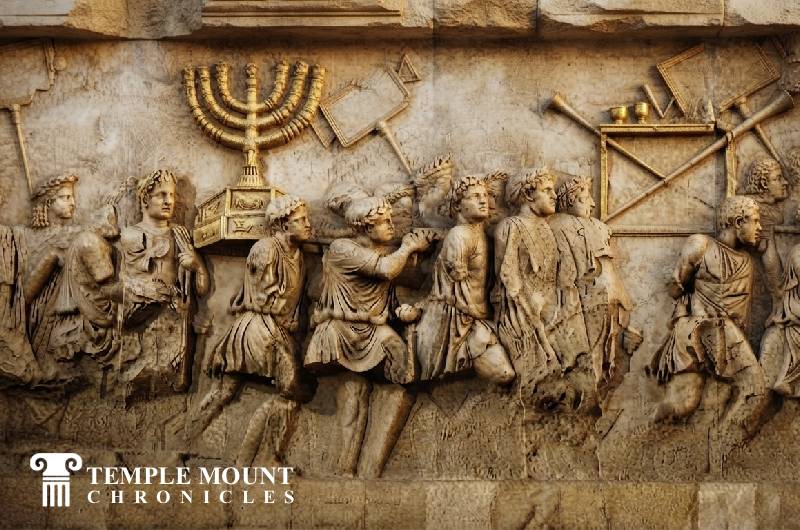
Roman soldiers carrying loot from the Jerusalem Temple in Rome, as depicted on the Arch of Titus.
The most powerful image appears inside the arch itself. Roman soldiers advance carrying the spoils taken from the Temple, including the seven-branched menorah, the Table of the Showbread and silver trumpets. Titus's quadriga appears on the opposite panel, with the emperor being crowned by the winged goddess Victory while the goddess Roma leads the procession. The two scenes work together: one shows the sacred property of Jerusalem being carried away, while the other shows Titus being transformed into the victorious Roman commander. The monument therefore presents the Temple's destruction from the perspective of its conquerors. What had been sacred furniture in Jerusalem becomes imperial imagery in Rome, and what had been a catastrophe for the Jewish population becomes evidence of Roman power.
The arch's inscription is equally important. It reads, in abbreviated Latin, “The Senate and People of Rome dedicated this arch to the deified Titus Vespasian Augustus, son of the deified Vespasian”. The wording places Titus within the official religious and political language of the Roman state. His victory was no longer simply a recent military event; after his death it had become part of the public memory of a deified emperor and his dynasty. The monument's location also mattered. It stood along the Via Sacra, one of the principal ceremonial routes through the Forum, placing the memory of Jerusalem's defeat directly within the monumental heart of Rome. Scholars have noted that the arch should not be understood as the actual triumphal arch through which Titus's procession passed; rather, it was an honorary monument whose imagery recalled and monumentalized the triumph. The central vault contains another imperial image, the apotheosis of Titus, showing the dead emperor being carried heavenward by an eagle.
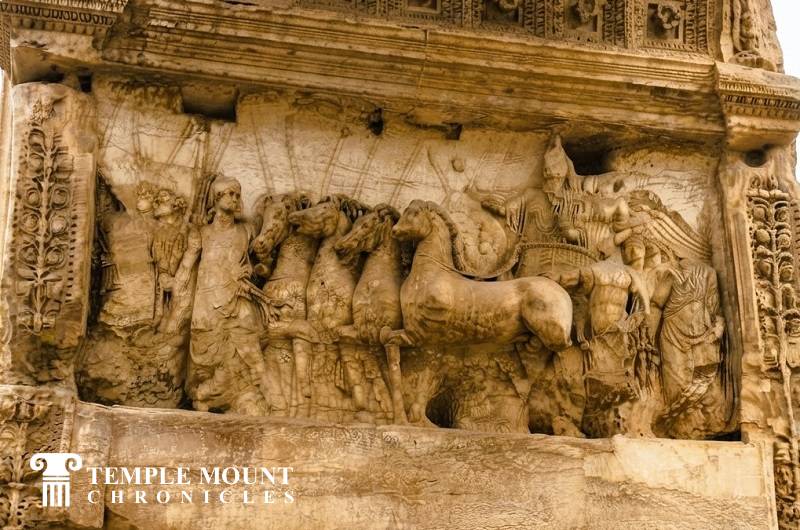
The Triumph of Titus relief panel, located on the interior southern wall of the arch’s passageway, represents a seminal development in Roman historical narrative sculpture.
For Jewish memory, however, the meaning of the monument could hardly have been more different. The relief preserves an image of the menorah and other Temple furnishings being carried away from Jerusalem, making the arch one of the most important surviving visual records of the destruction of the Second Temple. The biblical Temple had been the center of Israelite worship, and its destruction in 70 CE marked the end of the Second Temple period. The Arch of Titus consequently preserves two memories at once: the Roman memory of victory and the Jewish memory of catastrophe. The menorah's depiction is particularly striking because the object is recognizable even outside its original religious setting. In Rome it announces conquest; to later Jewish observers it became an enduring image of what had been taken from Jerusalem. Modern scholars, including Steven Fine, have emphasized the need to read the menorah relief within Roman triumphal art rather than treating it simply as an archaeological photograph of the Temple object. The unusual form of its base, for example, has generated considerable discussion about how closely the sculptors intended to reproduce the original menorah.
The arch therefore occupies an unusual position in the history of the Temple. The sanctuary itself disappeared in Jerusalem in 70 CE, but one of its most recognizable furnishings was carved into marble in Rome and preserved for nearly two millennia. The monument's original Roman purpose was celebratory: the Senate and People of Rome honored a deified emperor and commemorated the victory of the Flavian house. Yet the survival of the relief gave the destruction another kind of historical life. The menorah, the Temple table and the other spoils were no longer present in Jerusalem, but their removal was permanently represented on the route of Rome's imperial processions. The Arch of Titus thus became an unintended memorial as well as an imperial monument: a Roman celebration of victory that also preserves, for later generations, one of the clearest surviving images of the moment when the Second Temple passed from sacred sanctuary to Roman spoil.