Zerubbabel’s Temple: Jerusalem’s Second Temple
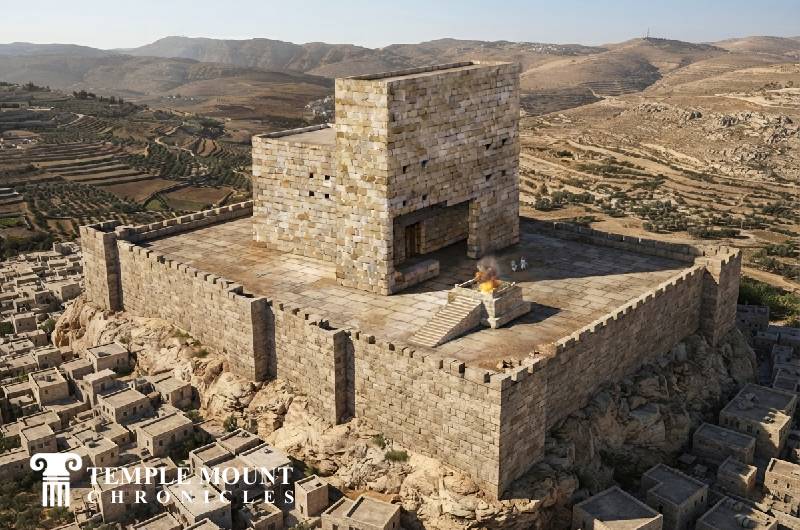
Artistic reconstruction based on biblical and historical sources.
When the Babylonians destroyed Jerusalem and Solomon’s Temple in 586 BCE, they ended the First Temple period. The Persian conquest of Babylon in 539 BCE changed the political landscape. In 538 BCE, Cyrus II permitted exiled populations, including Judeans, to return to their ancestral lands. The biblical books of Ezra and Haggai place the rebuilding of the Jerusalem Temple in the reign of Darius I, king of Persia from 522 to 486 BCE. The leading Judean official was Zerubbabel son of Shealtiel, described as governor of Judah, alongside Joshua son of Jehozadak, the high priest. Ezra 5:1–2 names the two together: “Haggai the prophet and Zechariah the prophet” encouraged Zerubbabel and Joshua as they resumed the work.
The rebuilding had begun earlier. Ezra 3 describes the altar being established and the foundations of the Temple being laid, followed by a period in which the work stalled. The decisive revival came in the second year of Darius, conventionally dated to 520 BCE. Haggai 1:1 gives an unusually precise date: the first day of the sixth month, when Haggai addressed Zerubbabel and Joshua. His complaint was blunt: the people were living in their own houses while “this house” lay in ruins. Haggai therefore told them to go into the hills, bring timber, and build.
Haggai’s message was not simply about construction. He presented the Temple as the physical center of Judah’s restoration after exile. On the twenty-fourth day of the sixth month of Darius’s second year, the people began work, according to Haggai 1:14–15. Two months later, Haggai addressed the discouragement surrounding the project: “Who is left among you that saw this house in its former glory?” (Haggai 2:3). The new building evidently did not match memories of Solomon’s Temple, and the prophet knew it. His answer was that the significance of the new Temple could not be measured merely by its size or appearance. Haggai 2:6–9 speaks of a future shaking of the nations and declares that “the latter glory of this house shall be greater than the former”. The same period produced Zechariah’s visions, including the striking statement in Zechariah 4:9: “The hands of Zerubbabel have laid the foundation of this house; his hands shall also complete it”.
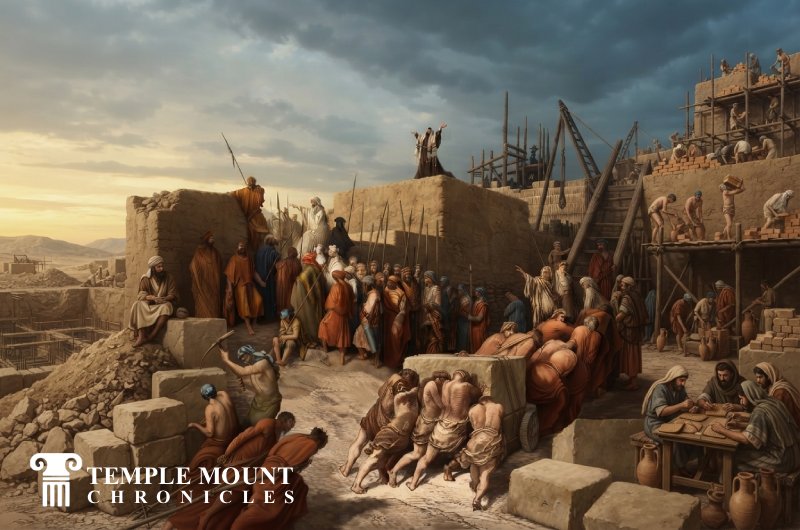
Rebuilding of the Zerubbabel's temple begins.
The Persian administration mattered because Jerusalem was no longer an independent kingdom. Tattenai, the governor of the province Beyond the River, investigated the rebuilding and asked by whose authority the Jews were constructing the Temple. Ezra 5:3–17 preserves the exchange. The elders identified Cyrus as the king who had originally authorized the work, and the matter was referred to Darius. Ezra 6 then describes a search of the royal archives, after which Darius ordered Tattenai to allow the construction to continue and to provide support from provincial revenues. The Temple therefore emerged within the political framework of the Achaemenid Persian Empire, not from a restored Davidic monarchy. Zerubbabel himself belonged to the Davidic line, however, which helps explain why his appearance in Haggai and Zechariah carries such political and theological weight.
The biblical date for completion is remarkably specific. Ezra 6:15 says that the Temple was finished “on the third day of the month Adar, in the sixth year of the reign of King Darius”. Darius’s sixth regnal year falls around 516–515 BCE, and the conventional date for completion is 515 BCE. Ezra immediately describes its dedication: one hundred bulls, two hundred rams, four hundred lambs, and twelve male goats were offered, “according to the number of the tribes of Israel” (Ezra 6:17). The priests and Levites were organized for service, and the returned exiles celebrated Passover. The building shown here therefore belongs not to the immediate aftermath of the Babylonian destruction, but to a Jerusalem that had spent roughly seventy years under Babylonian and then Persian rule.
What did Zerubbabel’s Temple actually look like? The uncomfortable answer is that the Bible does not give us enough information to draw a precise architectural plan. Ezra tells us about the foundations, the building materials and the Temple’s completion, but does not provide the kind of dimensions and room-by-room description later associated with the Temple. Josephus, writing in the first century CE, preserves a tradition that Cyrus authorized a Temple sixty cubits high and sixty cubits wide, with three courses of dressed stone and a course of local timber. Josephus also describes cedar being brought from Lebanon to Joppa. His account is valuable, but it was written more than five centuries after Zerubbabel’s Temple was completed and should not be treated as an eyewitness description.
The later Jewish sources preserve a much fuller picture of the Second Temple, but they describe a later phase of its history. The Mishnah’s tractate Middot, compiled around the early third century CE, describes the Temple precinct as 500 cubits by 500 cubits and records gates, chambers, courts and the soreg, the low lattice barrier separating areas of differing sanctity. Those measurements cannot simply be transferred onto a reconstruction of the Persian-period Temple: the Temple complex was altered substantially over the centuries, most dramatically by Herod the Great in the late first century BCE. Josephus says that Herod began his rebuilding in the eighteenth year of his reign, conventionally dated to 20/19 BCE, and greatly enlarged and beautified the Temple.
There is another difference between the First and Second Temples that the rabbis remembered as more important than stonework. The Babylonian Talmud, Yoma 21b, lists five things associated with the First Temple that were absent from the Second: the Ark, its cover and cherubim; the heavenly fire; the Shekhinah; the Holy Spirit; and the Urim and Thummim. The passage derives the number five from the spelling of Haggai 1:8 and turns the rebuilt Temple into something deliberately incomplete. Ezra 2:63 already hints at the loss of the Urim and Thummim when the governor forbids certain priests from eating sacred food until a priest can arise “with Urim and Thummim”.
Modern reconstruction therefore has to separate what is known from what is inferred. Lester L. Grabbe, in A History of the Jews and Judaism in the Second Temple Period, treats the Persian period as a period for which the evidence is frustratingly limited, requiring the biblical texts to be read alongside archaeology, Persian administrative evidence and later sources. Diana V. Edelman has gone further, challenging the conventional chronology of the rebuilding and arguing that the dating of Haggai, Zechariah and Ezra 1–6 deserves renewed scrutiny; her reconstruction questions whether the Temple rebuilding should be placed under Darius I at all. The conventional historical reconstruction remains c. 515 BCE, but the disagreement is important because it shows just how little of the Persian-period Temple survives outside the literary record. What can be said with confidence is that a Temple stood in Jerusalem by the early fifth century BCE, that Zerubbabel and Joshua are central figures in the biblical account of its rebuilding, that Haggai and Zechariah gave the project its prophetic voice, and that the Temple became the sanctuary around which Jewish religious life in the Second Temple period developed.