
Bronze Altar of Solomon’s Temple
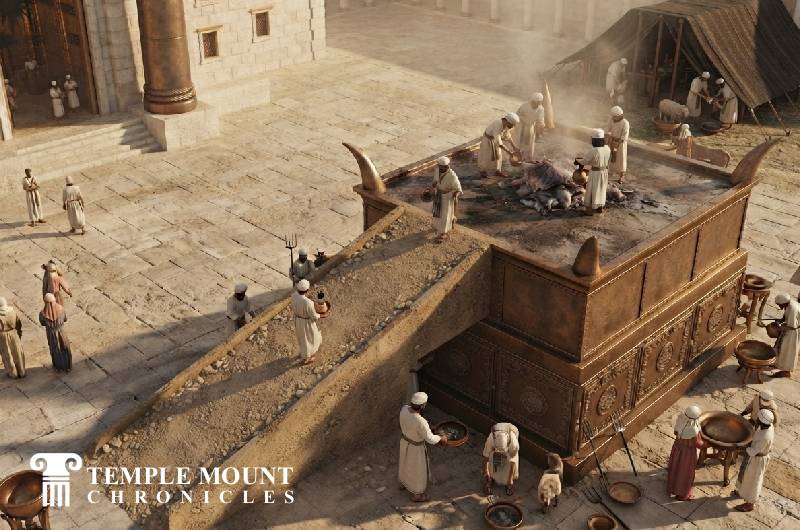
Illustration.
The mizbe’aḥ ha-neḥoshet—the bronze altar—was the principal installation for animal sacrifice in the courtyard of Solomon’s Temple. The biblical account gives it an unusually precise set of dimensions: twenty cubits in length, twenty cubits in width, and ten cubits in height (2 Chronicles 4:1). Unlike the golden altar of incense within the Temple itself, this was the great outdoor altar upon which the ‘olah (burnt offering), minḥah (grain offering), and sacrificial portions of the shelamim (well-being offerings) were presented. First Kings 8:64 makes clear that it stood in the court before the Temple, and that during Solomon’s dedication ceremony the ordinary altar proved too small to accommodate the enormous quantity of offerings; Solomon therefore consecrated additional ground in the court for the sacrifices.
The dimensions are important because they establish an altar of monumental scale, rather than the relatively modest structure that the phrase “bronze altar” might suggest to a modern reader. Twenty cubits square produced a surface of four hundred square cubits, while its height was ten cubits. The Hebrew text calls it mizbaḥ neḥoshet, literally an altar of bronze, but the biblical description does not tell us whether the entire mass was solid bronze, whether bronze covered a core of another material, or precisely how its internal construction was engineered. That distinction matters when reconstructing the First Temple. The text provides dimensions and material, but not an architectural cross-section. Nor does 2 Chronicles 4:1 describe the elaborate stepped base, ledges, drainage arrangements, or ramp known from later descriptions of the Temple altar. Those features should therefore not be projected backward into Solomon’s Temple as though the biblical text had explicitly recorded them.
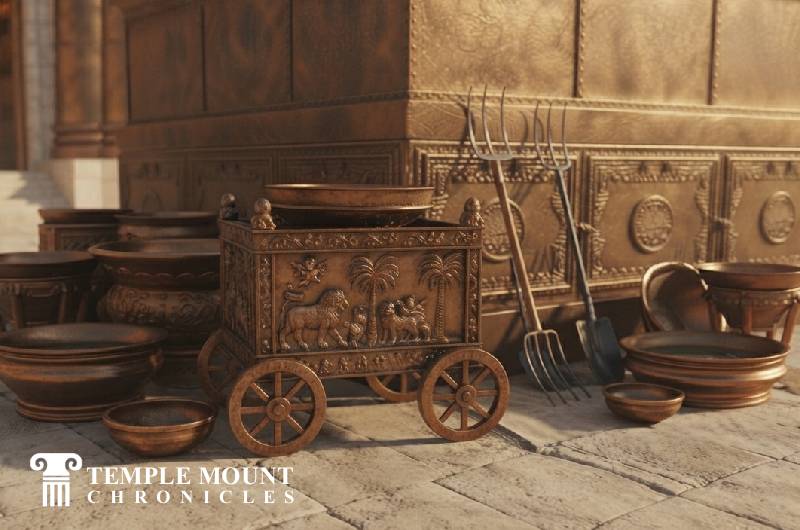
Illustration of the Solomonic period bronze implements used in the ritual activities surrounding sacrifice and the great altar.
The altar also formed the center of a wider system of vessels and implements used in the preparation, handling, and presentation of the sacrifices, including the utensils associated with its daily service.
The Bible is similarly restrained about the altar's approach. The detailed description of a ramp belongs to later Jewish sources describing the Second Temple. The Mishnah records a kevesh (ramp) on the south side of the altar, measuring thirty-two cubits in length and sixteen in width (Mishnah Middot 3:3). It also places the slaughtering area to the north of the altar, where rings were fixed into the pavement for securing the sacrificial animals.
The Talmud in Zevachim 62b explains the southern position of the ramp through the biblical requirement that an animal be slaughtered “on the side of the altar northward” (Leviticus 1:11).
These sources are invaluable for understanding later Temple practice, but they should be identified as rabbinic evidence for the Second Temple, not as a direct architectural description of Solomon's altar.
The sacrificial process itself also prevents a common misconception about how the altar functioned. The animals were slaughtered before their flesh was placed upon the altar. In the later Temple procedure described in Mishnah Tamid, the daily lamb was positioned in the northern part of the courtyard, slaughtered there, and its blood received by another priest. The animal was then prepared and its portions brought up to the altar. The Mishnah specifies twenty-four rings north of the altar and describes the associated slaughtering and skinning facilities.
This arrangement accords with the sacrificial legislation of Leviticus, where slaughter, treatment of the blood, preparation of the carcass, and burning upon the altar form distinct stages of the rite.
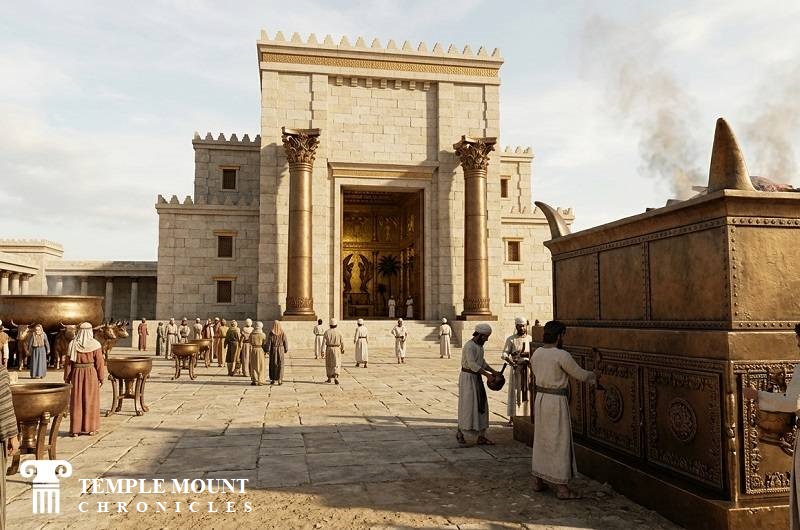
Illustration of the Solomonic temple with the great altar visible to the right.
What can be said with greatest confidence about Solomon's altar is therefore relatively limited but significant. It was a very large bronze altar, twenty cubits by twenty cubits and ten cubits high, standing in the court before the Temple and serving the sacrificial worship of the kingdom. The biblical account does not preserve its internal construction, the precise form of its ascent, or a complete description of its surrounding installations. Those details emerge only when the biblical evidence is read alongside later Jewish descriptions of the Temple. The result is not a complete architectural blueprint, but a firm historical core around which reconstruction must be undertaken with care: the dimensions and bronze material belong to the biblical evidence; the southern ramp, northern slaughtering area, rings, tables, and related arrangements belong explicitly to the later rabbinic description of the Temple.