Building the Tabernacle: The First House of God
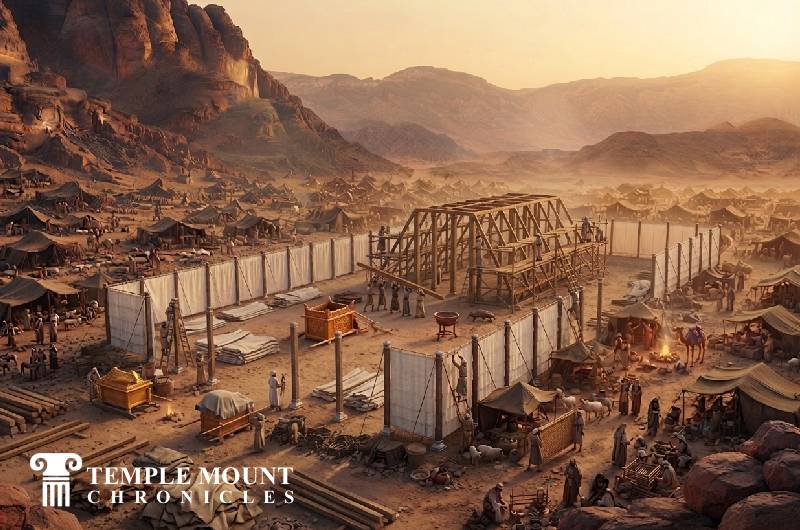
Artistic reconstruction of "building the Tabernacle".
The first Mishkan was built at Sinai after the covenant had been established between God and the people of Israel. The command was direct: “Let them make Me a sanctuary that I may dwell among them” (Exodus 25:8). The Torah calls the sanctuary both the Mishkan, the Dwelling, and the Ohel Mo'ed, the Tent of Meeting. Moses was shown a tavnit, a prescribed pattern, and instructed to reproduce it precisely: “Exactly as I show you—the pattern of the Tabernacle and the pattern of all its furnishings, so shall you make it” (Exodus 25:9). The biblical account therefore presents the Mishkan not as an improvised wilderness shelter, but as a carefully designed sacred complex whose purpose was to establish a dwelling for God's presence in the midst of Israel.
The materials were supplied by the Israelites themselves. Gold, silver and bronze were gathered alongside blue, purple and crimson yarn, fine linen, goats' hair, animal skins, acacia wood, oil and spices (Exodus 25:1–7). The Torah then names Betzalel ben Uri ben Hur of the tribe of Judah as the master craftsman, saying that God filled him with “a divine spirit of skill, ability, and knowledge in every kind of craft” (Exodus 31:1–5). Oholiav ben Ahisamakh of the tribe of Dan was appointed alongside him (Exodus 31:6). Their work encompassed metalworking, carving, weaving, embroidery and the preparation of the sanctuary's many components. The scale of this undertaking is reflected in the Torah's detailed accounting of the precious metals in Exodus 38. Jewish tradition subsequently saw the Mishkan's construction as closely connected with the laws of Shabbat: the Mishnah's list of the thirty-nine principal categories of melachah in Shabbat 7:2 includes weaving, dyeing, writing, building, dismantling and other forms of skilled work associated by rabbinic interpretation with the construction of the sanctuary.
At the heart of the Mishkan was a rectangular structure built from kerashim, upright boards of acacia wood. The Torah specifies boards ten cubits high and one and a half cubits wide, secured in silver sockets and joined by bars (Exodus 26:15–30). Across this framework were placed layers of curtains and coverings: finely woven linen decorated with blue, purple and crimson yarn, followed by goats' hair and outer coverings (Exodus 26:1–14). Inside, the parokhet divided the sanctuary into the Kodesh, the Holy Place, and the Kodesh HaKodashim, the Holy of Holies. Within the innermost chamber stood the Aron, the Ark, constructed of acacia wood overlaid with gold and crowned by the kapporet, above which were the keruvim (Exodus 25:10–22; 26:31–34). The Holy Place contained the Menorah, the Shulchan bearing the Bread of the Presence, and the golden altar of incense.
Beyond the Tent stood the chatzer, the courtyard, measuring 100 cubits by 50 cubits and enclosed by five-cubit-high hangings of fine twisted linen (Exodus 27:9–19). Its entrance was on the east and was marked by a distinctive screen of blue, purple and crimson yarn and fine linen. Inside stood the Mizbe'ach HaOlah, the large bronze altar for the offerings, and between the altar and the Tent was the kiyor, the basin at which Aaron and his sons washed before their service (Exodus 27:1–8; 30:17–21). The arrangement created a deliberate progression through sacred space: the Israelite approached from the east, entered the courtyard, passed the altar and basin, and proceeded toward the sanctuary itself. The Mishkan's architecture was therefore not merely functional. Its boundaries regulated access, distinguished the ordinary from the sacred, and placed the innermost presence of God at the center of the sanctuary. The illustration should consequently be understood as a reconstruction from the textual description, not as a surviving archaeological plan; no physical remains of the wilderness Mishkan are known.
The sanctuary also required an order of service. Aharon HaKohen, Aaron the priest, and his sons were consecrated for the avodah, the sacred service, and Exodus 28 prescribes their garments in detail, including the ephod, choshen breastpiece, robe, tunic, headgear and sash. The twelve stones set into the choshen represented the twelve tribes of Israel (Exodus 28:15–30). Once the artisans had completed their work, Moses assembled the Mishkan according to the divine instructions. Exodus 40 describes him erecting the structure, placing the Aron HaBrit behind the parokhet, arranging the Menorah and Shulchan, setting up the incense altar, positioning the bronze altar and kiyor, and finally enclosing the entire complex within its courtyard. The repeated statement that Moses did everything “as the LORD had commanded Moses” is one of the defining features of the construction narrative (Exodus 40:16–33).
The completion of the Mishkan was marked not by the final piece of construction but by the appearance of the divine presence: “The cloud covered the Tent of Meeting, and the glory of the LORD filled the Tabernacle” (Exodus 40:34). The Kavod, the divine glory, transformed the completed structure from an assembly of wood, textiles, bronze and gold into Israel's functioning sanctuary. The cloud thereafter determined the movement of the camp: when it lifted, the Israelites journeyed; when it remained, they stayed encamped (Exodus 40:35–38). The Mishkan was portable, but its sacred arrangement established a pattern that would outlast the wilderness itself. Israel would eventually possess permanent sanctuaries, and ultimately a Temple in Jerusalem, but the essential vocabulary of sacred space—Mishkan, Kodesh, Kodesh HaKodashim, Mizbe'ach, Kohanim, Aron and divine presence—had already been established at Sinai.