Coponius Gate: The Grand Western Entrance to the Temple
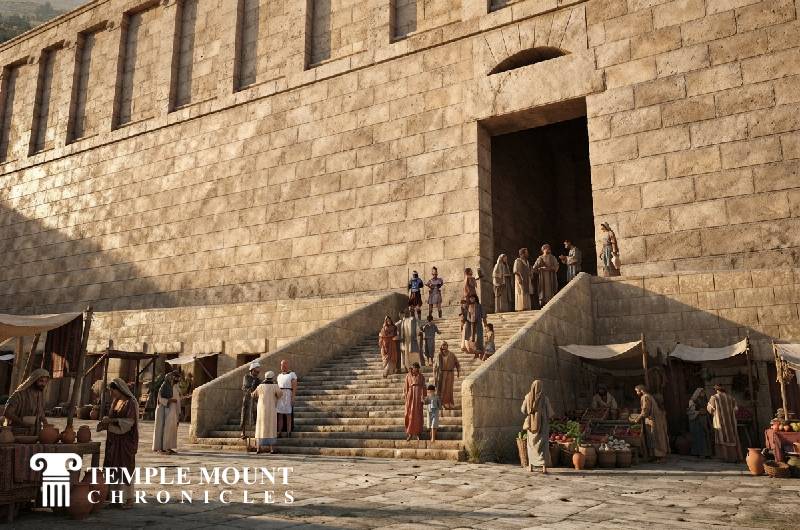
Conceptual illustration of the Coponius Gate in the Western Wall of the Temple Mount, Roman period.
The western side of the Second Temple Mount was not merely a retaining wall of immense stones. It was a monumental face of the Temple precinct, rising above the Tyropoeon Valley and confronting the densely settled city below. Somewhere along that western wall stood the gate remembered by the Mishnah as Kiponos (קיפונוס), the western gate of the Har HaBayit (Temple Mount). The Mishnah states simply that there were five gates to the Mount: two Huldah Gates on the south, the Kiponos Gate on the west, the Tadi Gate on the north, and the eastern gate associated with the image of Shushan. Unlike Tadi, which was not used, Kiponos “served for entrance and exit” (Middot 1:3).
The name has long been understood as a Greek form related to Coponius, the Roman prefect who governed Judea in the years immediately following the deposition of Herod's son Archelaus, circa 6–9 CE. The Mishnah itself, however, does not explain the name, and the connection between Kiponos and the Roman official is most likely an identification rather than an explicit statement of the ancient text.
To appreciate what such a western entrance meant, one must picture the Temple as it stood before the destruction in 70 CE. Herod's builders had transformed the natural hill of the Temple into an enormous artificial platform, enclosing it with walls of extraordinary scale.
On the west, the ground outside the enclosure fell away toward the Tyropoeon Valley, while the Temple platform stood high above it. Access to the area required more than an ordinary doorway cut into a city wall. Josephus describes four gates on the western side of the Temple enclosure (Antiquities 15.11.5 [§410]), one of which connected with the city by a passage over the intervening valley, while others opened toward the surrounding urban districts. His description makes clear that these were entrances comprising of a sophisticated system of bridges, streets, stairways, and elevated approaches. The western wall was functioned both as a boundary as well as infrastructure: people approached the sacred precinct from below and were carried upward into the world of the Temple. The enormous masonry that survives today is the silent remainder of that arrangement.
The Jewish sources are especially valuable because they preserve a different kind of memory from Josephus. Josephus describes the architecture and its relationship to Jerusalem; the Mishnah remembers the gates as part of the functioning sacred complex. That distinction matters. The Mishnah was not attempting to provide a modern archaeological plan of the Herodian enclosure. It records the gates from the standpoint of Jewish Temple practice and tradition. In Middot 1:3, Kiponos belongs specifically to the five gates of the Temple Mount, rather than to the seven gates of the inner Temple Court described immediately afterward.
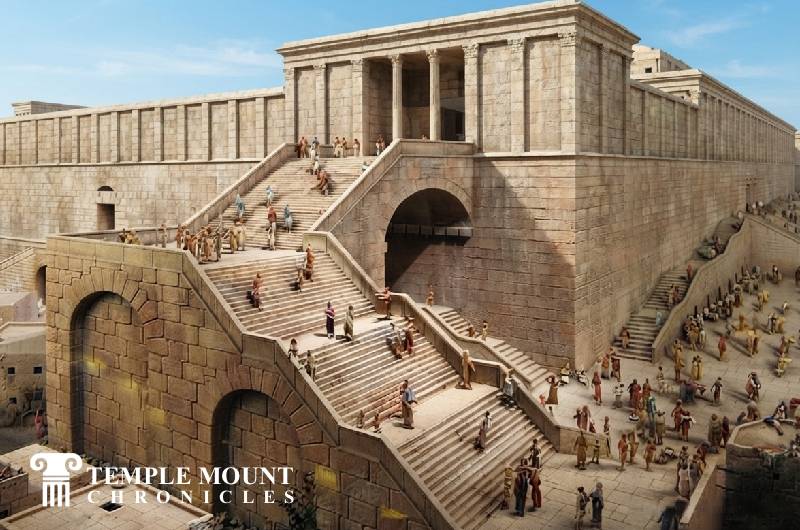
Illustration of the Robinson's Archway, with the Coponius Gate / Barclay's Gate partially visible in the background to the left.
The role however of the gate was not an entrance into the Azarah itself, but access to the larger sacred enclosure surrounding it. The medieval commentator Rabbi Ovadiah of Bertinoro understood the Mishnah's words in precisely this practical sense: through these gates people entered and departed the Temple Mount. For a Jew approaching the Temple in the Second Temple period, then, a western gate was not simply an opening in Herod's magnificent wall. It was a threshold between the ordinary streets of Jerusalem and the precinct whose holiness governed the movement of priests, pilgrims, Levites, and worshippers.
But where was Kiponos? Here the stones become less accommodating than the texts. In the nineteenth century, explorers examining the western wall encountered a massive ancient gateway beneath the later level of the Temple Mount, now called Barclay's Gate, after the American missionary and scholar James Turner Barclay, who recognized the buried structure in the 1850s CE. The surviving lintel is enormous, measuring about 7.5 meters in length and approximately 2.1 meters in height. The threshold lies substantially below the present exterior ground level, an important clue to the dramatic changes in elevation around the Temple Mount since antiquity. Inside the wall is a substantial vaulted passage belonging to the ancient gateway. The scale and construction make clear that this was not a medieval opening accidentally incorporated into the wall; it belonged to the monumental gateway system of the Herodian enclosure and continued to be used for access to the Mount in later centuries before eventually being blocked.
It was natural for the scholars and Temple Mount researchers to ask whether Barclay's Gate was the long-lost Kiponos Gate. The identification has considerable attractions. Barclay's Gate is unquestionably an ancient western entrance; its position corresponds broadly with the kind of access described by Josephus; and its monumental proportions suit the architecture of the Herodian Temple Mount. Yet it should not be presented as proven. Josephus gives four western entrances but does not name one of them Coponius, while the Mishnah gives Kiponos by name without supplying a physical landmark that can be matched unambiguously to the surviving wall. Some reconstructions have instead associated Kiponos with a more northerly western entrance, particularly the vicinity of the present Chain Gate. Even older archaeological literature disagreed over which of Josephus's western gates corresponded to which surviving remains. The prudent formulation is that Barclay's Gate is a leading candidate for the Coponius/Kiponos Gate, not an identification established beyond dispute.
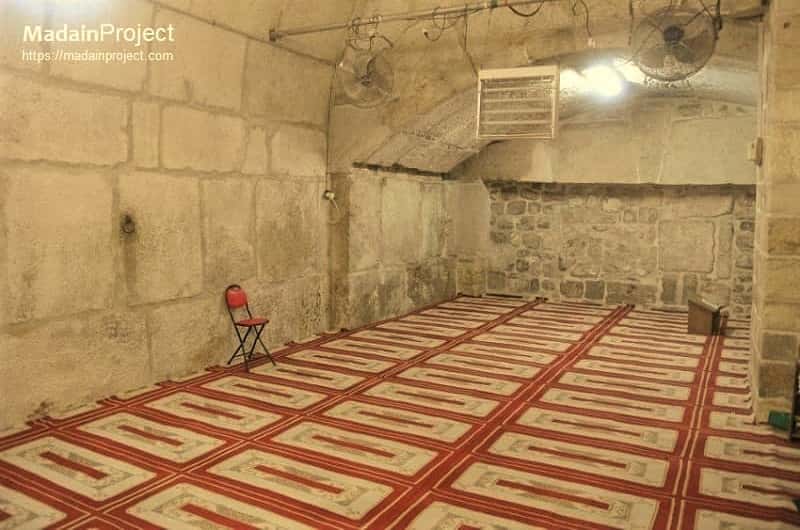
Interior of the present day "Masjid al-Buraq" / Barclay's gate, with the monumental lintel visible as well. Courtesy of the Madain Project , used with permission.
There is another layer to Barclay's Gate's long history. The ancient passage eventually ceased to function as an open entrance, and the space on the inner side became associated with the al-Buraq Mosque, whose present name reflects an Islamic tradition concerning the Islamic Prophet Muhammad's night journey. Medieval Muslim sources preserve traditions concerning the western area and the Buraq, although the precise identification of the place developed over time. For the history of the Temple itself, the important point is simpler: a space once belonging to the monumental entrance system of the Second Temple survived beneath later construction and acquired a new religious identity. The name “Barclay's Gate” is modern; “Kiponos” belongs to the Mishnah; and the Islamic designation belongs to a still later chapter in the history of the same physical space. The stone doorway carries several histories at once, and they should not be collapsed into one another.