
Huldah Gates — The Southern Approach to the Temple Mount
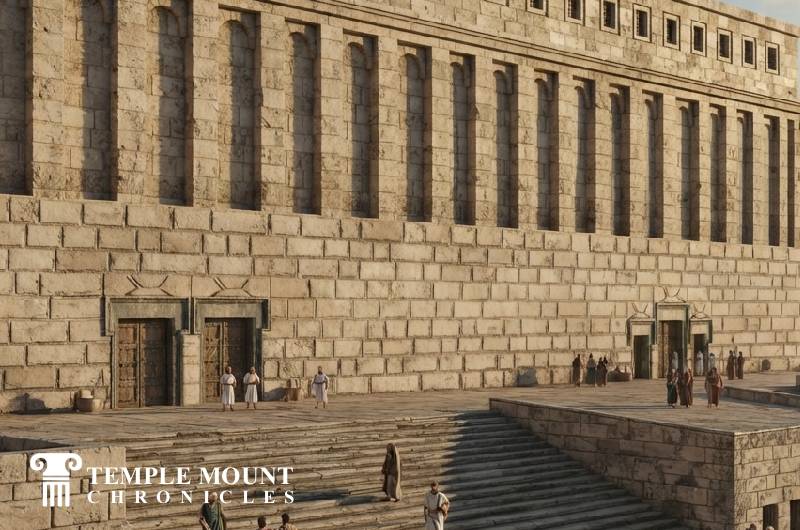
Reconstruction of the Huldah Gates on the southern wall of Herod's Temple Mount, viewed from the southwest.
Approaching Herod's Temple Mount from the south, a pilgrim would have encountered one of the great architectural thresholds of Jerusalem. The southern wall rose above a broad approach, and in its center were the entrances remembered by the Mishnah as the Sha'arei Ḥuldah, the Huldah Gates. The surviving remains are now known as the Double Gate and Triple Gate, although identifying each surviving Herodian opening with one of the Mishnah's two Huldah Gates involves some reconstruction. The illustration depicts this southern approach as it may have appeared in the Herodian period, before the destruction of the Temple in 70 CE.
The Mishnah's description is remarkably simple: “There were five gates to the Temple Mount: the two Huldah Gates on the south, used for entering and exiting” (Mishnah Middot 1:3). The wording is important. These were not merely decorative openings in the retaining wall. They were functioning entrances into the Har HaBayit—the Temple Mount itself—and formed part of the movement of people into and out of the sacred precinct.
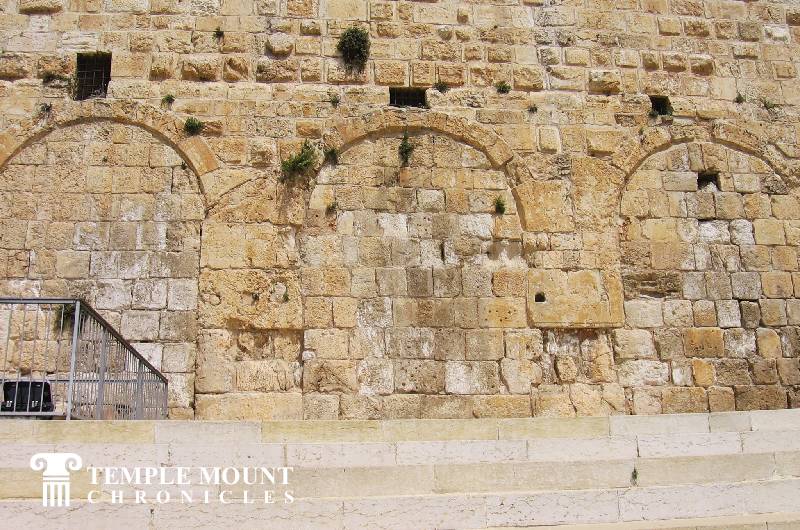
The so-called triple gate (modern period) or the eastern Huldah gates.
The southern gates were approached by monumental stairways and led into passageways running beneath the expanded platform. Archaeological investigation has revealed substantial remains associated with these approaches, including vaulted spaces and the great stairways by which pilgrims ascended. Modern research has identified the present Double and Triple Gate structures with the southern gateways described in the rabbinic sources, although the precise correspondence between the two surviving entrances and the Mishnah's two Huldah Gates is not entirely certain.
The importance of the southern approach becomes clearer when one remembers what Herod had actually built. His Temple Mount was an enormous artificial platform, created and enlarged with massive retaining walls. The southern entrance system allowed pilgrims coming from the lower city and the approaches to Jerusalem to rise gradually into this elevated sacred enclosure. The passage was therefore architectural as well as religious: from the streets and roads of Jerusalem, through the southern wall, along covered passageways, and finally upward toward the courts of the Temple. The physical remains beneath the present Mount preserve fragments of that carefully engineered transition.
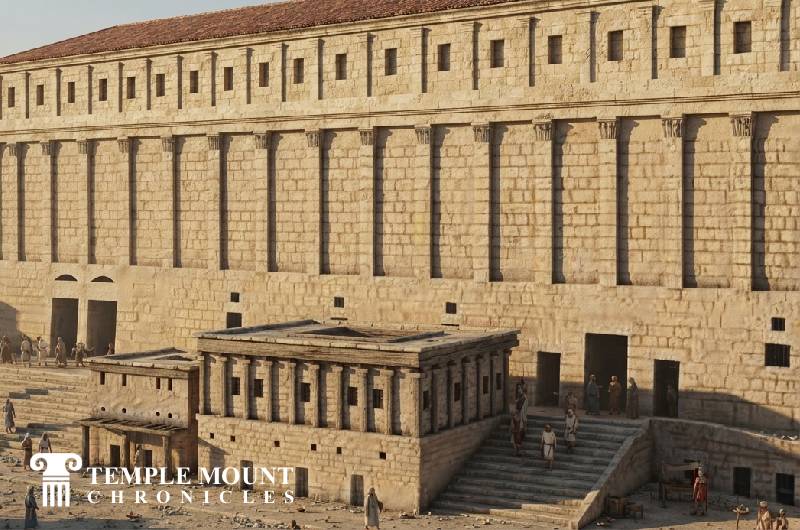
Conceptual illustration of the Huldah gates as seen from the south-east.
The name Huldah, however, presents a question of its own. The Mishnah gives the gates this name but does not explain why; later Jewish commentators proposed connections with Huldah the prophetess, who lived in Jerusalem during the reign of King Josiah (2 Kings 22:14; 2 Chronicles 34:22). That association is a later interpretation, not something the biblical books themselves say about a gate. What can be said with confidence is that by the rabbinic period the southern entrances were remembered as the Huldah Gates, and that the surviving Herodian architecture gives us a rare opportunity to place that textual memory against actual monumental remains. The gates through which pilgrims once passed have been sealed for centuries, but their passageways and stones still mark the southern threshold of the Temple Mount.