Quarrying and Moving the Stones for Herod’s Temple Mount
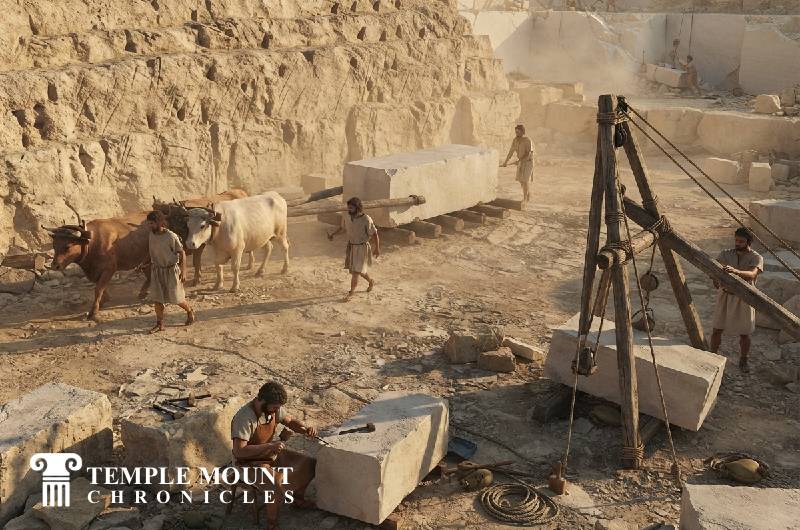
Quarrying and moving the .
Herod’s Temple Mount was built largely from the local limestone of the Jerusalem hills. The surrounding mountains are composed of Turonian and Cenomanian limestone, characterized by pronounced horizontal bedding. These natural layers generally range from about 18 inches to 5 feet in thickness, although exceptionally thick beds also occur. This layering was particularly useful to ancient quarrymen because it helped determine the natural height of the blocks they could extract. At an ancient quarry, the bedrock itself reveals the process: unfinished channels remain around blocks that were marked out but never completely removed, while the horizontal geological layers can still be followed through the quarry face.
The quarrying process began by straightening the face of the rock. The stonecutter created a flat vertical surface forming the side of the intended block, together with a level surface across its top. A narrow channel, approximately 4–6 inches wide, was then cut around the block on its sides and rear, leaving the bottom attached to the bedrock. Into two of these channels, arranged at right angles, the quarryman drove dry wooden beams tightly into place. Water was then poured over the wood. As the beams absorbed the water and swelled, they exerted pressure against the surrounding stone until the block separated from the underlying rock layer. The method exploited the natural bedding of Jerusalem limestone rather than attempting to cut through the entire mass of stone.
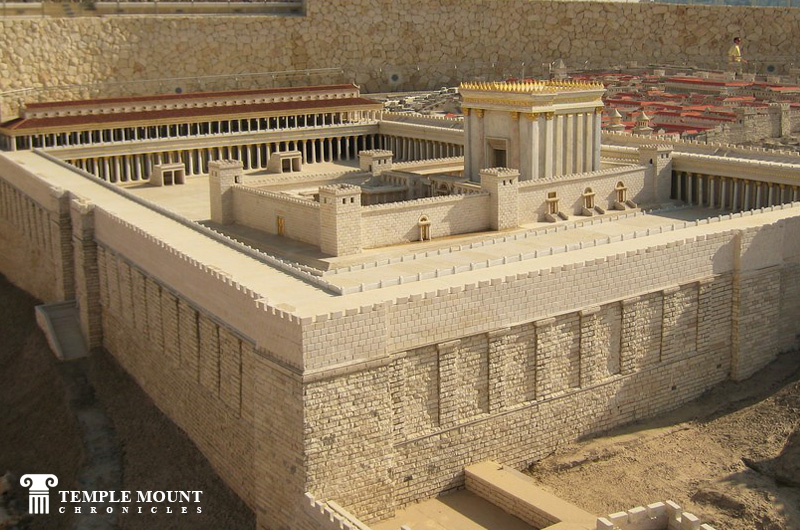
Herodian Temple Mount, view from the north-east.
Once detached, the rough block had to be squared and prepared for transportation. The masons dressed the stone while it was still manageable, removing irregularities and establishing the broad surfaces required of a finished ashlar. Particularly large stones were also prepared with projections approximately 12 inches long on opposite sides. These were functional rather than decorative. Ropes could be secured around the projections, giving the workers a secure means of handling the enormous blocks without having to lift or bind the entire stone directly.
The transportation of the stones depended on their size. Smaller blocks could be loaded onto wagons, while the largest stones required a more elaborate system. Large wooden rollers were placed beneath the blocks, and the projections provided attachment points for ropes. According to the description recorded by Josephus, specially arranged short, strong cranes fitted with winches could lift one side of a stone and lower it onto the rollers. Once supported, the block could be dragged forward by ropes attached around the projections. Oxen provided the pulling power, with Josephus reporting that as many as 1,000 oxen were employed for this work. The process therefore combined the natural properties of the limestone with simple machines—wooden beams, ropes, rollers, cranes, and winches—to handle stones weighing many tons.
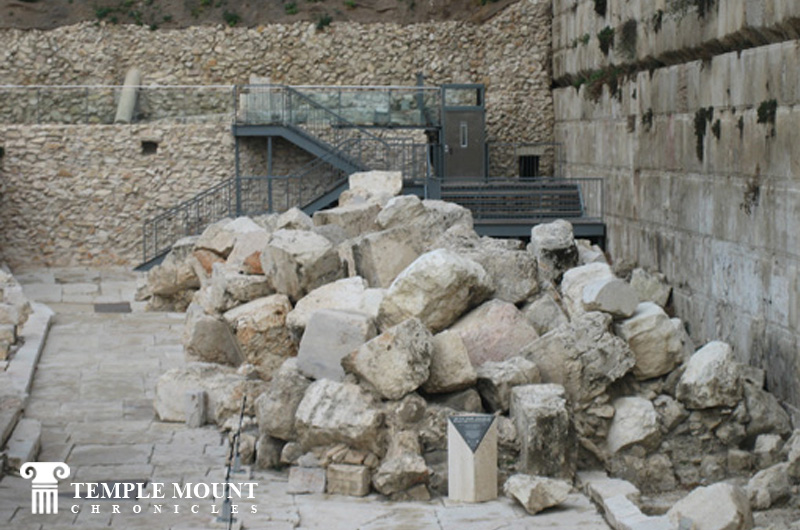
Some of the Herodian period blocks, from the Roman Destruction of the 70 CE, along the Western Wall, near the south-western corner.
The final stage was getting these blocks from transportation into their required position, a problem that becomes especially striking with the largest Herodian ashlars. Some of the stones associated with the Temple Mount weighed 50 tons or more, while exceptional blocks are estimated at around 160,000 pounds. The quarrying evidence therefore preserves more than the origin of the stones: it records a sequence of practical techniques developed specifically to extract, dress, lift, and move exceptionally heavy limestone. The quarry marks, unfinished blocks, dressing techniques, lifting projections, rollers, and hauling arrangements together provide a rare glimpse into the logistical expertise behind Herod’s monumental stonework.