
Ophel Walls: The Southern Fortifications
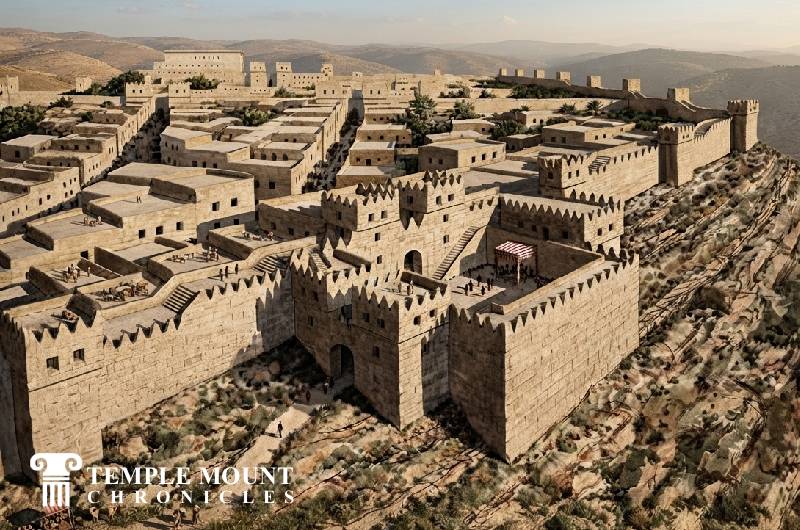
Artistic representation of the Ophel's great gate and the fortifications, bird's eye view from the south-west.
The Hebrew Bible explicitly identifies the Ophel as a fortified section of Jerusalem. In the reign of Jotham, “on the wall of Ophel he built much” (2 Chronicles 27:3), immediately after the construction of the Upper Gate of the Temple. Under Manasseh, the fortification was enlarged: he built an outer wall around the City of David, extended it toward the Gihon, “compassed Ophel”, and raised the wall to a great height (2 Chronicles 33:14). These passages establish that the Ophel was not merely a geographical rise but a deliberately fortified part of the city adjoining the Temple and royal precinct.
The Ophel's walls appear again in Nehemiah's description of Jerusalem's restoration. Nehemiah 3:26–27 places the Nethinim beside the Water Gate “toward the east”, followed by a projecting tower, a “great projecting tower”, and finally the wall of Ophel. The sequence is important because it gives us a series of defensive landmarks along Jerusalem's northeastern/southeastern perimeter. Nehemiah 11:21 likewise places the Nethinim on the Ophel. The biblical evidence therefore connects the Ophel wall with a defended approach containing gates and towers, immediately beside the Temple area.
Archaeological excavations south of the Temple Mount have uncovered substantial Iron Age fortifications, including large walls, towers and a monumental gatehouse. The excavated architecture demonstrates that this part of Jerusalem possessed significant defensive and administrative construction, although the dating and identification of individual structures remain debated. Eilat Mazar associated portions of the complex with the structures mentioned in Nehemiah, including the Water Gate and projecting towers, while later archaeological analyses have proposed later dates for some of the remains. What can safely be said is that the Ophel contained major fortifications; precisely which excavated structure corresponds to each biblical landmark is less certain.
The Ophel remained identifiable as a fortified zone centuries later. Josephus, describing Jerusalem during the First Jewish War, calls the area Ophlas and says that the city's ancient wall reached this place before joining the eastern cloister of the Temple (War 5.4.2). His description places Ophlas directly within the defensive system adjoining the Temple. Thus, across the biblical and Second Temple periods, the Ophel appears repeatedly as a strategically fortified section of Jerusalem, with its walls controlling the elevated ground and approaches immediately south and east of the Temple precinct.