Beginning of Creation and the Foundation Stone
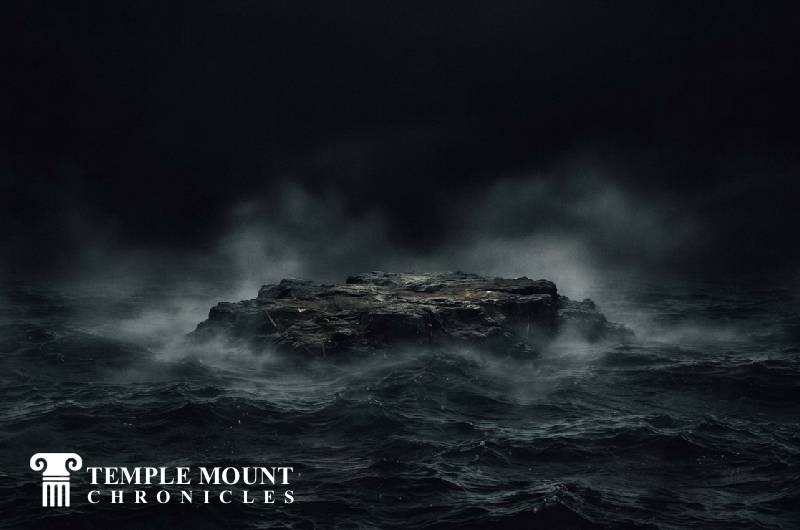
Artistic illustration of the Foundation Stone before the moment of creation.
The discussion in the Babylonian Talmud begins with a stone. In the Holy of Holies, after the Ark was no longer there, stood a stone known as the Even ha-Shetiyah, the Foundation Stone. The Mishnah had already described it as standing three fingerbreadths above the floor and as the place upon which the High Priest placed the incense on Yom Kippur. Then, in Yoma 54b, the Gemara asks why it was called Shetiyah. The answer is striking: “from it the world was founded”. The stone at the innermost point of the Temple was therefore understood as more than a surviving feature of the sanctuary. In the rabbinic tradition, it was connected to the very foundation of the created world.
The Gemara reaches this idea through a discussion of where the world itself was created. Rabbi Eliezer says it was created from its centre; Rabbi Yehoshua says from its sides; Rabbi Yitzḥak describes the Holy One, blessed be He, casting a stone into the sea, from which the world was founded. The Sages then give their answer: “From Zion was the world created”.
Their proof is drawn from Psalm 50, where God summons the earth and then appears from Zion, described as “the perfection of beauty”. The Gemara is not simply praising Jerusalem. Zion is being presented as the place from which the created order reaches its perfection. It then connects this teaching directly to the Foundation Stone of the Mishnah. Zion, the Temple, and the stone at the centre of the Holy of Holies become parts of the same sacred geography.
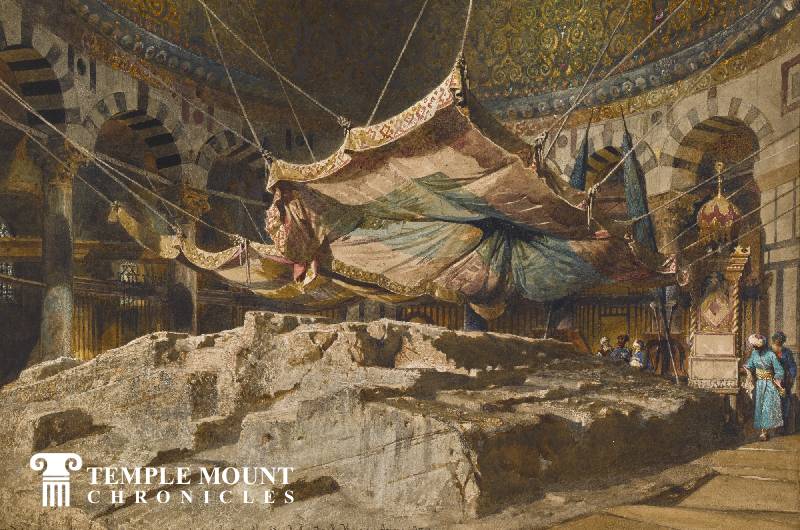
Watercolor painting titled The Holy Rock, Jerusalem by the German-born painter Carl Haag, completed in June 1859 CE.
The Torah itself does not say that Creation began in Jerusalem. Genesis begins with the creation of heaven and earth, with darkness over the tehom, the deep, and with the primordial waters before God separates them and brings forth dry land. The identification of the beginning of Creation with Zion belongs to a later Jewish reading of Scripture. The rabbis knew the biblical Creation account, but they also read it alongside the many biblical passages that give Zion a unique place in God's purposes: it is the city He has chosen, the place of His sanctuary, and the place from which His kingship is proclaimed. The result is a vision in which the Temple is not merely a sanctuary situated within the created world. Its innermost point can be understood as corresponding to the foundation of that world.
The Mishnah itself is more restrained. Yoma 5:2 describes the Even ha-Shetiyah in the Holy of Holies, says that it stood three fingerbreadths above the floor, and records its use by the High Priest after the Ark of the Covenant was no longer present. It does not explain the stone as the point from which Creation began. That explanation appears in the rabbinic discussion preserved in the Talmud. A related tradition in the Tosefta, Yoma 2:12, connects the stone with Zion and cites Psalm 50:2, showing that the association was not simply a late invention of the Babylonian Talmud. By the time these traditions were being transmitted, the stone at the centre of the Temple had acquired a significance that reached beyond its ritual function.
The connection with the primordial waters makes the idea still more striking. In Genesis, the first world is not yet the ordered world inhabited by man. There are waters, darkness, and the tehom, and God's creative acts progressively establish boundaries and order. The Bible never places those primordial waters beneath the Temple Mount, nor does it say that the Foundation Stone was present at the beginning of Creation.
Jewish tradition made that connection gradually, by bringing together different strands of Scripture: the deep and the waters of Genesis, the foundations of the earth, the sanctity of Zion, and the Temple as the chosen dwelling place of God's Presence. In that reading, Jerusalem occupies not merely a central place in Israel's religious life but a place at the centre of the world's sacred geography. The Temple stands within Jerusalem, the Holy of Holies within the Temple, and the Foundation Stone at its innermost point.
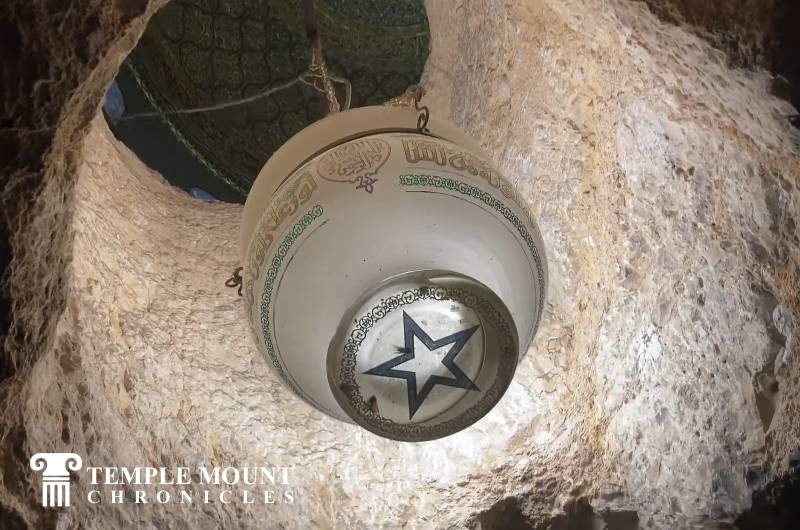
Modern chandelier in the central shaft.
This is what gives the Even ha-Shetiyah its unusual place in Jewish memory. It was a tangible object associated with the holiest room of the Temple, the place before which the High Priest performed the service of Yom Kippur. Yet the rabbis could also look upon it as the point from which the world itself had been founded. The two ideas were not contradictory. The Temple was the meeting place between Israel and God, and the Foundation Stone, at the heart of the Temple, could consequently be understood as the point where the earthly sanctuary touched the beginnings of Creation. Later traditions would place other mysteries beneath the rock and attach new meanings to the space below it. But the deeper Jewish tradition begins above it, with the stone itself: Even ha-Shetiyah—the foundation from which, according to the rabbis, the world was founded.