Holy of Holies: Kodesh HaKodashim
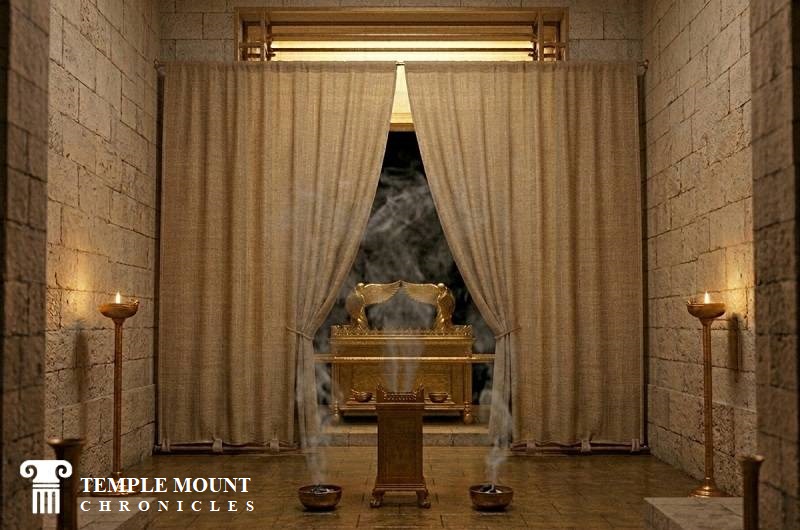
Artistic view of the Solomonic Temple's Holy of Holies, with the Ark of Covenant.
In Jewish tradition, the Kodesh HaKodashim—literally, the “Holy of Holies”—is not simply the innermost room of an ancient sanctuary. It represents the highest degree of sacred space within the Mishkan and later the Beit HaMikdash. The Torah first establishes this distinction in the construction of the Tabernacle: a parokhet, or veil, was to divide “between the Holy and the Holy of Holies” (Exodus 26:33). Behind it stood the Aron HaBrit, the Ark of the Covenant, beneath the kapporet, the golden cover with its keruvim. Yet the Torah is careful in how it describes what happens there. God tells Moses, “There I will meet with you” (Exodus 25:22), locating the divine encounter not in an image or physical representation of God, but in the sacred space above the Ark. This distinction is fundamental to Jewish understanding: the Kodesh HaKodashim was the designated place of divine presence, not a chamber containing a physical likeness of God.
The holiness of the inner chamber was expressed above all through restricted access. The Torah does not portray the Kodesh HaKodashim as a place into which priests freely entered as part of their daily service. On the contrary, Leviticus 16 specifically warns Aaron that he must not enter the sacred place “at will,” and prescribes the extraordinary service of Yom HaKippurim, the Day of Atonement. On that one day, the Kohen Gadol, the High Priest, entered the innermost sanctuary with incense and sacrificial blood, following a prescribed order of service (Leviticus 16:2–34). The limitation itself is significant. In the biblical conception, holiness was not simply greater proximity to something sacred; greater holiness required greater boundaries. The Kodesh HaKodashim was therefore the point toward which the sanctuary was oriented while simultaneously being the place from which ordinary human access was most restricted.
This idea of ordered holiness became deeply embedded in Jewish thought. The Mishnah's discussion of the Temple describes successive degrees of sanctity, culminating in the Kodesh HaKodashim, where entry was restricted to the High Priest on Yom Kippur (Mishnah Kelim 1:8–9). In Yoma, the rabbis preserve detailed traditions concerning the High Priest's movements, incense, blood sprinkling and the physical separation between the Sanctuary and the Holy of Holies. The Mishnah records a disagreement between the Sages concerning whether the Second Temple had two curtains or one between these chambers (Yoma 5:1), demonstrating that even the precise physical arrangement remained a subject of rabbinic discussion. These sources belong to the rabbinic period and should not be confused with direct descriptions from the wilderness period; nevertheless, they show how carefully Jewish tradition remembered and analyzed the sacred geography of the Temple.
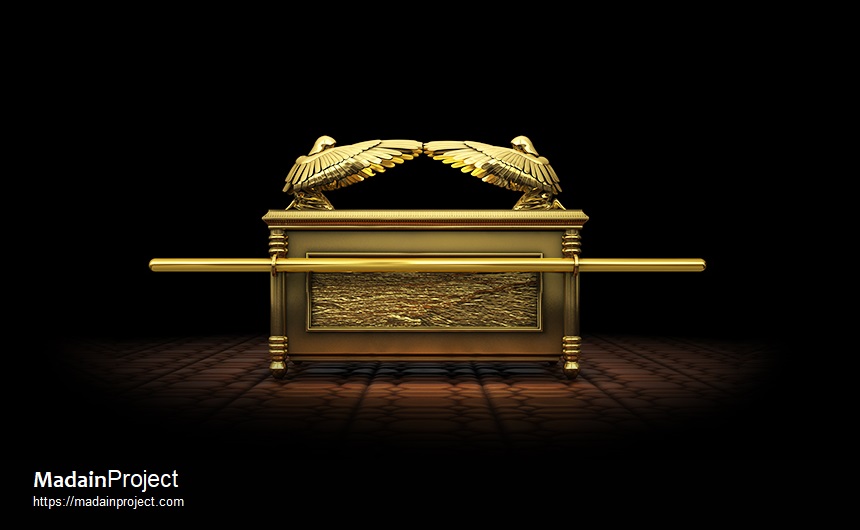
Ark of the Covenant, artistic illustration. Courtesy of Madain Project.
The Ark gives the Kodesh HaKodashim its distinctive biblical character. Exodus does not describe the Ark merely as a container for the tablets. It is the place above which God tells Moses that He will speak with him: “I will meet with you there, and I will impart to you—from above the cover, from between the two cherubim” (Exodus 25:22). The imagery is deliberately restrained. There is no statue of God enthroned inside the sanctuary. Instead, the space between the keruvim becomes the appointed place of encounter with the invisible God of Israel. This helps explain why the Kodesh HaKodashim cannot simply be understood through the category of an ancient royal throne room. Its symbolism belongs to Israel's uncompromising monotheism: the sanctuary marks God's presence without attempting to give God a physical form. Later Jewish terminology such as Shekhinah, referring to the divine indwelling or presence, developed within rabbinic literature; it is useful for describing Jewish reflection on the sanctuary, but it should not be projected backward as though it were the terminology used by the Torah itself.
The destruction of the Temples did not erase the Kodesh HaKodashim from Jewish memory. Instead, the innermost sanctuary became one of the clearest symbols of the holiness associated with the Mikdash and, ultimately, Jerusalem. Rabbinic sources preserve traditions concerning the chamber even after the Ark was no longer present. Yoma 5:2 states that after the Ark was taken away, a foundation stone called the Even HaShetiyah stood in the Holy of Holies, and upon it the High Priest placed the incense. Whether every detail of that rabbinic description can be independently reconstructed archaeologically is another question; the important historical point is that Jewish memory continued to distinguish the innermost sacred space even when its original furnishings were no longer visible. The Kodesh HaKodashim therefore became more than a room in an ancient building. It was the ultimate expression of a Jewish conception of holiness: a place set apart, approached through boundaries and ritual, and associated with the presence of the one God whom, as Solomon himself acknowledged at the dedication of the Temple, “the heavens to their uttermost reaches cannot contain” (1 Kings 8:27).