Biblical Description of the First Temple High Priest
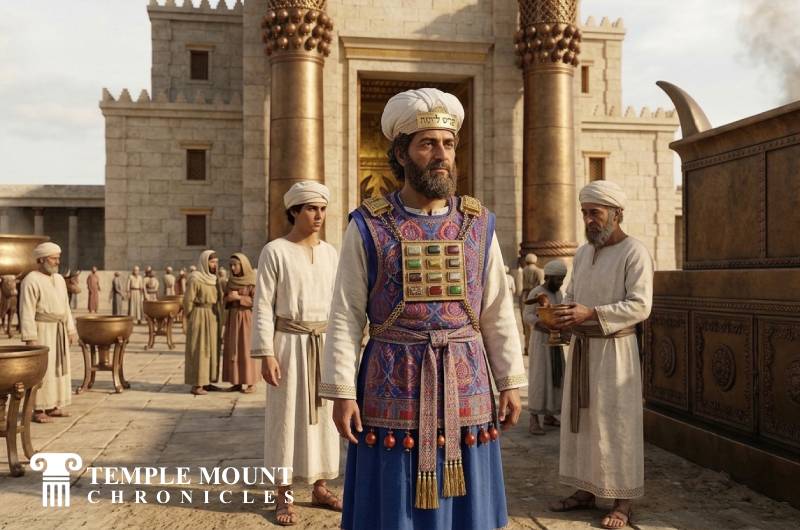
Illustration of a Judahite High Priest; during the Solomonic First Temple period.
The High Priest held a unique place in the worship of ancient Israel, serving as the consecrated representative of the people before the LORD. The Bible’s most detailed description of his sacred garments appears in Exodus 28, where God commands Moses to have Aaron’s garments made “for glory and for beauty”. These garments distinguished the High Priest from the other priests and expressed the holiness of his office.
At the center of the attire was the ephod, an elaborate garment made with gold, blue, purple, scarlet, and fine linen. Exodus 28:6 says: “And they shall make the ephod of gold, of blue, and of purple, of scarlet, and fine twined linen, cunningly wrought”. Its shoulder pieces carried two onyx stones engraved with the names of the sons of Israel, six names on each stone. The purpose was explicitly symbolic: “And thou shalt put the two stones upon the shoulders of the ephod for stones of memorial unto the children of Israel: and Aaron shall bear their names before the LORD upon his two shoulders for a memorial” (Exodus 28:12).
Attached to the ephod was the breastpiece of judgment, a square, folded garment containing twelve precious stones arranged in four rows of three. Each stone represented one of the twelve tribes of Israel and was engraved with its name. Exodus 28:21 states: “And the stones shall be with the names of the children of Israel, twelve, according to their names, like the engravings of a signet; every one with his name shall they be according to the twelve tribes”. The breastpiece also contained the Urim and Thummim, whose exact nature remains uncertain: “And thou shalt put in the breastplate of judgment the Urim and the Thummim; and they shall be upon Aaron’s heart, when he goeth in before the LORD” (Exodus 28:30).
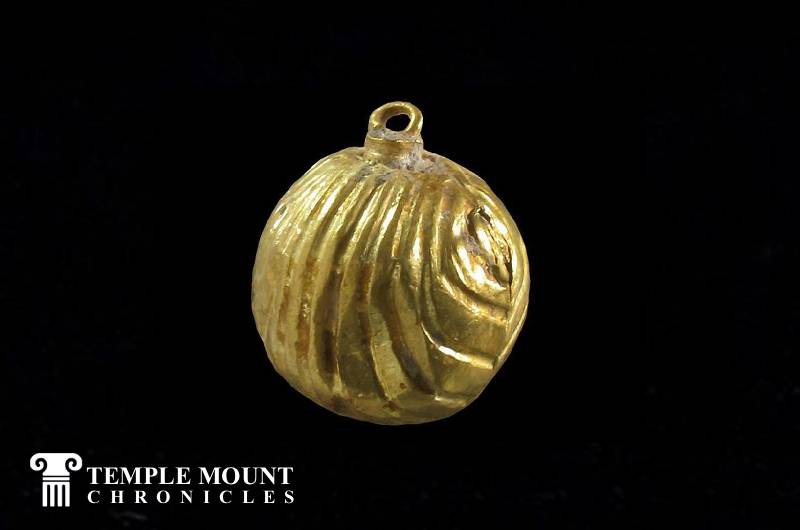
The gold bell discovered during an excavation in the City of David National Park in Jerusalem.
Beneath the ephod was a robe of blue, with its hem decorated with alternating pomegranates and golden bells. Exodus 28:33–35 describes it: “And beneath upon the hem of it thou shalt make pomegranates of blue, and of purple, and of scarlet, round about the hem thereof; and bells of gold between them round about”. The sound of the bells accompanied Aaron as he entered and departed the Holy Place. Over the robe were the linen tunic, sash, and turban, completing the distinctive garments of the priestly office.
The most prominent symbol of holiness was the golden plate worn on the High Priest’s forehead. Exodus 28:36–38 commands: “And thou shalt make a plate of pure gold, and grave upon it, like the engravings of a signet, HOLINESS TO THE LORD”. The plate was fastened to the front of the turban and was to remain upon Aaron’s forehead as he performed his priestly duties. The text explains that Aaron would bear the iniquity associated with the holy offerings of Israel, so that they might be accepted before the LORD.
The High Priest’s garments therefore carried a remarkable theological symbolism. He bore the names of Israel upon his shoulders, carried them upon his heart, and bore the declaration of holiness upon his forehead. His clothing was not merely ceremonial decoration; it expressed his role as the consecrated representative of Israel in the presence of God. Although Exodus describes these garments in connection with Aaron and the tabernacle, the Aaronic priesthood continued into the period of the Jerusalem Temple, forming the biblical foundation for the priestly service of the First Temple.