
Battle of Jerusalem and the Splitting of the Mount of Olives
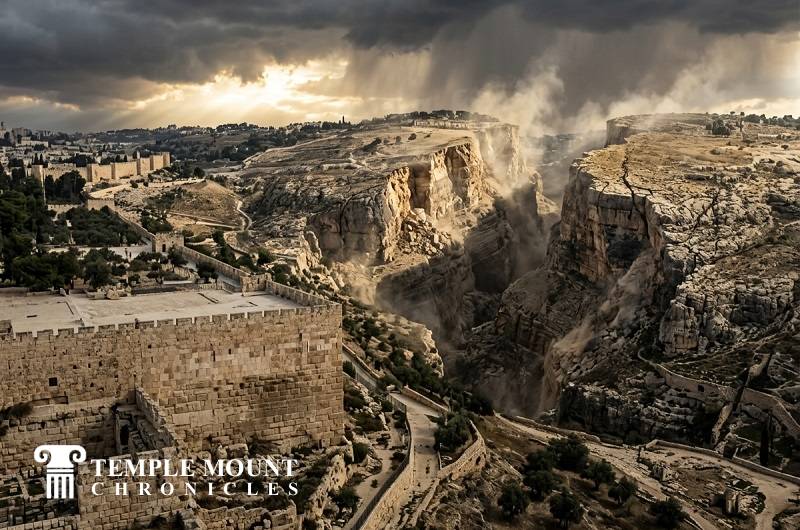
Artistic rendering of the after the war of Gog and Magog.
The prophetic framework of biblical eschatology assigns a catastrophic, transformative role to the landscape immediately surrounding the Temple Mount during the final global conflict known as the War of Gog and Magog. Documented extensively within the fourteenth chapter of the Book of Zechariah (Zecharyah), this apocalyptic trajectory describes a definitive military siege where the combined forces of all nations descend upon Jerusalem. From a scholarly and text-critical perspective, the narrative serves as the direct theological bridge between the physical degradation of the earthly city and its ultimate supernatural exaltation. The text moves with strict geographic specificity, mapping out real valleys, gates, and mountain peaks to ground an inherently cosmic event within the concrete topography of Judaea.
According to the classical prophetic account, the final confrontation peaks when the tactical vulnerability of Jerusalem reaches an absolute crisis point. Zechariah 14:1–2 outlines a harrowing scenario wherein the city’s defenses collapse under international pressure, resulting in the plunder of residential quarters and the forced exile of exactly half of the remaining urban population. Within traditional Jewish commentaries, such as those of the Radak and Malbim, this tactical collapse is interpreted as a vital spiritual crucible—a ultimate national refining process that forces the remnant of Israel to completely abandon reliance on geopolitical alliances and look solely toward divine intervention.
The definitive turning point of the conflict manifests as a radical, localized manifestation of the divine presence directly upon the eastern ridge of the city. Zechariah 14:4 states with absolute precision that "on that day His feet will stand on the Mount of Olives, which faces Jerusalem on the east". In Christian eschatology, this verse is widely read by classical theologians as a literal, physical prediction of the Second Coming of Jesus, returning precisely to the same mountain ridge from which he historically ascended. Conversely, traditional Judaic interpretation views this description as an anthropomorphic metaphor for the sudden, catastrophic disruption of nature by the creator, shifting the cosmic balance of power in an instant.
The immediate physical consequence of this divine intervention is an immense, localized earthquake that permanently alters the geology of Jerusalem. The text specifies that the Mount of Olives will violently tear down the center from east to west, creating a massive, broad valley as half of the mountain displacement shifts physically toward the north and the other half toward the south. This structural reconfiguration functions as an emergency egress route, allowing the trapped, besieged citizens of Jerusalem to flee to safety through the newly carved mountain corridor, which is described as extending all the way to a historic settlement named Azal. The text explicitly equates the magnitude of this seismic disruption to the terrifying earthquake that struck Judaea during the eighth-century BCE reign of King Uzziah.
Following this topographical shift, the entire hydrological structure of the Temple Mount region undergoes a complete reversal that mirrors the eden-like transformations recorded by Ezekiel. Zechariah 14:8 details that "living waters shall flow out from Jerusalem," dividing into two distinct channels where half of the sub-surface torrent surges eastward down toward the Dead Sea and the opposite half empties westward into the Mediterranean Sea. This continuous, year-round flow completely flushes out the arid valleys of the Judaean Wilderness, effectively transforming the high-altitude acropolis of the Temple Mount from a dry, fortified hill into the primary, fertile oasis of the ancient Near East.
Ultimately, the architectural and geopolitical isolation of the Temple Mount is dissolved as the surrounding mountains are structurally flattened into a uniform plain. The prophecy states that all the rugged terrain from Geba to Rimmon will be leveled, while the city of Jerusalem itself will be raised up structurally and securely inhabited from Benjamin's Gate to the Corner Gate. In this final eschatological state, the Temple Mount loses its historic status as a contested, war-torn military stronghold and is elevated into the uncontested spiritual capital of the globe, where the remaining populations of all nations are required to travel annually to celebrate the Feast of Tabernacles (Sukkot).
Notes
Images on this page are illustrative.