Foundation Stone: The Even ha-Shetiyah
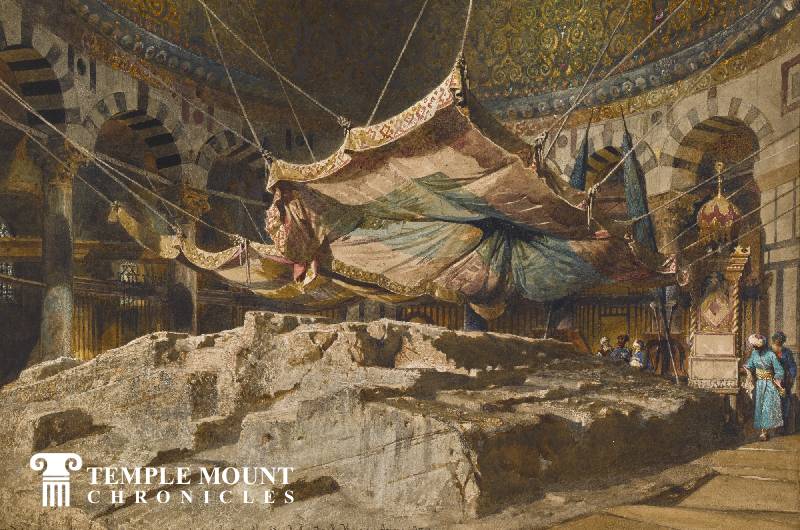
Watercolor painting titled The Holy Rock, Jerusalem by the German-born painter Carl Haag, June 1859 CE.
The Foundation Stone enters Jewish literature not first as a cosmic object, but as a stone in the Holy of Holies. The Mishnah, describing the Yom Kippur service, states that after the Ark was taken away, “there was a stone there from the days of the earlier prophets”, called Shetiyah. It stood three fingerbreadths above the floor, and upon it the High Priest placed the fire-pan when he entered the innermost chamber of the Temple. The description is strikingly spare. The Mishnah tells us where the stone was and how it was used, but not its size, shape, composition, or how it came to occupy that place. What it preserves is its essential role: at the centre of the Holy of Holies, where the Ark of the Covenant had once stood, the stone served as the physical point upon which part of the most sacred service of the year was performed.
The name Even ha-Shetiyah—the Foundation Stone—acquired a deeper meaning in later rabbinic tradition. The Tosefta and Jerusalem Talmud connect the stone with the foundation of the world, and the Babylonian Talmud preserves the tradition in Yoma 54b. There the Gemara asks why the stone was called Shetiyah and answers that the world was hushtat, “founded”, from it. This cosmological interpretation should not simply be read back into the Mishnah.
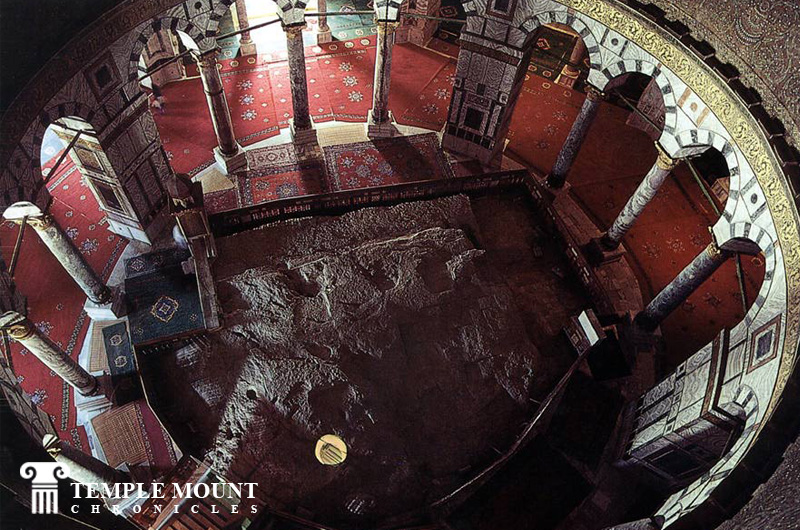
An elevated view of the Foundation Stone; the Dome of the Rock interior.
The Mishnah gives us a sacred stone and its ritual function; the identification of that stone with the foundation of Creation represents a further development in the tradition. The distinction is important because it allows the history of the idea to be followed rather than treating all later meanings as though they had been present from the beginning.
The physical identity of the stone presents a separate question. Jewish tradition eventually identified the Foundation Stone with the great rock at the centre of the Temple Mount, known in Arabic as the Sakhrah and now enclosed within the Dome of the Rock. Medieval Jewish authorities could speak of this identification with considerable confidence. Rabbi David ibn Zimra, the Radbaz (c. 1479–1573), for example, wrote that the Foundation Stone was beneath the Dome. Yet the strength of a religious tradition is not the same as archaeological proof. The Second Temple / Herodian Temple no longer survives, the Holy of Holies cannot be excavated, and there is no surviving inscription or other physical evidence that independently identifies the exposed rock with the stone described by the Mishnah. The identification is therefore firmly rooted in Jewish tradition, but cannot be demonstrated archaeologically.
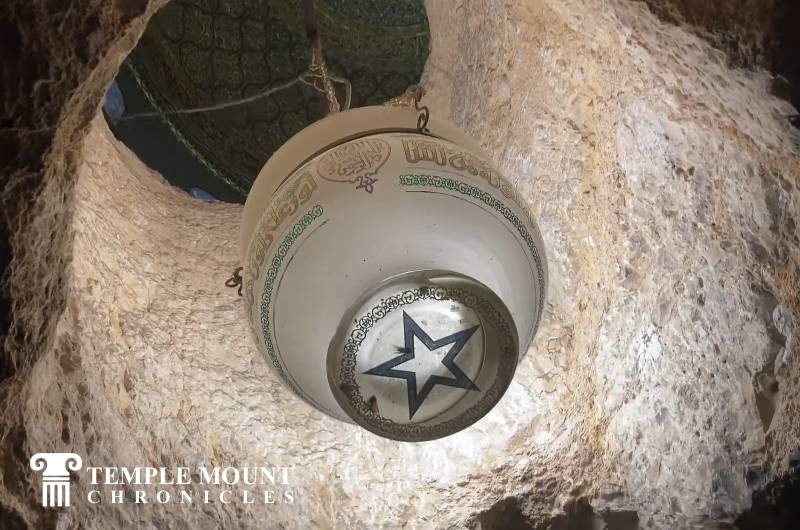
The shaft or piercing in the foundation stone.
The location of the stone also became important in rabbinic descriptions of the Temple's changing condition. The Mishnah's statement that it remained after the Ark had been removed places it in the later history of the First Temple period tradition rather than describing an object whose significance depended entirely upon the Ark itself. The Tosefta preserves another detail: when the Ark was no longer present, the stone was used in its place as the focus of the High Priest's service. This makes the Even ha-Shetiyah particularly unusual among Temple objects. It was neither an ordinary furnishing nor simply a relic of an earlier sanctuary. It occupied the same sacred centre after one of the Temple's defining objects had disappeared, and the rabbinic descriptions preserve that continuity without explaining exactly how the stone itself came to occupy the position it held.