Solomon's Temple in the Bible
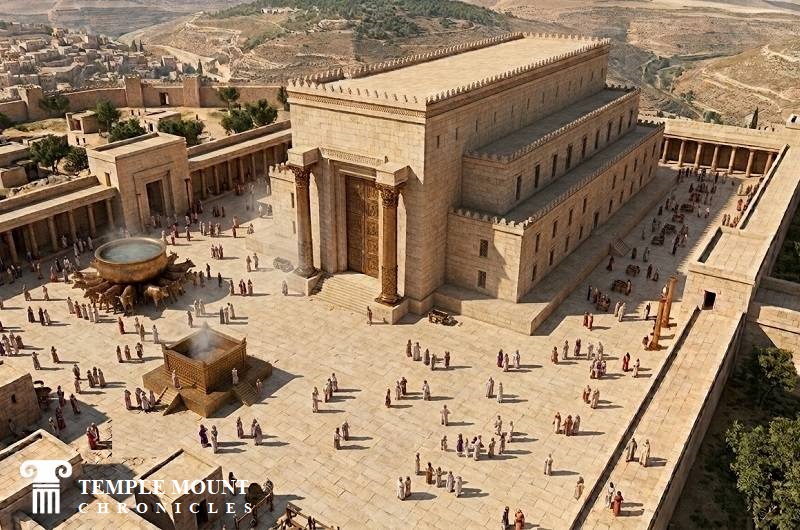
Illustration of Solomon's Temple complex as described in the Bible.
The architectural and spiritual blueprint of the First Temple—known in Jewish tradition as the Beit HaMikdash (the Sanctified House)—constitutes a foundational pillar of biblical historiography, Jewish liturgy, and Near Eastern history. Documented primarily within the Hebrew Bible in the books of Melachim (1 Kings 5–8) and Divrei HaYamim (2 Chronicles 2–5), this monumental structure was erected by King Solomon (Shlomo HaMelech) in the tenth century BCE on the summit of Mount Moriah. From a traditional Jewish perspective, the Temple was not merely an imperial showcase or a localized sanctuary, but the definitive earthly dwelling place for the Shechinah (the Divine Presence). It served as the singular, permanent replacement for the portable Tabernacle (Mishkan) that accompanied the Israelites through the wilderness, cementing Jerusalem as the immutable geopolitical and spiritual core of the Jewish people.
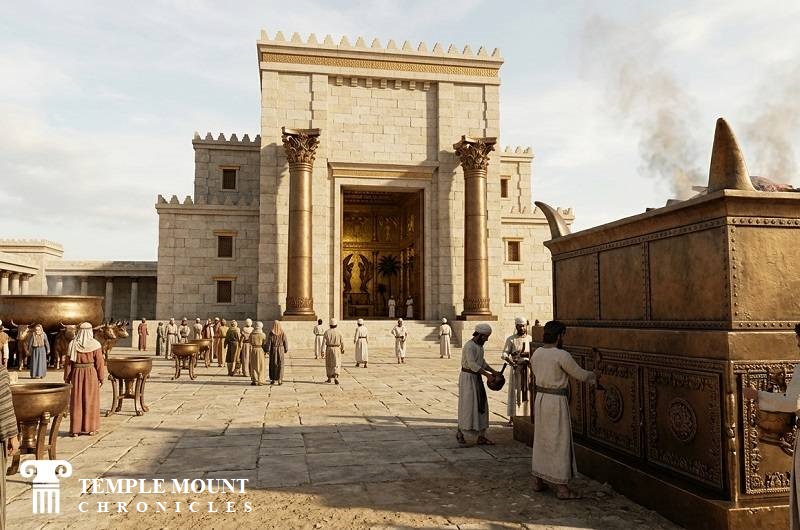
Facade of the Solomonic Temple as related in the Bible.
The physical dimensions and structural layout of the Beit HaMikdash are detailed in the biblical text with the precision of an ancient architectural survey. Measured in sacred cubits (amot), the core sanctuary was an elongated rectangular building sixty cubits long, twenty cubits wide, and thirty cubits high. The structure was divided into three progressively sacred, linearly aligned sections. Worshippers entered through the Ulam (the entrance porch), which was flanked by two monumental, freestanding bronze pillars named Yachin (meaning "He will establish") and Boaz (meaning "In Him is strength"). Beyond the porch lay the Heikhal (the Holy Place or Main Sanctuary), a vast hall containing the primary cultic apparatus: the Golden Altar of Incense, the Table of Showbread, and ten golden Menorots that illuminated the windowless, cedar-paneled interior.
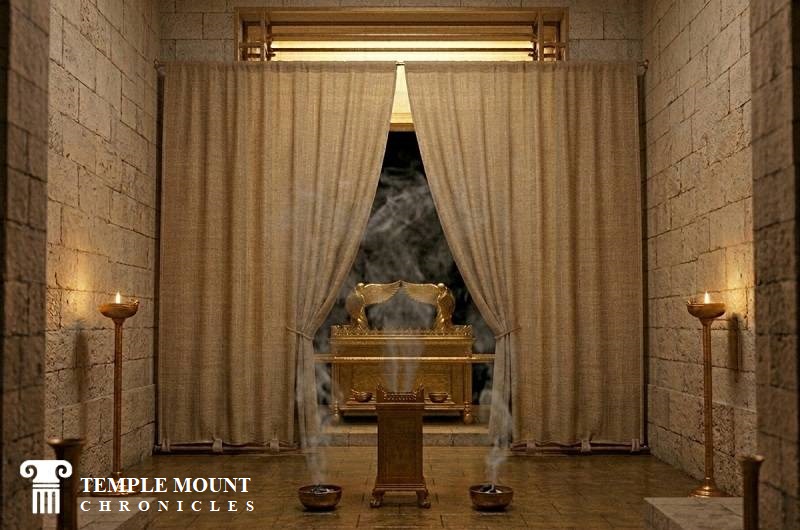
Conceptualised illustration of the Solomonic period Holy of Holies.
The ultimate focus of the entire complex was the Kodesh HaKodashim (the Holy of Holies), a perfect cube measuring twenty cubits in every dimension, situated at the westernmost terminus of the building. This innermost chamber was entirely devoid of natural light and housed the Aron HaKodesh (the Ark of the Covenant), which contained the stone Tablets of the Law received by Moses at Mount Sinai. Overarching the Ark were two colossal cherubim carved from olive wood and heavily overlaid with pure gold, their wings spanning the entire width of the room. In Jewish theology, this room represented the epicenter of cosmic holiness; access was strictly restricted to the Kohen Gadol (High Priest), who entered this sacred void only once a year on Yom Kippur (the Day of Atonement) to perform the critical expiation rituals for the collective sins of Israel.
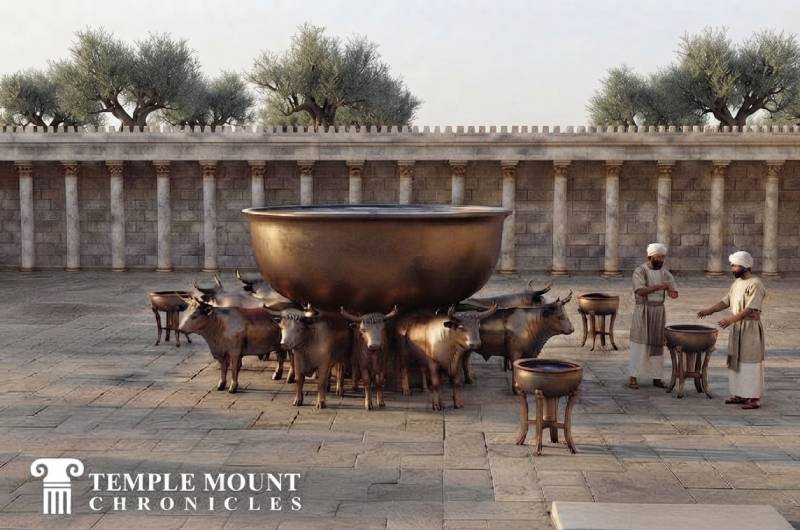
Molten Sea: the bronze basin and the twelve oxen of the Solomonic temple.
The construction materials and craftsmanship utilized for the Beit HaMikdash underscore its supreme status as a project of absolute purity and international collaboration. King Solomon secured a diplomatic and logistical treaty with King Hiram of Tyre to acquire massive quantities of Lebanese cedar, cypress wood, and highly skilled Phoenician stonecutters. A critical halachic (Jewish legal) directive governed the quarrying process: because iron tools are instruments of war and destruction, no iron hammers, axes, or chisels were permitted to be used at the temple site itself. Every massive limestone block was meticulously pre-cut and fitted at distant quarries, allowing the immense building to be assembled in profound, reverent silence. The interior walls were completely lined with cedar panels, entirely obscuring the underlying stone, and subsequently overlaid with hammered gold leaf decorated with reliefs of palm trees, open flowers, and cherubim.
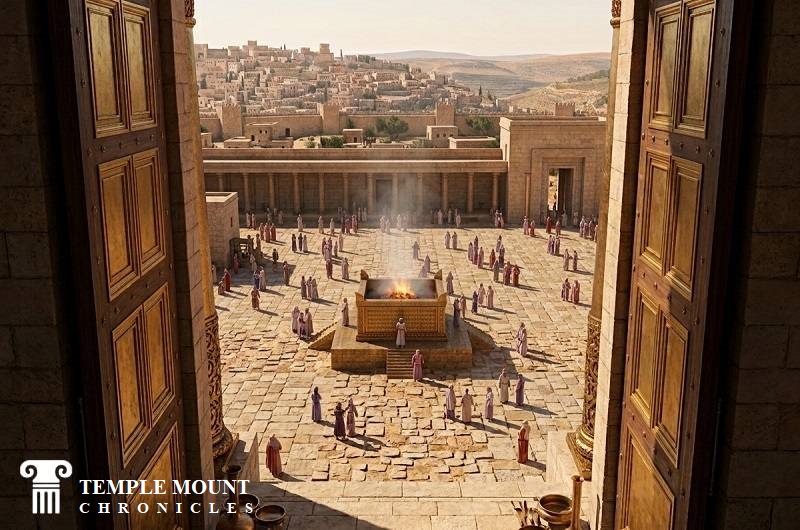
Elevated view of the courtyard and the altar from the interior of the Temple.
While the primary scriptural descriptions are rooted firmly in the Hebrew Bible, the architectural legacy of Solomon's Temple heavily informs the downstream theology of the Christian tradition. In the Christian New Testament, the physical dimensions and baseline imagery of the Beit HaMikdash are frequently adapted as theological metaphors. For instance, the multi-layered layout of the Temple—specifically the restrictive veil separating the Holy Place from the Holy of Holies—is utilized in the New Testament Epistle to the Hebrews to contrast the ancient Levitical priesthood with the spiritual mediation of Jesus. Christian tradition interprets the tearing of the inner temple veil during the crucifixion as a profound theological shift, symbolizing immediate access to the Divine without the necessity of the animal sacrificial systems or a physical high priest operating within a stone sanctuary.
Notes
Images on this page are illustrative.