
Jerusalem in the Time of Nehemiah
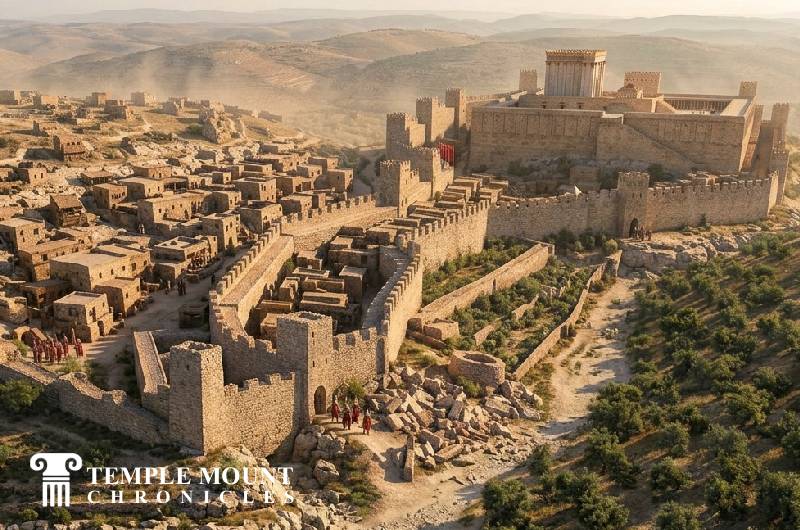
Jerusalem during the time of Nehemiah, with Zerubbabel's Temple (illustration).
Jerusalem in the time of Nehemiah was a city recovering from catastrophe. More than a century after the Babylonian destruction of Jerusalem, much of the city remained in ruins, and its defensive walls and gates had not been fully restored. Nehemiah, serving as cupbearer to the Persian king Artaxerxes, received a report from Jerusalem that “the remnant that are left of the captivity there in the province are in great affliction and reproach: the wall of Jerusalem also is broken down, and the gates thereof are burned with fire” (Nehemiah 1:3).
When Nehemiah arrived in Jerusalem, he secretly inspected the ruined defenses at night. He passed through the Valley Gate, examined the Dung Gate, the Fountain Gate, and the walls around the city, finding the damage extensive enough that his horse could not pass through some sections. He then called the people to rebuild, declaring, “Come, and let us build up the wall of Jerusalem, that we be no more a reproach” (Nehemiah 2:17). The rebuilding was organized into sections, with priests, officials, craftsmen, merchants, and families working alongside one another.
The Book of Nehemiah provides an unusually detailed account of the city's gates. Among those named are the Sheep Gate, Fish Gate, Old Gate, Valley Gate, Dung Gate, Fountain Gate, Water Gate, Horse Gate, East Gate, and Inspection Gate. The account also mentions towers and important features of the city's defenses, including the Tower of Hananel, the Tower of the Hundred, the Tower of the Ovens, and the Broad Wall. These names give us a valuable glimpse into the layout and character of Persian-period Jerusalem, even though the precise location of every gate remains debated.
The Temple remained the religious heart of Jerusalem during this period. It had already been rebuilt by the returned exiles several decades before Nehemiah's arrival, during the leadership of Zerubbabel and the high priest Joshua. Nehemiah's work was therefore not the rebuilding of Solomon's Temple, but the restoration of the city's defenses and civic life around the sanctuary. The combination of a functioning Temple and newly restored walls marked an important stage in Jerusalem's recovery after the Babylonian exile.
The work faced opposition from surrounding leaders, including Sanballat, Tobiah, and Geshem, who attempted to discourage the builders and undermine Nehemiah's leadership. The response was both practical and determined: workers repaired the walls while remaining prepared to defend themselves. Nehemiah records that the builders worked with one hand while holding weapons with the other, turning the reconstruction into a communal effort to secure the city.
According to the biblical account, the wall was completed on the twenty-fifth day of Elul, in fifty-two days. After the gates were installed, Nehemiah appointed gatekeepers, singers, and Levites and established guards throughout Jerusalem. The city was not simply being enclosed by a wall; its political, religious, and social order was being restored.
Yet Jerusalem was still far from being a densely populated imperial capital. Nehemiah specifically observes that “the city was large and spacious, but the people in it were few, and the houses had not yet been rebuilt” (Nehemiah 7:4). This detail is important when imagining the Jerusalem of Nehemiah: its newly repaired fortifications could be impressive while large portions of the city remained relatively sparsely inhabited and in the process of recovery.
The Jerusalem of Nehemiah therefore stood at a turning point in its history. The Temple had been restored, the walls were being rebuilt, and the returned Jewish community was reestablishing itself under Persian rule. Nehemiah's Jerusalem was not yet the monumental city that Herod would create centuries later, but a smaller Persian-period settlement whose renewed walls, gates, Temple, and community represented the remarkable recovery of Jerusalem after exile.