Vessels and Implements of Solomon’s Altar
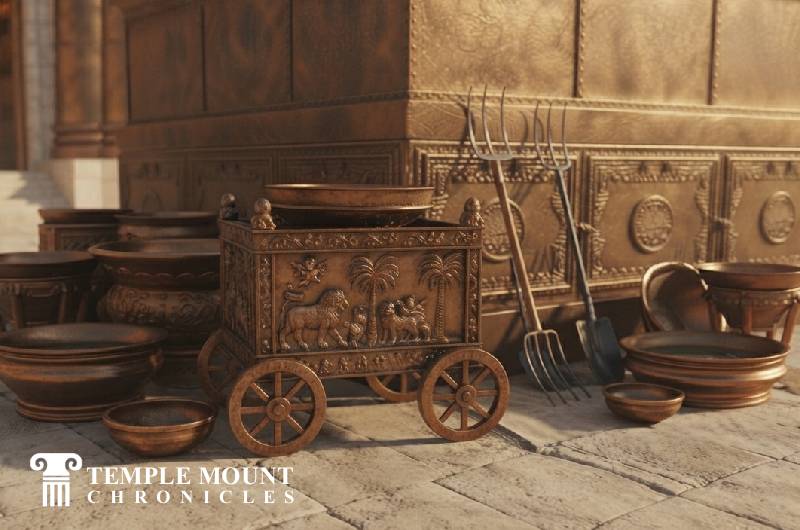
Illustration.
The sacrificial service of Solomon’s Temple required more than the great bronze altar itself. Around it was an array of vessels and implements for handling the offerings, ashes, and other materials of the avodah (Temple service). The most important biblical evidence comes from the account of the work of Huram, the master bronze worker whom Solomon brought into the Temple project. First Kings 7:40–45 and 2 Chronicles 4:11–16 list among his finished works pots, shovels, basins, and forks, and state that these objects were made of burnished bronze. They were part of the equipment made for the beit YHWH, the House of the LORD, during Solomon's reign.
The terminology requires some care because English translations differ considerably. The Hebrew words do not always correspond to modern categories of kitchen or workshop tools, and the biblical passages do not provide detailed drawings or dimensions. In 2 Chronicles 4:16, for example, the objects include sirot (pots), ya'im (shovels), and mizlagot (forks or flesh-hooks), together with other associated implements. The parallel passage in 1 Kings 7:45 uses a somewhat different term in some textual traditions and translations for the final group of vessels. This is not merely a matter of vocabulary: it reminds us that the biblical inventory should not be turned into a precise archaeological catalogue when the text itself leaves several forms and functions uncertain.
The pots, or sirot, were substantial bronze vessels associated with the sacrificial service. Their precise shape and capacity are not given in the account of Solomon's Temple, and it would therefore be misleading to portray them with invented dimensions. The shovels, ya'im, likewise belonged to the practical work surrounding the altar, most plausibly for dealing with ashes and other material produced by the sacrifices. The forks, mizlagot, are particularly suggestive of the handling of sacrificial meat. The same Hebrew term appears in the description of the Tabernacle's altar implements in Exodus 27:3, where the altar's utensils include pots, shovels, basins, flesh-hooks, and firepans. Yet Solomon's account does not specify the shape, number of prongs, length, or dimensions of his forks. A reconstruction can reasonably show heavy bronze forks used by priests, but their exact appearance remains unknown.
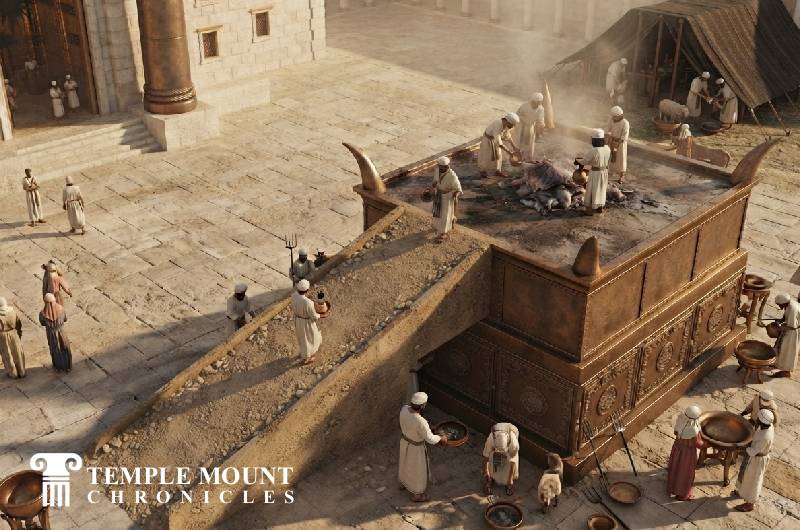
An elevated view of the Solomon's great bronze altar.
The larger bronze basins (kiyyorot) belong to a somewhat different category. They were not simply hand tools of the altar, but important installations for the Temple's sacrificial service. Solomon commissioned ten bronze basins, each four cubits across and each mounted on one of ten elaborate wheeled stands. First Kings 7:38–39 places five stands on each side of the Temple, while the great Sea stood separately toward the southeast. The Chronicler gives their purpose more explicitly: the basins were for washing or rinsing what was associated with the burnt offerings, while the Sea was for the priests' washing (2 Chronicles 4:6). The stands themselves were elaborate bronze constructions, decorated with lions, oxen, cherubim, and wheels, showing that even equipment serving practical ritual purposes could form part of the highly ornamental bronze program of Solomon's Temple.
All of these objects belonged to an extraordinary bronze-working enterprise. First Kings says that Huram's equipment was made of polished or burnished bronze and that the objects were cast in clay molds in the Jordan plain, between Succoth and Zarethan. The Chronicler similarly states that they were cast in the region between Succoth and Zeredah, using thick clay molds. So many bronze objects were produced that Solomon did not have them weighed; the quantity of metal was simply too great to determine.
The biblical inventory therefore gives us a rare glimpse into the material infrastructure of the Solomonic Temple: the altar was not an isolated monument, but the center of a highly organized sacrificial system supported by purpose-made bronze vessels and tools. What their precise forms looked like remains uncertain, but their existence, their bronze construction, their association with Huram's workshop, and their place within Solomon's Temple complex are firmly rooted in the biblical account.