Molten Sea: The Great Bronze Basin of Solomon’s Temple
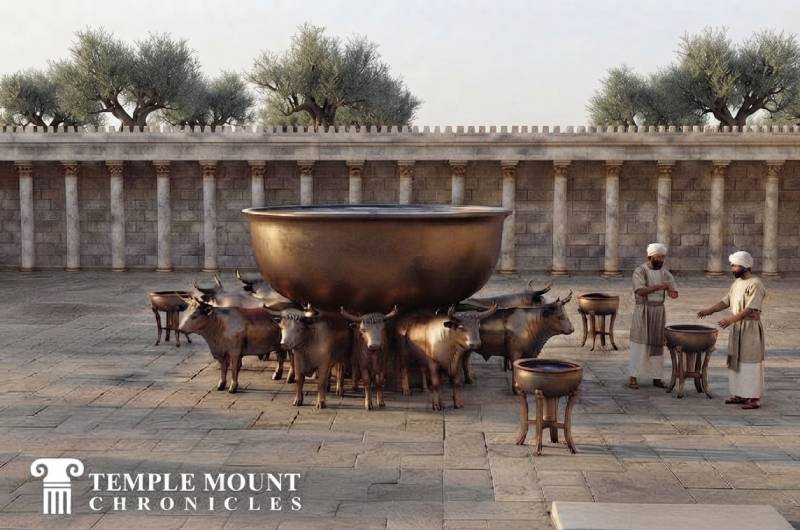
Reconstruction of Solomon’s Molten Sea, the monumental bronze basin supported by twelve outward-facing oxen within the southern Temple court.
The Bronze Sea was among the most imposing objects made for Solomon’s Temple: a vast circular vessel of cast bronze, set apart for the service of the sanctuary. The biblical account in 1 Kings 7:23–26 gives it almost architectural dimensions. It was ten cubits from rim to rim, five cubits high, and thirty cubits in circumference, with a wall a handbreadth thick. Its rim was fashioned “like the brim of a cup, like the flower of a lily,” while two rows of rounded or gourd-like ornaments encircled it beneath the rim. The vessel rested upon twelve bronze oxen, three facing each of the four directions, their hindquarters turned inward. These details are unusually precise, yet they do not amount to a complete engineering description. The Sea can therefore be reconstructed with some confidence in its scale and principal features, but not in every aspect of its physical appearance.
Its sheer size is worth pausing over. Using a working cubit of approximately 45 centimetres, the biblical dimensions produce a basin roughly 4.5 metres in diameter and 2.25 metres high. It was not a small laver that could simply be carried into position, but a monumental bronze installation occupying a significant part of the Temple precinct. The comparison with the circumference is itself instructive: ten cubits across and thirty cubits around gives the familiar rounded ancient measurement rather than the precise mathematical circumference of a modern circle. The text also says that the vessel held 2,000 baths in 1 Kings 7:26, whereas 2 Chronicles 4:5 gives 3,000. The difference has generated attempts at reconciliation, including proposals that the figures represent different measures of ordinary and maximum capacity, but the biblical texts themselves do not explain the discrepancy. It is better to preserve the difference than to manufacture a certainty that the sources do not provide.
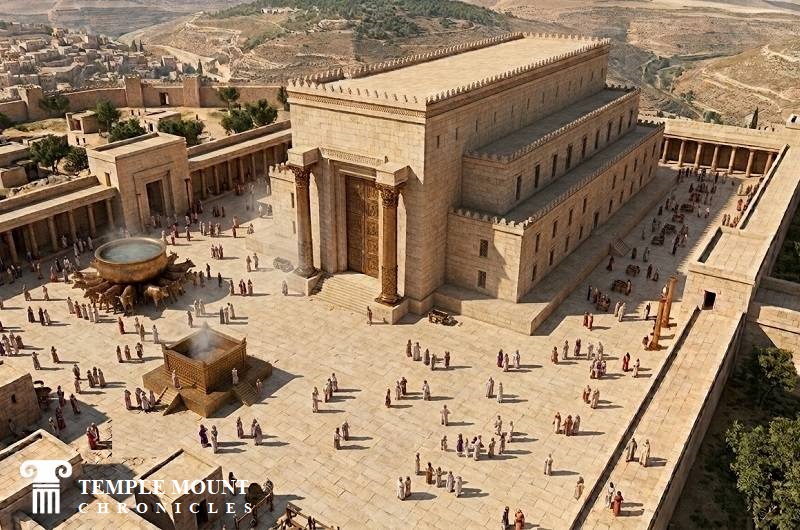
Elevated view of the Solomonic temple complex, with the molten sea to the left above the altar.
The function of the Sea is stated most clearly by the Chronicler. After describing the great basin, 2 Chronicles 4:6 distinguishes it from the ten smaller bronze basins: the smaller vessels were used to rinse portions of the burnt offerings, while the Sea was used by the priests for washing. Thus the Sea should not simply be described as a general reservoir or as a decorative fountain. It was associated specifically with the ritual washing of the priests. First Kings, by contrast, describes the Sea without explicitly stating its function, making Chronicles an important witness within the biblical tradition itself. The distinction also helps explain why the ten smaller lavers belong in a reconstruction of the Temple’s bronze installations. They were substantial working vessels, five placed on the south and five on the north, serving a different purpose from the great Sea.
The Sea was not an isolated work of Judean craftsmanship. Solomon entrusted the Temple’s major bronze work to Hiram of Tyre, whom 1 Kings 7:13–14 describes as a highly skilled bronze worker. The account concludes that Hiram made the Sea, the twelve oxen beneath it, the ten stands and lavers, and the other great bronze furnishings. The casting itself is associated with the Jordan plain, between Succoth and Zarethan, where the large collection of objects was cast. This is an important part of the historical picture: the furnishing of Israel’s central sanctuary involved sophisticated metalworking associated with the wider artistic and technological culture of the Levant. First Chronicles 18:8 further preserves a tradition that David had accumulated large quantities of bronze which Solomon used for the Sea, the pillars, and other vessels. The biblical account thus presents the object as both sacred furnishing and remarkable technological achievement.
The location of the Sea is more specific than a generic “Temple courtyard.” First Kings 7:39 places it on the right side of the Temple, eastward and toward the south, while 2 Chronicles 4:10 gives the same general orientation. In conventional reconstructions this places the great basin toward the southeastern part of the Temple complex. The ten smaller stands were distributed five to the south and five to the north. This matters because an image that places the Sea directly before the Temple entrance, on its central axis, creates an impression for which the biblical description provides no support. A cautious reconstruction can instead place the Sea toward the southern side of the court, allowing the Temple building itself to remain outside the principal field of view. The object then appears as the biblical sources present it: one component of a carefully ordered sacred complex.
The twelve oxen are among the most secure elements of any reconstruction. Three faced north, three west, three south, and three east, with their rear parts turned toward the centre. They were therefore not simply twelve animals standing in a row beneath a tank. Their arrangement was radial, binding the enormous basin visually and structurally to the four directions. The biblical description does not explain why oxen were chosen, nor does it explicitly identify them with the twelve tribes of Israel. That familiar interpretation belongs to later reflection and should not be presented as though it were stated by Kings or Chronicles. Their presence nevertheless belongs to a wider ancient Near Eastern visual world in which bovine imagery could accompany monumental and sacred installations. Later Jewish interpretation continued to find significance in their orientation; Babylonian Talmud Zevaḥim 62b, for example, uses the arrangement of Solomon’s Sea in a discussion of orientation within the Temple.
What the Sea actually looked like is more difficult. The biblical description establishes a round cast-bronze vessel, its dimensions, thickness, decorated rim, two rows of rounded ornaments, and twelve oxen beneath it, but it does not provide an elevation drawing or describe the precise curvature of its body. Josephus, writing in the first century CE, gives the vessel a hemispherical form and describes it as a deep basin supported by the oxen. His account is valuable because it demonstrates how the ancient description was understood in the Second Temple period, but Josephus lived centuries after Solomon and cannot be treated as an archaeological eyewitness to the First Temple. A historically responsible illustration may therefore adopt a deeply curved or hemispherical profile, particularly because that form accords with Josephus and provides a plausible interpretation of the biblical dimensions, but the image should be understood as reconstruction rather than recovered fact. The same caution applies to the exact engineering of the oxen, the thickness and curvature of the lower body, and the means by which water entered or left the vessel.
The smaller bronze lavers help place the Sea within its working environment. The biblical account gives ten of them, each mounted upon an elaborate bronze stand, with five stands on the south and five on the north. They were used for rinsing portions of the burnt offerings, while the Sea was used for priestly washing. Their presence in a reconstruction near the great basin is therefore reasonable, although the sources do not state that the smaller vessels were filled directly from the Sea. Nor do they describe the complete hydraulic arrangements of the Temple. Later Jewish tradition preserves further ideas about the Sea’s water supply, including a Jerusalem Talmud passage describing a channel associated with it, but this is evidence for later interpretation rather than direct evidence for Solomon’s tenth-century BCE installation. A reconstruction may therefore show the lavers as part of the same functional environment without inventing visible pipes, fountains, or a definite connection between the vessels. The distinction is important: practical plausibility can guide an illustration, but it cannot substitute for evidence.
The Sea remained part of the Temple’s history long after Solomon. In the reign of Ahaz, 2 Kings 16:17 records a striking alteration: the king removed the basins from their stands, took the Sea down from the bronze oxen beneath it, and placed it upon a stone pavement. The text does not say that Ahaz destroyed the Sea. Hezekiah subsequently undertook a major restoration of the sanctuary, and 2 Chronicles 29:18–19 says that the priests cleansed the Temple and restored and consecrated vessels that Ahaz had discarded, although the Sea itself is not specifically named. The final fate of the great basin is less ambiguous. When Jerusalem fell to Babylon, the bronze furnishings were broken apart and carried away. Second Kings 25:13–17 and Jeremiah 52:17–23 explicitly name the bronze Sea and the twelve oxen among the objects taken to Babylon. The great vessel that had stood within Solomon’s sanctuary was therefore dismantled, its bronze separated from its original form, and carried away with the other treasures of the Temple.