Red Heifer: The Parah Adumah
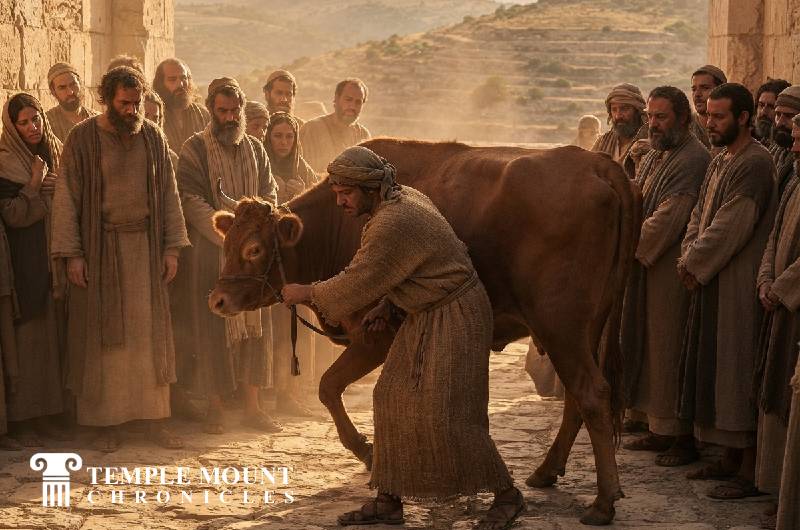
Artistic illustration of a Re Heifer.
The Torah's law of the red heifer begins with an animal that sounds almost impossibly specific. “This is the statute of the Torah”, says Numbers 19: a completely red female cow, parah adumah, without blemish and upon which no yoke had been placed. It was not brought to the altar like an ordinary sacrifice. Instead, the animal was taken outside the Israelite camp and slaughtered in the presence of the priest. Its blood was sprinkled toward the front of the Tent of Meeting, after which the entire animal was burned—hide, flesh, blood, and dung. Cedar wood, hyssop, and a piece of crimson material were thrown into the fire. The ashes were then gathered and preserved for a particular purpose: they would become part of the water used to purify a person who had contracted impurity through contact with the dead. The ritual is therefore not a sacrifice for forgiveness. It belongs to the Torah's system of tumah and taharah, ritual impurity and purification.
The source of that impurity was death itself. Numbers 19 states that anyone who touched a corpse, entered a tent containing one, or came into contact with a human bone or grave became tamei, ritually impure. The impurity was unusually serious because it prevented a person from entering the sanctuary. The remedy involved “living water”—mayim chayim—into which some of the ashes were placed, producing the mei niddah, the water of purification. On the third and seventh days, the person was sprinkled with it; only then could the purification process be completed. The Torah therefore creates an unusual chain: death produces impurity, the ashes of a burned animal are preserved, and those ashes are mixed with water to restore a person to ritual purity. The same chapter then makes the paradox explicit: the person who sprinkles the purification water becomes impure until evening, as does the one who handles the ashes. The ritual purifies the impure while transmitting a temporary impurity to those who prepare and administer it.
The Torah does not explain why the animal had to be red, why it had to be female, or why it could not have carried a yoke. Those requirements were simply part of the ḥukkah, the statute given to Israel. Later Jewish tradition was deeply interested in the question. The Mishnah records a famous teaching that Solomon, despite his wisdom, could not fully comprehend the law of the red heifer. Yet the basic ritual itself was not treated as a philosophical riddle. It was a command to be carried out according to its rules. The rabbis consequently paid close attention to details that might disqualify an animal: even a small amount of another-colored hair could matter, as could evidence that the animal had been worked or yoked. The concern was not merely that the heifer should look generally reddish. Its condition had to conform to the demanding definition preserved by the tradition.
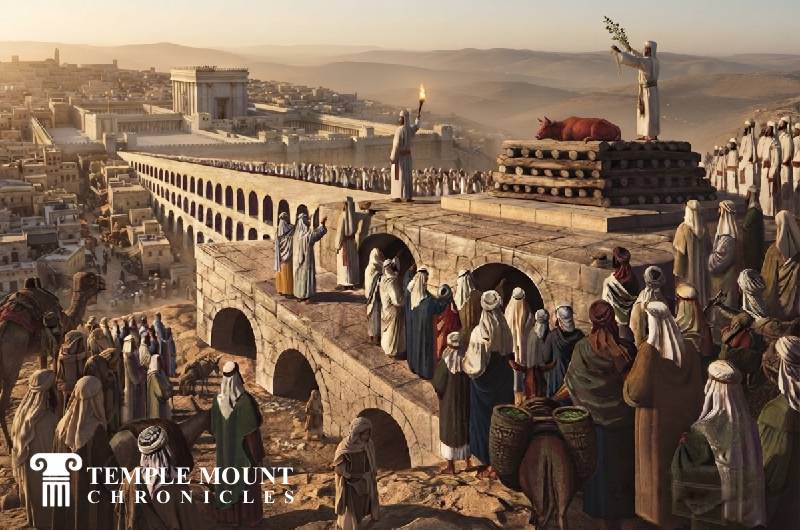
Illustration of the Red Heifer ceremony on the Mount of Olives.
By the Second Temple period, the preparation of the red heifer had acquired a distinctly Jerusalem setting. The Mishnah's tractate Parah describes the ceremony in detail and places the burning on the Mount of Olives, east of the Temple. A priest prepared the animal there while facing toward the Temple, and the ashes were subsequently brought back for use in purification. The arrangement created a striking relationship between the two hills: the Temple was the centre of Israel's sacred service, while the red heifer was prepared outside the Temple precinct but directly in relation to it. The Mishnah describes a specially constructed causeway connecting the Temple area with the Mount of Olives, intended to prevent the priests from becoming impure through contact with graves beneath the route. Whether every detail of the Mishnah's description reflects an unchanged Second Temple practice is a historical question, but the text preserves a clear memory of the red heifer as a Jerusalem ritual whose geography mattered.
The ashes were not used casually or discarded after the ceremony. According to the Mishnah, they were divided and preserved for future purification, and the preparation of a red heifer became an event of considerable ritual importance. Mishnah Parah also preserves the tradition that only a limited number of red heifers had been prepared throughout Israel's history. Rabbi Yose ben Halafta taught that nine had been prepared from the time of Moses until the destruction of the Second Temple, and that the tenth would be prepared by the king Messiah. That statement belongs to rabbinic tradition, not to the Torah itself, and it reflects the extraordinary importance the sages came to attach to the ritual. Once the Temple was destroyed, the practical system for which the ashes were required could no longer function. The red heifer consequently remained one of the most distinctive rituals of the Temple tradition: a purification rite performed outside the sanctuary, using the ashes of an animal burned in sight of the sacred centre, for the specific purpose of allowing those touched by death to return to the realm of ritual purity.