
Ophel Pithos Inscription
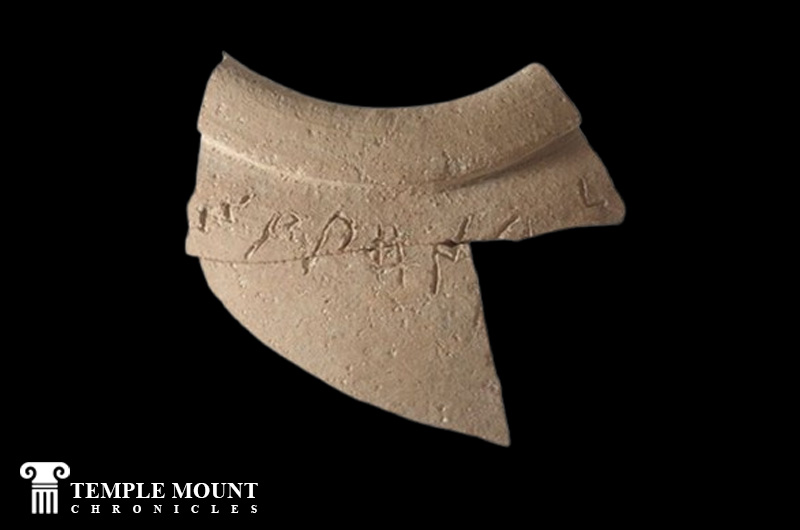
The Ophel Pithos inscription in proto-Canaanite script.
The Ophel Pithos Inscription consists of eight monumental, proto-Canaanite letters incised on the shoulder of a large, ceramic storage jar (pithos). Discovered in July 2012 during excavations directed by Eilat Mazar near the southern wall of the Temple Mount in Jerusalem, the artifact was retrieved from a tenth-century BCE locus associated with an ancient royal structure. It is widely classified as the oldest alphabetic inscription ever found in Jerusalem. The script reads from left to right, representing a linguistic precursor to the Old Hebrew alphabet. The vessel itself was manufactured from local clay and served as a bulk storage container, typical of Iron Age IIA Judean administrative complexes.
Epigraphic analysis of the broken inscription remains a subject of intense debate among Northwest Semitic paleographers. Scholar Christopher Rollston dates the script to the eleventh or tenth century BCE based on the stance and morphology of the letters, which include a mem, nun, leth (or hhet), resh, and shin. Early reconstructions by Shmuel Ahituv, Gershon Galil, and Douglas Petrovich proposed varying readings due to the fragmentary nature of the diagnostic characters. While Galil interpreted the text as a classification of cheap wine belonging to a specific regnal year, Ahituv and David Ben-Shlomo concluded that the surviving sequence does not yield an indisputable West Semitic word, suggesting instead a non-Semitic or Hurrian name.
Petrographic analysis conducted on the pithos fragments provides critical geographic and economic context for early Jerusalem. The mineral composition of the clay indicates that the vessel was manufactured in the immediate vicinity of the Jerusalem hills rather than imported from the lowlands or coastal plains. Because the inscribed pithos was found alongside fragments of six other identical jars within a fill beneath a structural floor, archaeologists deduce that these vessels were part of a centralized, state-regulated storage system. The presence of a formal inscription on locally produced administrative pottery strongly implies the existence of a functioning scribal apparatus and an organized royal bureaucracy in Jerusalem during the traditional timeline of the United Monarchy.
The historical implications of the Ophel Pithos Inscription bear directly on the contentious archaeological debate surrounding the scale of tenth-century BCE Jerusalem. Minimalist scholars have historically argued that Jerusalem was merely a small, agrarian village during the reigns of David and Solomon, lacking the literacy required for statehood. However, the discovery of a monumental inscription within a monumental administrative building contradicts this model, providing empirical evidence of literacy and complex civic organization. While the inscription does not definitively prove the biblical narrative of a vast empire, it confirms that Jerusalem functioned as a literate, centralized administrative hub capable of managing surplus commodities and employing professional scribes during the early Iron Age IIA.