Burning the Heifer on the Mount of Olives
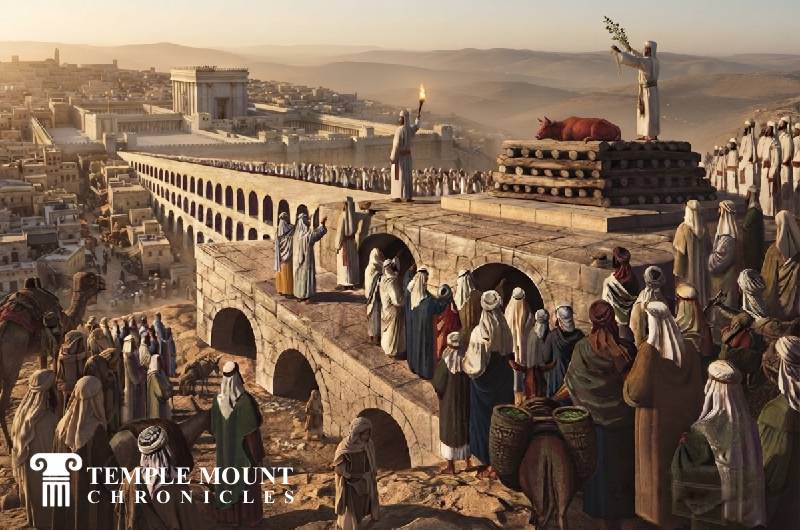
Illustration of the Red Heifer being burnt in a ceremony on the Mount of Olives, with the Second Temple in the background connected with the arched ramp.
The Torah does not name the Mount of Olives. In Numbers 19, the red heifer is to be brought “outside the camp”, where Eleazar the priest sees it slaughtered, takes some of its blood, and sprinkles it seven times toward the front of the Tent of Meeting (the Tabernacle). The animal is then burned together with cedar wood, hyssop, and crimson material, and its ashes are gathered for the preparation of the purification water.
The geographical setting becomes much more precise in the rabbinic sources. Mishnah Parah 3:6 states that a ramp was constructed from the Temple Mount to Har Ha-Mishḥah, the Mount of Olives, and that the priest who would burn the heifer, the heifer itself, and those assisting in its preparation went out by this route. The ceremony therefore took place outside the Temple precinct, but not somewhere disconnected from it: the Mount of Olives stood directly across from the Temple and formed the eastern setting for the ritual.
The Mishnah's description of the ramp is unusually elaborate. It says that it was made of arches upon arches, with each arch positioned over the space beneath it, because of the danger of a kever ha-tehom, a “grave of the depths”. The concern was ritual rather than architectural. An unnoticed grave could transmit corpse impurity to the priest or others involved in the preparation, potentially compromising the procedure. The Tosefta preserves the same concern but also records a different description of the structure. According to Rabbi Eliezer, there was no such ramp; instead, there were marble columns with cedar beams laid across them.
The disagreement is significant. Both traditions agree on the essential geography—the Temple Mount and the Mount of Olives were connected for the purposes of the red-heifer ritual—but they do not preserve an identical picture of the structure used to make that journey.
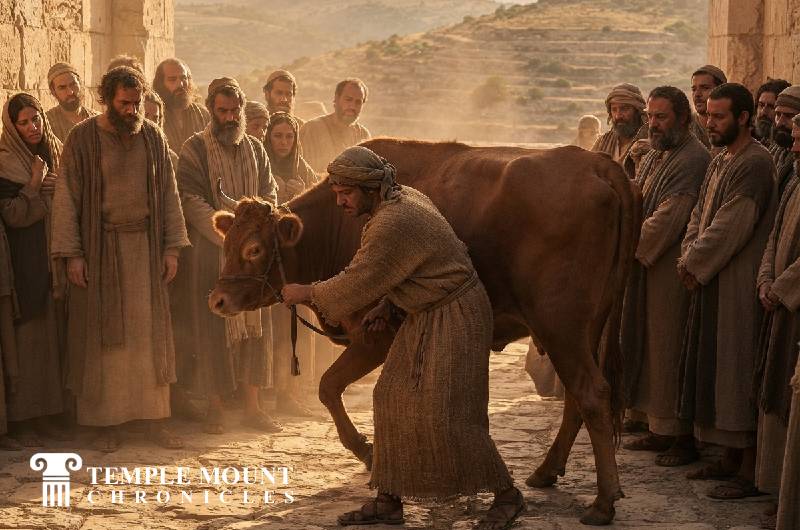
Illustration of the Red Heifer.
The Mount of Olives was not simply the place where the heifer happened to be burned. Mishnah Parah 3:7 describes the elders of Israel going ahead on foot to the mountain, where there was a beit tevilah, a place of immersion. The priest who would burn the heifer was deliberately rendered impure and then immersed. This was connected to a dispute with the Sadducees, who maintained that the priest had to remain in a state of complete ritual purity until sunset before carrying out the procedure. The Sages deliberately arranged matters differently, so that the ceremony would visibly follow their interpretation of the law. The Babylonian Talmud preserves this dispute in Ḥagigah 23a, explaining the reason for deliberately rendering the priest impure before his immersion. The ceremony on the mountain thus involved not only the heifer itself, but a carefully controlled process of priestly preparation.
Once the priest had immersed himself, the Mishnah gives us a remarkably precise picture of the burning site. Wood was arranged there in a tower-like structure, with openings made into it and its front facing west. The heifer was bound with a reed rope and placed upon the pyre with its head toward the south and its face toward the west. The priest stood in the east, facing west. He slaughtered the animal, received its blood, and sprinkled it seven times toward the Holy of Holies, dipping his finger anew for each sprinkling. Only after completing those sprinklings did he kindle the fire. The geography is therefore built directly into the ritual: the priest stood on the eastern side of Jerusalem, on the Mount of Olives, facing the Temple to the west, while directing the blood toward the innermost sanctuary.
This orientation gives the ceremony its peculiar character. The red heifer was not offered upon the Temple altar, and its burning did not take place inside the Temple courts. Yet the priest's actions remained visually and ritually directed toward the Temple. The Mishnah does not describe him merely facing Jerusalem in general; it specifies that the sprinkling was “toward the Holy of Holies”. The Mount of Olives consequently functioned as an extension of the Temple's ritual geography without being part of the Temple precinct itself. The distinction is important when reconstructing the ceremony. The Torah's requirement that the heifer be taken outside the camp is developed in rabbinic tradition into a procedure carried out at a particular location east of the Temple, from which the sanctuary remained the fixed point of orientation.
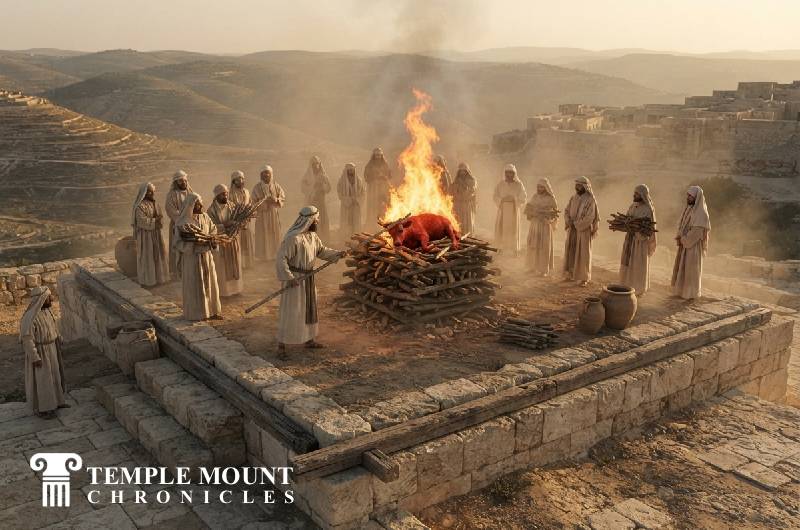
Priests performing the ritual burning of the Red Heifer on the Mount of Olives. The platform is over-interpreted.
After the burning, the remains were processed into ashes that would serve for purification. Mishnah Parah 3:11 states that the ashes were divided into three portions: one was deposited in the ḥel of the Temple, one on the Mount of Olives, and one was distributed among the priestly watches. The portion kept on the mountain was used by the priests in preparing themselves for the ritual.
The Mount of Olives therefore appears in the rabbinic sources twice: first as the place where the heifer itself was burned, and then as one of the places where its ashes were preserved. What we possess is a remarkably detailed rabbinic geography of a ritual whose biblical command begins only with the instruction to take the heifer “outside the camp”. The precise physical site of the ancient burning has not been securely identified archaeologically, but the Jewish textual tradition is unequivocal about the setting it assigns to the ceremony: east of the Temple, on the Mount of Olives, with the priest and the heifer facing toward the Holy of Holies.