Menorah: Form and Function
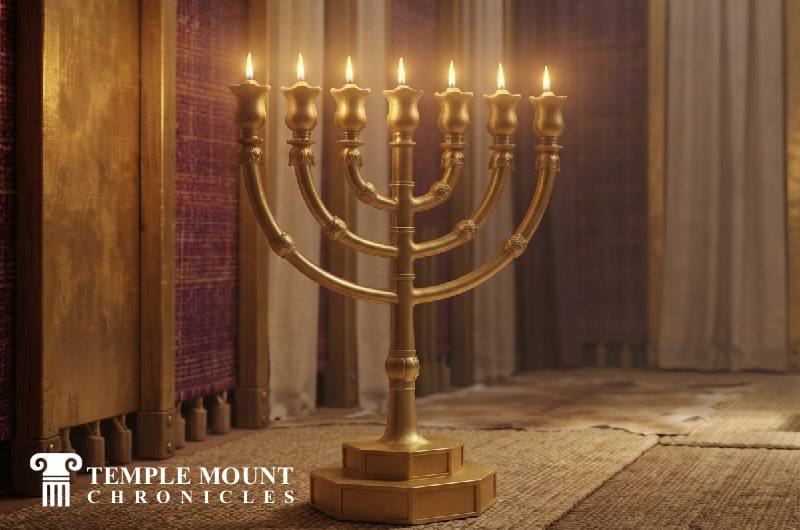
Artistic Illustration of the Jewish Menorah (Mosaic Period).
The menorah was not merely a symbolic seven-branched emblem but a precisely described vessel of the Israelite sanctuary. In Exodus 25:31–40, Moses is commanded to make it from zahav tahor, pure gold, as a single piece of hammered work (miqshah). Its central shaft had six branches extending from it, three on each side, producing seven lamps in all. The Torah specifies an elaborate vegetal ornamentation: cups (gevi'im) shaped like almond blossoms, kaftorim (knobs or bulbous forms), and perahim (flowers). Each of the six branches was to have three almond-shaped cups, while the central shaft had four; three knobs were positioned beneath the pairs of branches. The branches and their ornamentation were not separate pieces assembled into a frame but were to be worked as one with the menorah.
The seven lamps themselves were distinct from the lampstand, and their purpose was practical as well as sacred: they were positioned so that they cast their light toward the area in front of the menorah. The associated implements—tongs and trays or firepans—were likewise to be of pure gold. Exodus gives a weight of one talent of gold for the menorah together with these utensils and, significantly, ends the description by requiring that it be made according to the pattern shown to Moses on the mountain (Exodus 25:31–40).
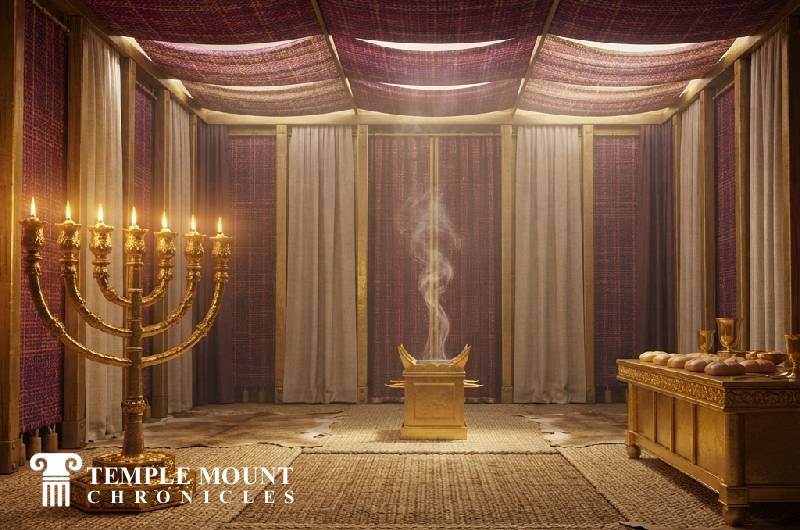
Interior of the Kodesh of the Mosaic Tabernacle, with the the Menorah, Table of the Showbread and the altar of the incense. View towards the Kodesh HaKodashim Holy of Holies.
The Torah's description, however, does not give every measurement needed to reconstruct the menorah as a three-dimensional object. That additional precision appears in the rabbinic tradition, particularly in Babylonian Talmud, Menahot 28b–29a, where the sages discuss the menorah's dimensions and ornamental elements. A tradition transmitted in the name of Shmuel states that the menorah was eighteen handbreadths high.
The Talmud proceeds through the shaft in measured sections, describing its base and lower flower, unornamented portions, and successive arrangements of cups, knobs, and flowers. It also records analogies for the forms of these ornaments: the gevi'im resembled Alexandrian drinking cups, the kaftorim resembled a particular kind of apple, and the perahim resembled the flowers of columns (Menahot 28b). The same discussion counts twenty-two cups, eleven knobs, and nine flowers on the menorah. These figures belong to the rabbinic description and should not simply be read back into the text of Exodus as though the Torah itself supplied them. They represent an important later attempt to define the physical object in precise terms after the Temple was no longer standing. The Mishnah and Talmud therefore preserve not an archaeological measurement of a surviving menorah, but a rabbinic conception of the menorah's form, dimensions, and workmanship.
Its function was equally exacting. The menorah belonged inside the Sanctuary and required continuous priestly maintenance rather than being a lamp simply lit and left unattended. Mishnah Tamid 3:9 describes a priest entering the Sanctuary to tend the lamps, removing ashes and burned wicks, replacing them with fresh oil and wicks, and dealing separately with the two eastern lamps and the remaining five. The Mishnah also mentions a stone with three steps in front of the menorah on which the priest stood while preparing the lamps, a practical detail that accords with the rabbinic tradition that the menorah stood eighteen handbreadths high.
Mishnah Menahot 9:3 preserves the rabbinic measure of half a log of oil for each lamp, enough to burn through the night; the Babylonian Talmud and later halakhic tradition develop the regulations governing the oil, wicks, cleaning, and relighting of the lamps. Thus the menorah's function was not simply to provide illumination. It was a consecrated Temple vessel whose lamps were prepared, kindled, cleaned, and maintained as part of the ordered service of the Sanctuary. Its form and its function were inseparable: the seven lamps, the gold construction, the specialized ornaments, the oil, wicks, utensils, and priestly maintenance together constituted a single ritual object whose physical details were themselves part of the sacred service.