How a Threshing Floor Became the Site of the Temple
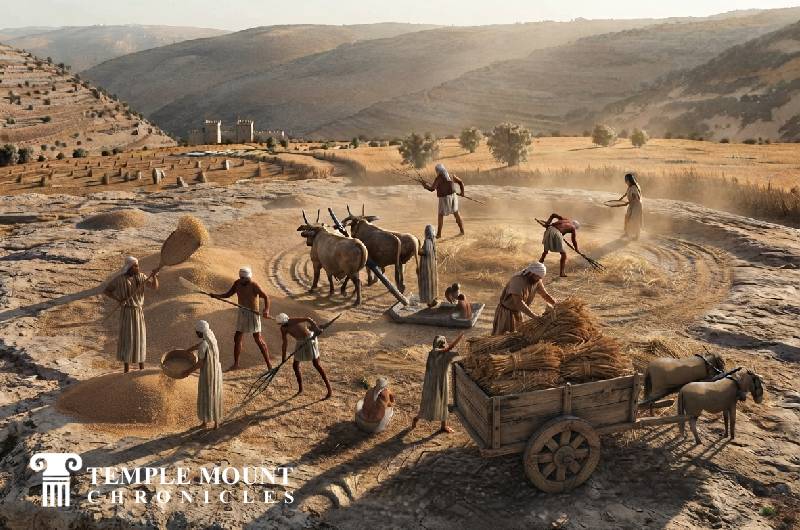
Artistic illustration of the threshing floor of Araunah the Jebusite.
David did not build the Temple, but after purchasing Ornan’s threshing floor he identified the place for the sanctuary that his son would build. “This is the house of the LORD God”, David declared, “and this is the altar of burnt offering for Israel” (1 Chronicles 22:1). The statement follows immediately after the account of the altar and the fire from heaven, and it marks a change in the biblical narrative: the place where David had offered sacrifice was now designated for the future beit ha-Elohim—the house of God.
David then began preparing the materials for its construction. He gathered stone, cedar, iron, bronze, silver and gold, and explained to Solomon that the house was to be built for the name of the LORD. Yet David himself would not undertake the building, telling Solomon, “a son shall be born to thee, who shall be a man of rest”, and that this son would build the house (1 Chronicles 22:2–10).
David's preparations went beyond collecting materials. He assembled the leaders of Israel and charged Solomon with building the sanctuary, instructing him to keep the commandments of the LORD and reminding him that “the LORD hath chosen thee to build an house for the sanctuary” (1 Chronicles 28:10). David then gave Solomon the plans for the Temple and its courts, chambers, treasuries, and vessels, together with instructions concerning the priestly and Levitical service (1 Chronicles 28:11–19).
The work therefore passed from David's preparation to Solomon's construction. The biblical account preserves the distinction between the two kings: David selected and prepared the place and accumulated the resources, while Solomon carried out the building itself.
The geographical identification is made most explicitly in 2 Chronicles 3:1: “Then Solomon began to build the house of the LORD at Jerusalem in mount Moriah, where the LORD appeared unto David his father, at the place that David had prepared in the threshingfloor of Ornan the Jebusite”. The verse links three designations within a single location—Mount Moriah, the place where the LORD had appeared to David, and Ornan’s threshing floor.
Solomon's construction followed David's preparation, and the biblical account dates the beginning of the work to the second month of Solomon's fourth year (1 Kings 6:1). The house measured sixty cubits in length, twenty in width and thirty in height, with the inner sanctuary—the Most Holy Place—twenty cubits in each dimension (1 Kings 6:2, 20). When the Temple was completed and the Ark of the Covenant was brought into the inner sanctuary, “the glory of the LORD had filled the house of the LORD” (1 Kings 8:10–11). The threshing floor that David had prepared had become the site on which Solomon established the Temple of Jerusalem.