
Mizbe'ach HaOlah: The Mosaic Altar
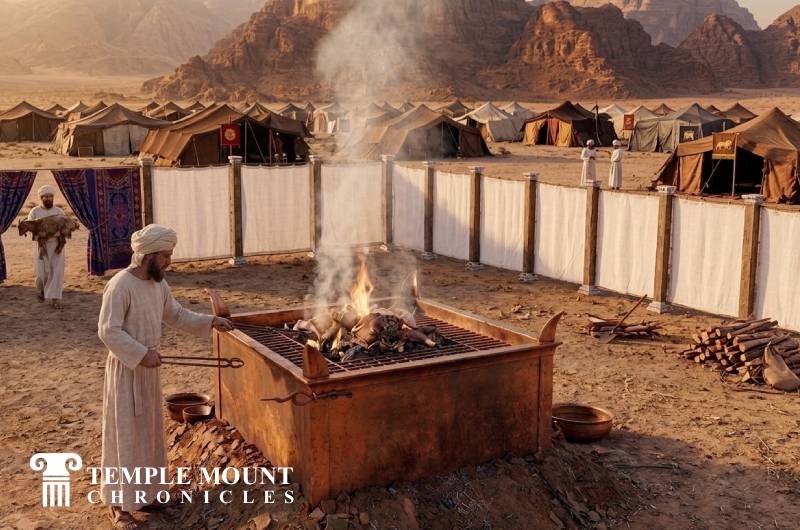
Priests performing the ritual burning of the sacrifices (illustration).
The Mizbe'ach HaOlah—the Altar of Burnt Offering—was the principal altar of the Mishkan, the portable sanctuary described in the Torah. Unlike the furnishings within the Tent itself, it stood in the open chatzer, the courtyard, where the sacrificial service could be performed. Its dimensions were fixed at five cubits by five cubits, with a height of three cubits (Exodus 27:1; 38:1). The Torah does not describe a massive stone monument, but a wooden structure of acacia wood, overlaid with nechoshet, copper or bronze. It was to be “hollow, of boards”, a detail that matters when reconstructing its appearance: the altar was a constructed framework, not simply a solid block of metal or stone.
Four keranot, or horns, rose from its four corners, formed as part of the altar itself and likewise covered with copper (Exodus 27:2). Around its structure was a mikbar, a copper grating of meshwork, with four copper rings attached to its corners. Acacia-wood poles covered in copper passed through these rings, allowing the altar to be carried when the Mishkan was dismantled and moved. The Torah then names its working equipment: pots for removing ashes, shovels or scrapers, basins, flesh hooks and fire pans, all made of copper (Exodus 27:3–7). These unusually practical details show that the Mizbe'ach was designed not merely as a symbolic object but as a working installation for repeated, carefully regulated service.
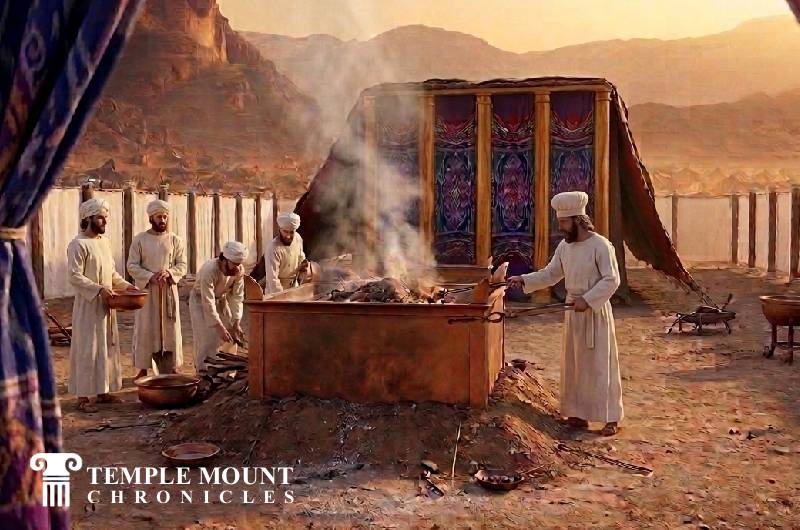
Mosaic altar in the Chatzer (courtyard of the Mosaic period Tabernacle in Sinai).
Its position was equally deliberate. The courtyard measured 100 cubits in length and 50 in width, enclosed by linen hangings, with its entrance on the eastern side (Exodus 27:9–18). The Mizbe'ach stood within this enclosure before the Tent of Meeting, making it the most prominent sacred object encountered before approaching the sanctuary itself. Upon it were placed the offerings prescribed by the Torah, including the olah, the burnt offering described in Leviticus 1. In this offering the animal was slaughtered, its blood was applied to the altar, and its flesh was arranged upon the fire. The altar therefore brought together several elements of the avodah, the sacred service: fire, blood, flesh, wood, ashes and the priestly handling of each according to prescribed rules.
Fire was not incidental to the altar's purpose. Leviticus commands that a fire be kept burning upon it continually: “A fire shall be kept burning upon the altar; it shall not go out” (Leviticus 6:6). The kohanim, the priests descended from Aaron, tended the altar and carried out the sacrificial rites. Yet the Torah's account does not provide every practical detail needed to reconstruct precisely how the altar appeared in use. The biblical text identifies its structure and implements with considerable care, while later Jewish sources preserve additional traditions concerning sacrificial procedure. This distinction matters for an illustration: the altar's five-by-five-cubit dimensions, copper covering, horns, grate and carrying poles are directly grounded in Exodus, while the precise appearance of the fire, arrangement of priests and handling of individual implements necessarily involve reconstruction.
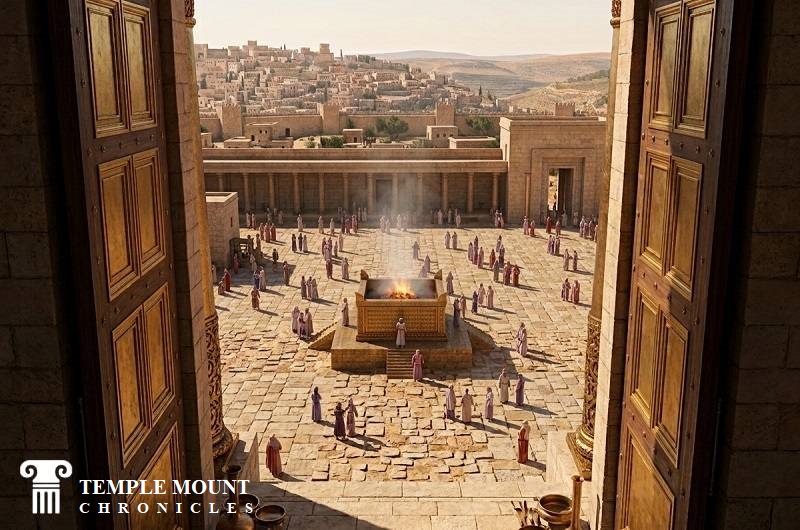
Altar in the Solomonic Temple, Iron Age Jerusalem.
The Mosaic altar should also be distinguished from the altars of the later Jerusalem Temples. The function continued; the physical structure did not remain the same. The Second Temple altar described in Mishnah Middot 3 was a much larger stone structure, with a foundation, ledges, horns and a designated area for the altar fire; the Mishnah's measurements bear little resemblance to the portable five-by-five-cubit construction of the Mishkan. The Mizbe'ach HaOlah of the Mosaic sanctuary was therefore the first altar in this particular sanctuary tradition, designed to travel with Israel through the wilderness. Its later counterparts would stand permanently in Jerusalem, but the essential architectural idea remained recognizable: a designated altar occupying the central sacrificial zone between Israel's approach and the sanctuary itself.