Tabernacle: The Temple Before the Temple
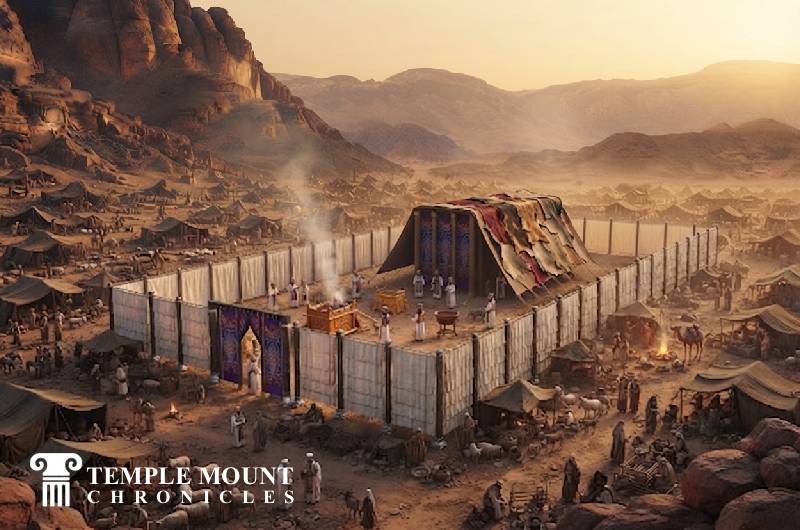
Very first Tabernacle, setup by Moses in the wilderness at the foot of the Mount Sinai.
The Jewish Temple begins not in Jerusalem but at Sinai. After the covenant had been established and the people of Israel had received the commandments, the biblical text records a command that would shape Israelite worship for centuries: “And let them make Me a sanctuary that I may dwell among them” (Exodus 25:8). The following verse is equally important: Moses was instructed to construct the sanctuary according to a divinely shown pattern—“Exactly as I show you—the pattern of the Tabernacle and the pattern of all its furnishings, so shall you make it” (Exodus 25:9). The sanctuary was therefore not conceived merely as a shelter for religious objects. It was a portable sacred complex organized around the presence of God, with the Ark, the Tent of Meeting, the altar, the laver, the priesthood, and a defined system of approach.
The architecture itself established a hierarchy of holiness. Exodus 27 describes a rectangular courtyard surrounding the sanctuary, while Exodus 40 records Moses placing the laver between the Tent of Meeting and the altar, erecting the enclosure, and setting up its eastern entrance. When the work was completed, the biblical narrative reaches its decisive moment: “the cloud covered the Tent of Meeting, and the Presence of Lord filled the Tabernacle” (Exodus 40:34). The cloud was not simply an atmospheric detail. It marked the Tabernacle as the visible center of Israel's encampment and, according to the narrative, determined when the nation remained in place and when it traveled. “When the cloud lifted from the Tabernacle, the Israelites would set out” (Exodus 40:36).
This is where the description in the accompanying illustration matters. A historically informed reconstruction should not depict the Tabernacle as an isolated tent surrounded by a few wandering families. Numbers 2 presents Israel encamped by tribal divisions around the sanctuary, while Numbers 3–4 assigns the Levite clans specific responsibilities for the sanctuary and its equipment. The sacred precinct was therefore embedded within an organized camp. At its center stood the sanctuary; immediately around it were those charged with its service; beyond them were the tribes of Israel. The arrangement expresses something fundamental about the biblical conception of the sanctuary: God's dwelling was placed in the midst of the people, precisely as Exodus 25:8 states. The image is consequently best understood not as a portrait of an archaeological site, for no contemporary visual record survives, but as an artistic reconstruction based upon the dimensions, materials, furnishings, priestly functions, and camp organization described in the biblical texts.
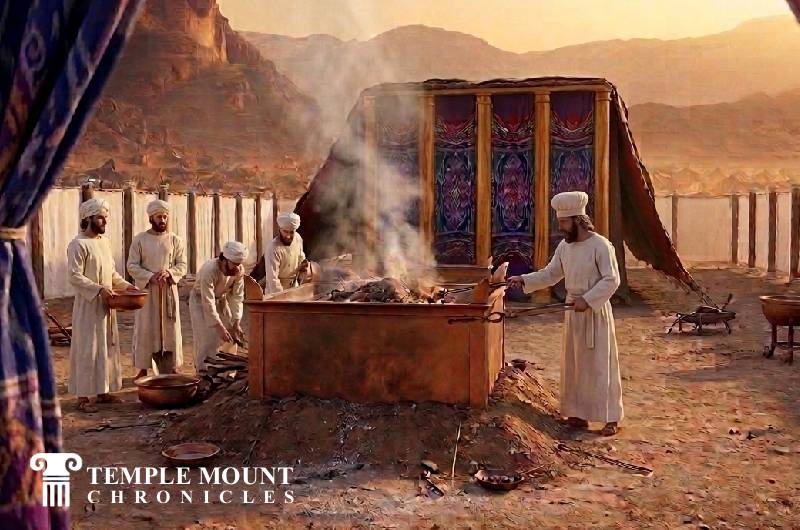
Burning the Sacrifice; Mosaic Tabernacle at Mount Sinai.
The Tabernacle was portable by design, but its function anticipated something more permanent. After Israel entered Canaan, the Tent of Meeting was established at Shiloh, where Joshua 18:1 states that “the whole community of the Israelite people assembled at Shiloh, and set up the Tent of Meeting there”. The sanctuary therefore moved from the wilderness camp into the settled land without immediately becoming a permanent stone temple. Shiloh became an important sanctuary in the biblical narrative, appearing again in the stories surrounding Eli, Samuel, and the annual pilgrimage of Elkanah (1 Samuel 1:3). The later rabbinic tradition preserved the distinction between the sanctity of Shiloh and that of Jerusalem: Mishnah Megillah 1:11 describes Shiloh as a sanctuary whose sacred status differed from the enduring sanctity attributed to Jerusalem.
The decisive transition came under David and Solomon. The biblical account does not say that the wilderness Tabernacle itself was originally intended to stand on the Temple Mount. Rather, the connection developed through the sanctuary, its worship, its priesthood, and especially its sacred furnishings, which were eventually incorporated into Solomon's Temple. First Kings dates the beginning of Solomon's construction to the fourth year of his reign and the 480th year after the Exodus according to the Masoretic textual tradition (1 Kings 6:1). When the Temple was dedicated, “the priests brought the Ark of the Covenant to its place” (1 Kings 8:6), and the account explicitly refers to the earlier tent and its sacred vessels. Josephus, writing in the first century CE, makes the continuity especially explicit: in Antiquities of the Jews 8.4.1, he describes Solomon transferring “the ark, and the tabernacle which Moses had pitched, and all the vessels” into the new Temple. Josephus further says that the lampstand, table, and golden altar were placed before the inner sanctuary in the same positions they had occupied in the Tabernacle.
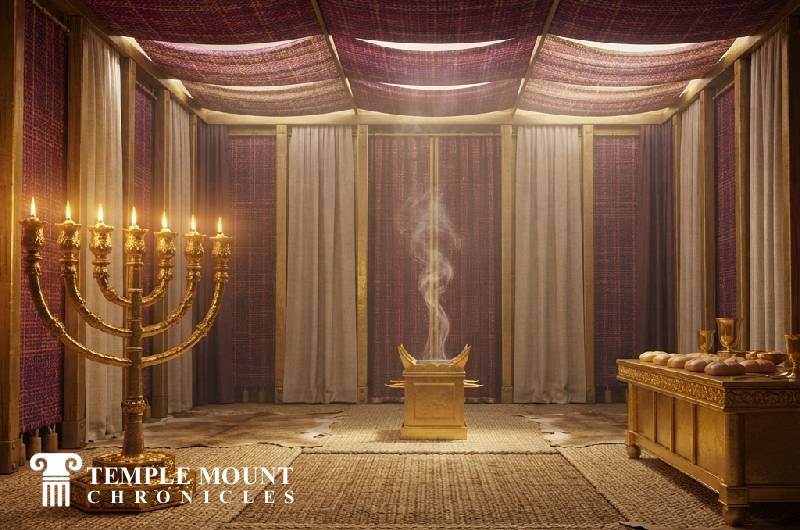
Interior of the Kodesh (קֹדֶשׁ), the Mosaic Tabernacle, with the Jewish Menorah, Table of the Shewbread and the altar of the incense. View towards the Kodesh HaKodashim (קֹדֶשׁ הַקֳּדָשִׁים).
The Temple itself, however, introduced a crucial geographical transformation. The portable sanctuary had accompanied Israel through the wilderness and had subsequently been established at places such as Shiloh; Solomon's Temple was built in Jerusalem, on Mount Moriah. Second Chronicles 3:1 identifies the site directly: “Then Solomon began to build the house of the LORD at Jerusalem in Mount Moriah”, locating the Temple on the threshing floor of Ornan the Jebusite, the place associated with David's altar and sacrifice in 1 Chronicles 21. The connection between Moriah and Jerusalem also reaches back into the biblical story of Abraham and Isaac in Genesis 22, although identifying the mountain of Genesis 22 specifically with the later Temple Mount is an interpretive tradition rather than something Genesis itself explicitly states. Later Jewish interpretation made that identification explicit; Rashi, for example, connects “the land of Moriah” in Genesis 22:2 with Jerusalem and cites 2 Chronicles 3:1.
The significance of the Temple Mount, therefore, lies not in the claim that the Tabernacle once stood there—it did not, on the biblical evidence—but in the transformation of the Tabernacle's sanctuary into a permanent Jerusalem institution. Solomon's building retained the essential sacred geography of the earlier sanctuary: an outer area of approach, an altar for sacrifice, a sanctuary divided into sacred zones, a veil, and an innermost chamber associated with the Ark and the divine presence. The scale and materials changed dramatically, but the conceptual structure remained recognizable. First Kings 8 makes the continuity particularly striking: after the Ark had been installed, the Temple was filled with the cloud, recalling the moment when the cloud had filled the wilderness Tabernacle. Solomon then acknowledged the theological limitation of the building itself: “But will God really dwell on earth? Even the heavens to their uttermost reaches cannot contain You, how much less this House that I have built!” (1 Kings 8:27).
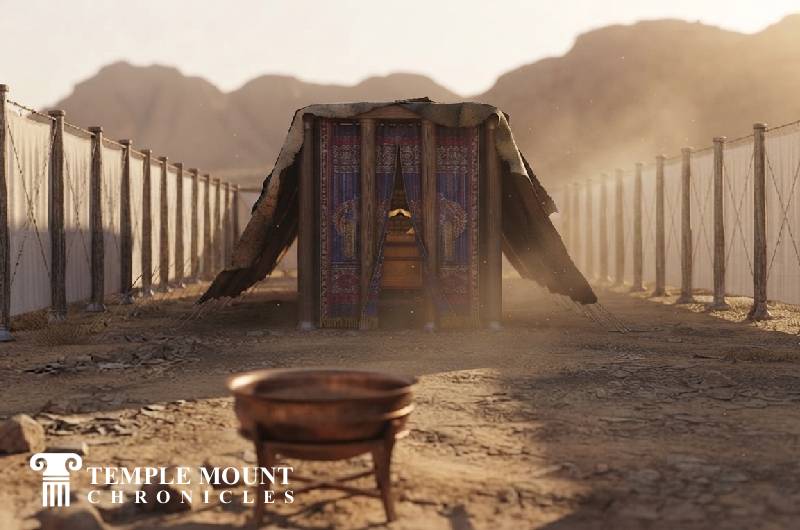
Entrance to the Tabernacle (see notes).
The later history of the Temple Mount thus cannot be separated entirely from the earlier sanctuary in the wilderness. The Tabernacle supplied the biblical model of a defined place of approach, sacrifice, priestly service, sacred furnishings, and divine presence; Jerusalem transformed that portable model into a permanent national sanctuary. By the time Jewish sources describe the Temple Mount in detail, the architectural vocabulary had become far more elaborate. The Mishnah's Middot describes the Temple Mount as a vast square measuring 500 cubits by 500 cubits and records its gates, courts, chambers, and arrangements (Middot 1:1–3). That description belongs to the later Temple complex, not to Moses' Tabernacle, but it preserves the culmination of a sanctuary tradition whose biblical starting point was a portable dwelling in the wilderness. The movement from Sinai to Shiloh and finally to Jerusalem was therefore not simply a change from tent to stone: it was the gradual localization and monumentalization of the sanctuary whose first command was, “that I may dwell among them”.
Notes
The biblical text describes five pillars supporting the entrance curtain (Exodus 26:36–37). This illustration uses four visible pillars for artistic/compositional reasons and should not be understood as a precise architectural reconstruction.