Shofar: Trumpeting on the Temple Mount
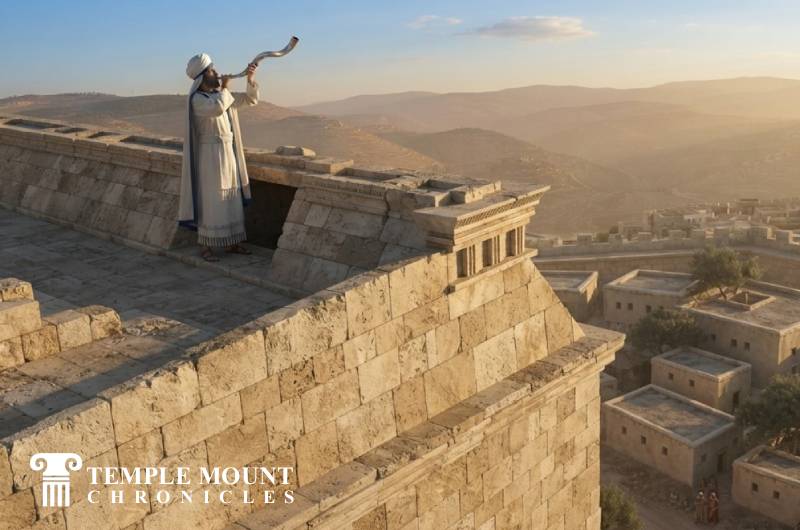
A priest (kohen) blows the shofar for the Temple's Rosh Hashanah service.
Before the destruction of the Herodian Temple, the shofar had a place in Jerusalem that is difficult to recover from the quiet of the archaeological record. Its voice belonged to a world in which sacred time was announced not only by calendars and sacrifices but by sound. On Rosh Hashanah, according to the Mishnah, the shofar was sounded in the Temple together with two silver ḥaẓoẓerot (trumpets), one on either side of the shofar player. The arrangement was deliberate: “the shofar would sound a long blast, whereas the trumpets would sound a short blast, because the mitzvah of the day is with the shofar” (Mishnah Rosh Hashanah 3:3).
The instrument itself was described in terms that would have distinguished it sharply from the shofar familiar to most Jews today. The Mishnah says that the Temple shofar of Rosh Hashanah was made from the horn of a ya'el, generally understood as an ibex or wild goat, and that it was pashut—straight. Its mouth was overlaid with gold. Beside it stood the two trumpets. This is not a generic description of how Jews blow a shofar today; it is a specific description of the Temple practice preserved by the early rabbinic tradition. Indeed, the very next section describes a different arrangement for public fast days: there the shofarot were curved and the trumpets stood between them, because on those days the ritual precedence belonged to the trumpets rather than the shofar.
That distinction is important because the Torah itself does not describe the Rosh Hashanah service in the form preserved by the Mishnah. The Torah commands the making of two silver ḥaẓoẓerot and gives them to the priests for summoning the congregation and for sounding over sacrifices and on appointed days (Numbers 10:1–10). The shofar has a much older and broader biblical history: it appears at Sinai, at Jericho, in royal and military contexts, and in the proclamation of the Jubilee. By the Second Temple period (circa 516 BCE-70 CE), these different forms of sacred sound had acquired distinct ritual functions. The Temple was therefore not a place where one simply “blew horns”; it was a carefully ordered world of priestly trumpets, shofar blasts, Levite music, sacrifice, procession, and proclamation.
The biblical tradition already associates trumpet sound with the sacrificial service. At the dedication of Solomon's Temple, the priests sounded trumpets while the Levites performed with cymbals and other instruments (2 Chronicles 5:12–13). In the account of Hezekiah's restoration of the Temple, the priests sounded trumpets while the Levites sang and the sacrifices were offered. Josephus, recounting the episode centuries later, likewise describes the priests “sounded the trumpets” while the Levites performed their music during the sacrifices.
The Mishnah gives us a much more intimate glimpse of what that soundscape may have been like. During the Sukkot celebration known as the Beit HaShoevah, the Levites stood on the fifteen steps descending from the Court of the Israelites to the Women's Court with lyres, harps, cymbals, trumpets, and other instruments. Two priests stood at the upper gate holding trumpets. Their tekiah–teruah–tekiah blasts marked stages of the water-drawing procession, from the approach to the tenth step through the Women's Court and onward toward the eastern gate. At that gate, the participants turned around to face west, toward the Temple, deliberately contrasting themselves with the people condemned in Ezekiel's vision for turning their backs on the Sanctuary and facing the rising sun. Here the sound of the trumpet was inseparable from the architecture of the Mount: gates, stairs, courts, and direction gave the blasts their ritual meaning.
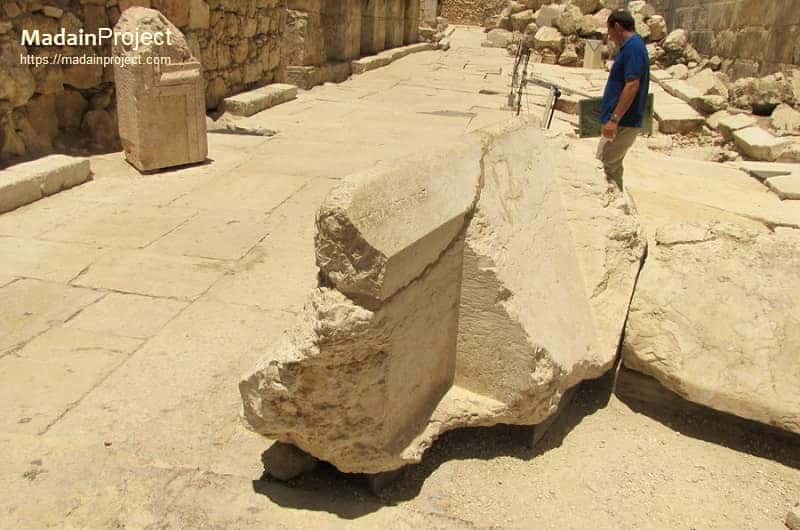
The "to the place of trumpting..." inscription. Courtesy of the Madain Project .
The Temple's trumpets also regulated ordinary time. Mishnah Sukkah 5:5 records no fewer than twenty-one trumpet blasts each day: three for opening the gates, nine accompanying the morning Tamid offering, and nine accompanying the afternoon offering. On days with additional offerings there were additional blasts, while the eve of Shabbat brought further signals to mark the cessation of labor and the transition from the weekday into sacred time. During Sukkot, the number could rise as high as forty-eight. This is perhaps the most revealing evidence for the Temple's soundscape: the trumpets did not merely create music. They organized the day.
But on Rosh Hashanah the shofar occupied a different place. The Mishnah's description is unusually precise because the ritual required the shofar to remain unmistakably primary. Its blast was extended; the accompanying trumpet blasts were shortened. The physical arrangement—shofar in the center, two trumpets at its sides—made the hierarchy audible as well as visible. The Talmud later discusses this Temple practice in Rosh Hashanah 27a, and medieval halakhic tradition retained the distinction between the shofar and the ḥaẓoẓerot. What survives here is therefore not merely a memory of “music in the Temple”, but a halakhic memory of which sound belonged to which commandment.
There was one further privilege of the Temple. Mishnah Rosh Hashanah 4:1 records that when Rosh Hashanah fell on Shabbat, the shofar was nevertheless sounded in the Temple, while it was not sounded outside the Temple it self. The later rabbinic discussion explains the exceptional status of the Temple and its immediate sphere. the destruction of the Mikdash changed not only the physical location of Jewish worship but its acoustics: the shofar remained, the commandment remained, and its voice continued to summon Jews on Rosh Hashanah—but the ancient setting in which that voice had stood between priests, trumpets, sacrifices, courts, and the Sanctuary was gone. The surviving Mishnah preserves one of the rare detailed descriptions from which that lost sound can still be reconstructed.