Second Temple Spoils in Rome
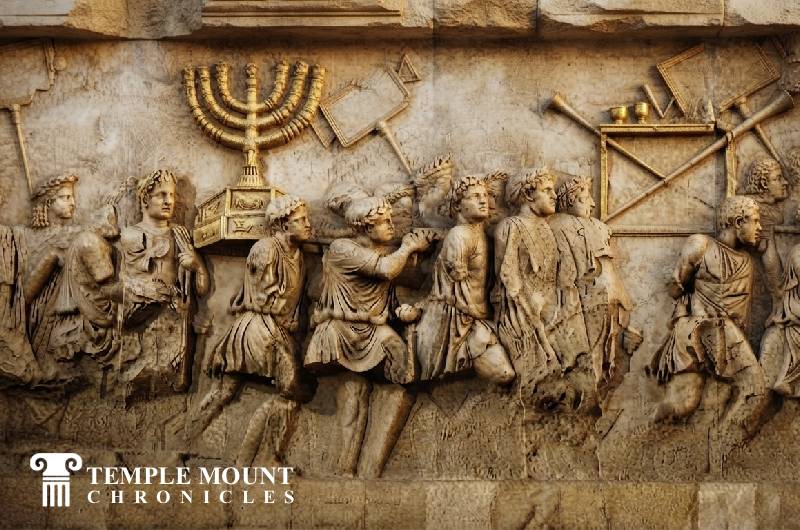
Illustration of the "Temple loot" plaque from the Arch of Titus in Rome.
When the Second Temple fell in Jerusalem in 70 CE, its sacred furnishings became Roman spoils. Among the objects seized were the seven-branched menorah, the golden Table of the Showbread, sacred vessels, trumpets, curtains, priestly garments and other equipment used in the Temple service. The Jewish historian Flavius Josephus gives the fullest ancient account. During the final stages of the siege, the priest Jesus son of Thebuthi surrendered golden lampstands, tables, bowls and vessels to Titus, while the Temple treasurer Phineas revealed further priestly garments and materials. Josephus's inventory shows that the Roman haul was considerably larger than the few objects later preserved in Roman art. The most prominent treasures, however, were the golden table and the seven-branched menorah, which Josephus says “made the greatest figure” in the triumph of Vespasian and Titus in Rome in 71 CE, followed by a copy of the Jewish Law.
The golden table is generally identified with the Table of the Showbread described in Exodus 25:23–30 and Leviticus 24:5–9, while the menorah was the seven-branched lampstand prescribed in Exodus 25:31–40. These were not simply valuable pieces of gold but objects with defined roles in the Temple's daily and weekly worship. In Jerusalem they belonged to the sacred furnishings of the sanctuary; in Rome they became trophies of conquest. The Roman triumph deliberately transformed their meaning. Josephus describes the menorah and table being carried before the Roman public as visible proof of Jerusalem's defeat. The Arch of Titus, erected after Titus's death in 81 CE, preserves the most famous visual representation of this procession, showing Roman soldiers carrying the menorah, the Temple table and other objects. The relief was made after the triumph itself, but it confirms the prominence these particular Temple furnishings had in Roman representations of the victory.
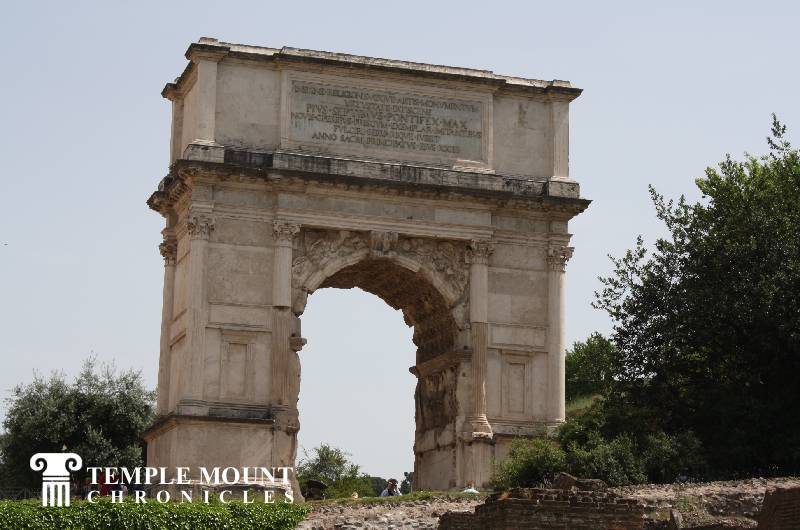
Western view of the Arcus Tītī (Arch of Titus) in the Roman Forum of Rome.
After the triumph, the principal golden vessels were deposited in Rome's Temple of Peace, completed around 75 CE by the emperor Vespasian. Josephus says that the golden vessels and instruments taken from the Jewish Temple were placed there as “ensigns of his glory,” among the works of art and treasures assembled for the imperial complex. Not everything was kept in the same place. Josephus specifically says that the Jewish Law and the purple curtains of the sanctuary were stored in the imperial palace. The objects therefore entered different parts of the Roman imperial collection. Jewish tradition also remembered Temple property surviving in Rome: in Yoma 57a, the Babylonian Talmud preserves Rabbi Elazar ben Yosei's statement, “I saw it in Rome,” referring to the Temple curtain. The passage is not an inventory and cannot establish the continued presence of every Temple vessel, but it shows that the memory of identifiable Temple objects in Rome remained alive in Jewish tradition.
The later history of the spoils becomes increasingly uncertain, although one important ancient account describes a possible chain of movement. In 455 CE, the Vandal king Gaiseric sacked Rome and carried away imperial treasures to Carthage. After the Byzantine general Belisarius defeated the Vandals, the treasures were brought to Constantinople and displayed in his triumph of 534 CE. The sixth-century historian Procopius specifically identified among them “the treasures of the Jews” that Titus had carried away from Jerusalem. Procopius then relates that a Jewish observer warned that the treasures should not remain in the imperial capital because they belonged in the place where Solomon had originally deposited them. According to his account, Emperor Justinian I ordered them sent to Christian sanctuaries in Jerusalem. Procopius does not provide enough detail to establish which individual objects were involved, and there is no archaeological evidence demonstrating that the menorah or Table of the Showbread actually reached Jerusalem.
Beyond Procopius, the fate of the Second Temple spoils disappears into tradition and speculation. Later stories have placed the menorah in Rome, hidden it beneath churches, sent it into the sea, or returned it to Jerusalem, but none provides a continuous documentary or archaeological trail. What can be established is more limited: the Temple furnishings were seized in 70 CE, displayed in the Roman triumph of 71 CE, and placed in Roman imperial spaces, with Josephus specifically locating the golden vessels in the Temple of Peace. Centuries later, Procopius still identified a group of Jewish treasures moving from Rome to the Vandals and then to Constantinople. After Justinian's reported decision to send them east, the historical record falls silent. The objects that had once served the sanctuary in Jerusalem had become Roman spoils, carried into the imperial capital and preserved for generations as trophies of the destruction of the Temple.