Soreg: The Fence That bordered the Temple
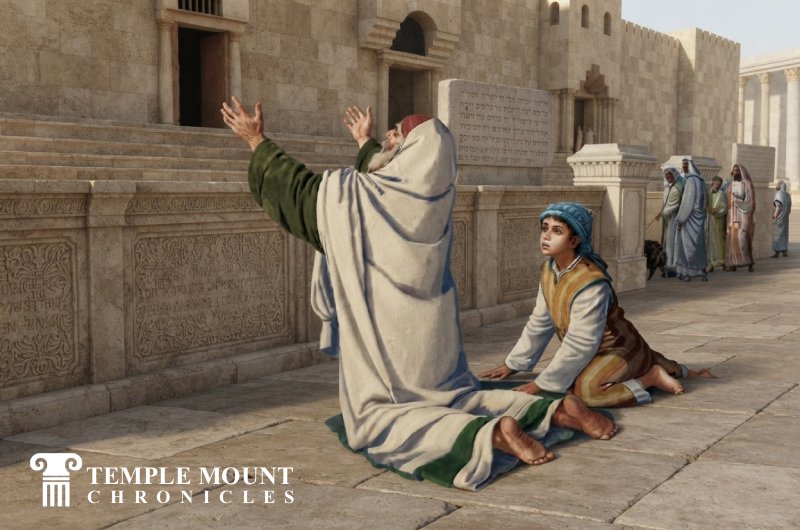
Among the many boundaries that structured the Jerusalem Temple, few were as visually modest yet historically significant as the soreg. The word soreg (סורג) refers to a latticed barrier that stood within the outer enclosure of the Temple Mount, marking the point beyond which certain people could not proceed. It was not the wall of the Temple itself, nor was it the great retaining walls surrounding Herod's expanded platform. It was an inner boundary, separating the more accessible outer area from the increasingly sacred precincts of the Mikdash. The Mishnah describes it as ten tefachim—handbreadths—high, and places the cheil, the ten-amah area immediately inside it, farther toward the sanctuary.
The importance of the soreg lay not in its height but in what it represented. The Temple was organized according to degrees of holiness, with access becoming increasingly restricted as one approached the sanctuary. Mishnah Kelim 1:8 specifically states that the cheil possessed a higher degree of sanctity because Gentiles and people affected by corpse impurity could not enter it. The soreg therefore formed part of a carefully controlled transition into the sacred interior. The Mishnah also preserves a memory of thirteen breaches in the barrier, which it attributes to the Greek kings; when these breaches were repaired, thirteen prostrations were instituted corresponding to them.
Josephus gives us a remarkably valuable first-century CE description of this boundary. Writing about the Temple shortly before its destruction, he describes a stone partition running around the inner Temple area, approximately three cubits high, with pillars set at intervals. On these were placed inscriptions warning foreigners not to enter farther into the sanctuary. The notices were written in Greek and Latin so that visitors who did not speak the languages of the Jewish population could understand the prohibition. Josephus's account is particularly important because it comes from the Second Temple period itself and confirms that the boundary was not merely a later rabbinic reconstruction of the Temple.
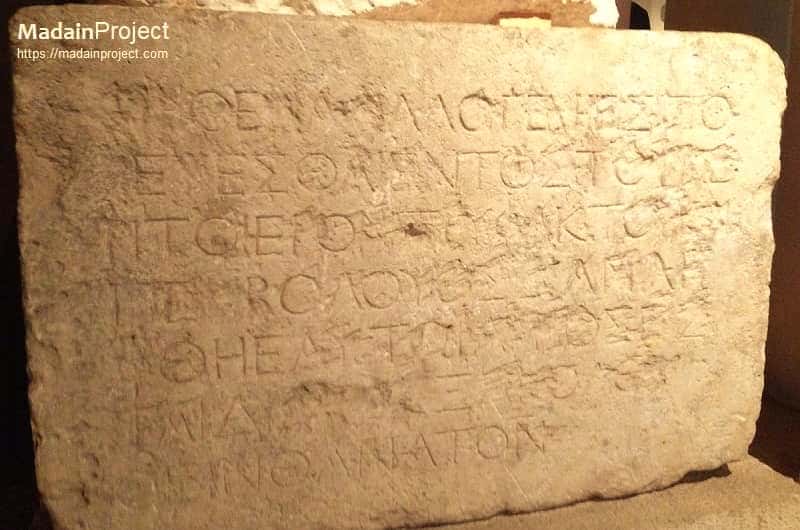
Greek inscription warning the pagans to not enter the sacred inner precinct. Photo courtesy of Madain Project.
We also possess something extraordinarily rare in the archaeology of the Temple: an actual warning inscription. In 1871 CE, the French archaeologist Charles Simon Clermont-Ganneau discovered a complete limestone inscription that had originally belonged to the Temple complex. A second, fragmentary example was subsequently found. The surviving Greek text warns that no foreigner was to pass within the balustrade and enclosure around the sanctuary, and that anyone caught doing so would be responsible for the death that followed. The complete inscription is now preserved in the Istanbul Archaeology Museums, while the fragment is held by the Israel Museum. The wording corresponds closely to Josephus's description and provides direct epigraphic evidence for the physical boundary and the prohibition associated with it.
The soreg is more than an obscure architectural detail. It allows us to see how the Second Temple actually functioned as sacred space. A pilgrim approaching the Temple did not simply cross one doorway and find himself inside a single building. He moved through a succession of boundaries, courts and increasingly holy areas, each with its own rules of access. The soreg marked one of those thresholds. Its existence is known from rabbinic tradition, described by Josephus, and confirmed by inscriptions carved in stone during the Second Temple period itself. The surviving warning is especially significant because it allows the ancient text and the physical remains to meet: a rule described in literature once stood publicly engraved on the very boundary through which movement into the Temple's holier precincts was controlled.