
Dome of the Chain: A Prototype for Dome of the Rock?
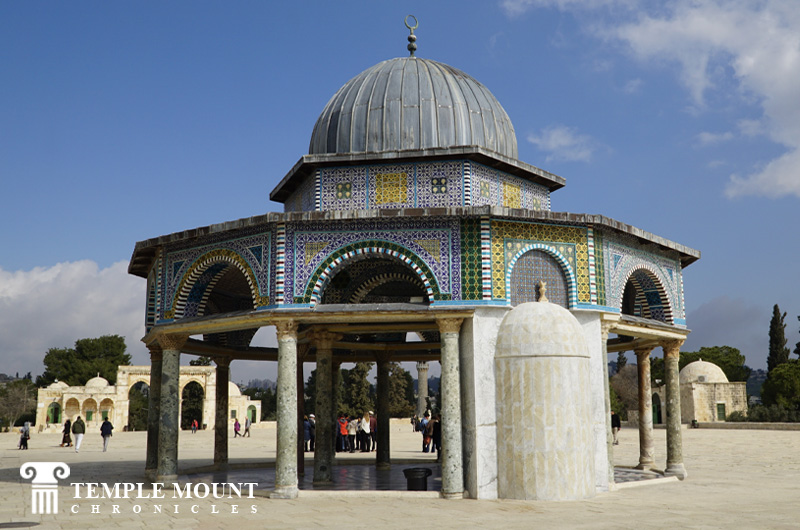
Dome of the Chain with the mihrab.
The Dome of the Chain (Qubbat al-Silsila) is an autonomous, heptagonal domed structure located on the Temple Mount (al-Haram al-Sharif) in the Old City of Jerusalem, situated immediately east of the Dome of the Rock. Constructed during the Umayyad Caliphate, epigraphic and architectural evidence attributes its founding to Caliph Abd al-Malik ibn Marwan in 72 AH (691/692 CE), making it one of the oldest surviving structures in Islamic architecture.
Unlike its larger neighbor, the Dome of the Chain lacks external walls, featuring an open-air design supported by two concentric rings of columns. The outer hexagonal arcade contains eleven columns, while the inner hexadecagonal ring consists of six columns that support the central drum and the timber-framed dome, utilizing Late Antique marble columns and capitals reused as spolia from earlier Byzantine or Roman structures.
Due to its architectural similarity with the Dome of the Rock; it has been theorised that it may have been built as a prototype for its neighboring structure. But the structural relationship between the Dome of the Chain and the Dome of the Rock remains a subject of significant debate among architectural historians. Early scholarship, influenced by the 10th-century geographer al-Muqaddasi, posited that the Dome of the Chain served as a small-scale architectural model (maquette) for the Dome of the Rock. However, modern spatial analysis and geometric measurements reject this hypothesis, noting that the Dome of the Chain is a regular heptagon, whereas the Dome of the Rock is an octagon.
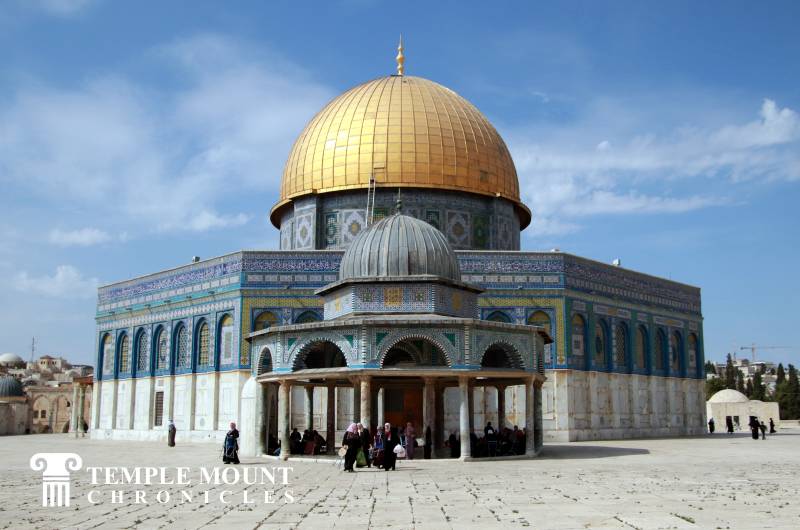
Dome of the Chain with the Dome of the Rock in the background, view from the east.
Another issue is that the structural axes of the two buildings do not align precisely, suggesting independent geometric planning. Excavations and surveys indicate that the Dome of the Chain sits directly over the exact topographical center of the platform, a placement that highlights its independent symbolic and structural importance within the Umayyad building program.
The original function of the structure has elicited various interpretations due to the absence of contemporary Umayyad administrative records. One prominent historical theory identifies it as the Bayt al-Mal, the public treasury of the Umayyad Caliphate, where tax revenues and administrative funds were secured. Arabic sources, such as the writings of the 11th-century historian al-Wasiti, support this view by stating that Abd al-Malik utilized the secure precinct to store wealth during the concurrent construction of the Dome of the Rock. Alternatively, the building's central open-air pavilion design and prominent location have led scholars like Oleg Grabar to suggest it functioned as a monumental assembly point or a tribunal court, integrating both civic administration and religious authority within the sacred precinct.
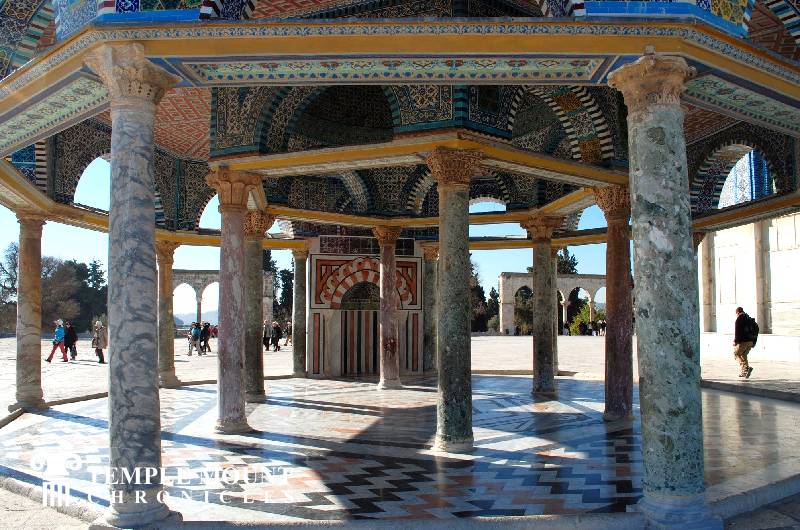
Interior view of the Dome of the Chain.
Religious and eschatological traditions heavily define the building's nomenclature and cultural significance. The name "Dome of the Chain" derives from a traditional narrative documented by early Islamic chroniclers, which claims a miraculous chain once suspended from the dome would detect perjury by slipping from the grasp of a liar while remaining accessible to the truthful. The structure also holds an explicit geographical association with Islamic eschatology; it is traditionalized as the site where the scales of justice (al-Mizan) will be suspended on the Day of Judgment. During the Crusader occupation of Jerusalem in the 12th century, the building was converted into a Christian chapel dedicated to Saint James the Less, but it was restored to Islamic use following the Ayyubid conquest by Saladin in 1187 CE, after which it underwent major tile and structural restorations under the Mamluk Sultan Baybars and the Ottoman Sultan Suleiman the Magnificent.