Walls of the Temple Mount
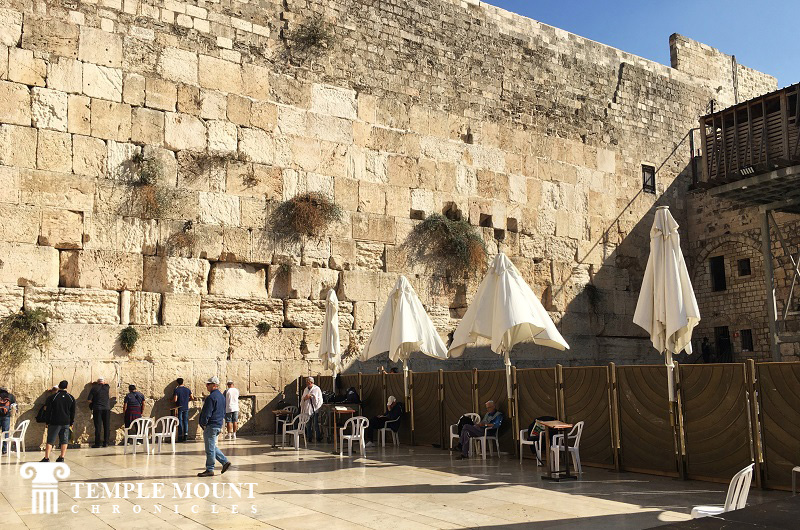
View of the "Wailing Wall", part of a much larger Western Wall of the Temple Mount.
The perimeter walls enclosing the Temple Mount compound in the Old City of Jerusalem represent one of the most complex engineering achievements of the ancient world. Originally expanded during the late second century BCE under the Herodian construction project, these massive retaining walls were designed to support an immense artificial plateau. The architectural engineering required to stabilize the sheer slopes of Mount Moriah involved the quarrying and placement of megalithic limestone blocks, known as ashlar stones. Today, the visible layers of these walls reveal a distinct historical stratigraphy, combining ancient Second Temple period masonry with subsequent Byzantine, Umayyad, and Ottoman restoration projects.
The Southern and Eastern walls provide equally critical data regarding the ancient topography and historical transitions of the precinct. The Southern Wall features the remnants of the Double and Triple Gates, ancient thoroughfares that originally granted pilgrims access into the temple courts from the City of David. Meanwhile, the Eastern Wall stands as the oldest surviving segment of the perimeter, containing masonry styles that many scholars attribute to the earlier Hasmonean dynasty. This eastern sector also houses the sealed Golden Gate, a structure displaying intricate Byzantine architectural design that reflects the shifting political and religious control over Jerusalem during the first millennium CE.
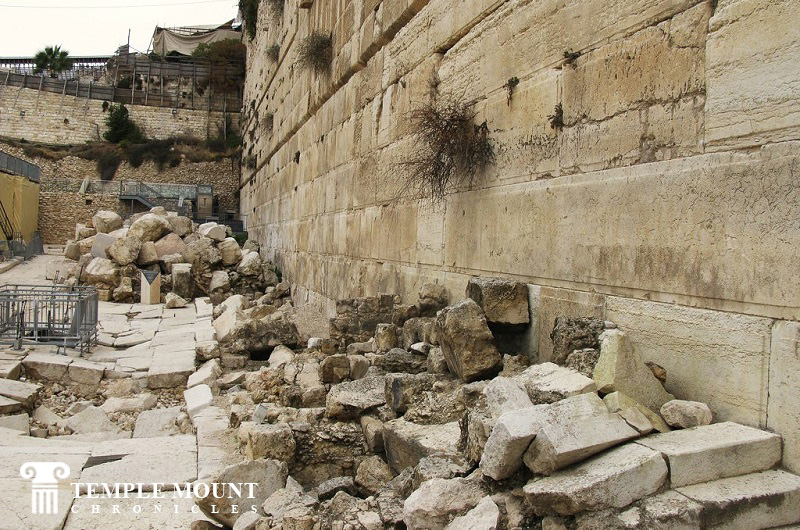
Rubble and ruins along the western wall, near the southern corner.
Among the four sides of the trapezoidal enclosure, the Western Wall stands as the most historically scrutinized and culturally significant segment. While the visible open-air plaza area serves as a primary locus for religious veneration, the structure extends deep underground, where archaeological excavations have revealed the true scale of the Herodian engineering. Within the Western Wall Tunnels, researchers have documented monumental foundational courses, including the famous "Master Course"—a singular stone blocks weighing upwards of several hundred tons. These massive foundational layers were laid without mortar, relying entirely on precise stone-cutting and gravitational weight to withstand seismic activity and the intense lateral pressure of the earthen fill behind them.
In contemporary academic discourse, the walls of the Temple Mount are viewed not merely as religious boundaries, but as a multi-layered historical archive. Every major conflict and regime change in Jerusalem's tumultuous past has left a physical imprint on the stone surfaces. From the deliberate destruction marks left by Roman legions in 70 CE to the beautiful, uniform defensive parapets rebuilt by Suleiman the Magnificent in the 16th century, the walls act as a structural timeline. Preserving and studying this fragile masonry remains an essential aspect of Near Eastern archaeology, providing ongoing insights into the building technologies, political ambitions, and cultural evolutions of the ancient Levant.