Sanctuary at Dan: Jeroboam's Temple
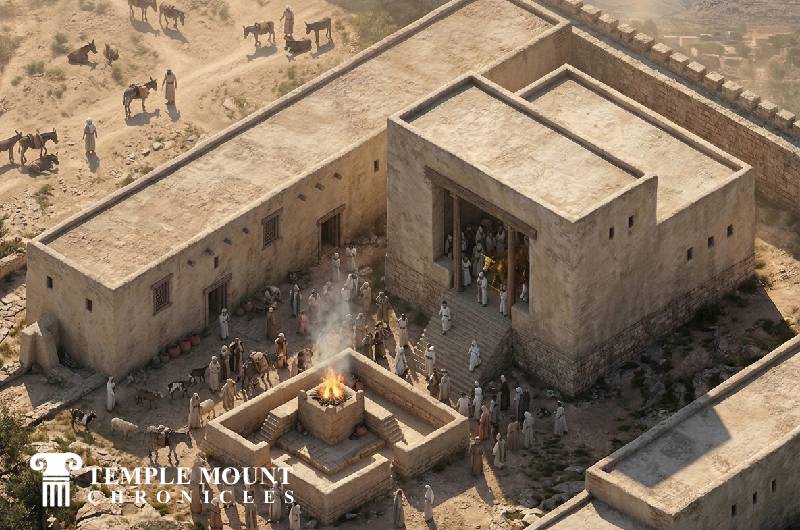
Jeroboam's rival temple in Dan (illustration).
Jeroboam’s sanctuary at Dan was established as one of the two royal sanctuaries of the northern kingdom of Israel, alongside Bethel. The biblical account is unusually explicit about the object placed there: “He set up one in Bethel, and the other he placed in Dan” (1 Kings 12:29). The preceding verse identifies these objects as two golden calves, which Jeroboam presented with the declaration, “Here are your gods, O Israel, who brought you up from the land of Egypt” (1 Kings 12:28). The language deliberately recalls the sin of the Golden Calf in Exodus 32:4, although the Bible does not state that Jeroboam regarded the calf as a separate deity. What it does record is that he created an alternative system of worship and placed one of its central cult objects at Dan.
The sanctuary therefore cannot be understood merely as a local shrine: it was established by the king as part of the religious structure of the northern kingdom. 1 Kings 12:31 further states that Jeroboam “made a house of high places” (beit bamot) and appointed priests “from among the people, who were not of the sons of Levi.” The biblical terminology is important. The text does not give the Dan sanctuary a formal name equivalent to the Beit HaMikdash, the Temple in Jerusalem, but describes it through its cultic function and the institutions Jeroboam established around it.
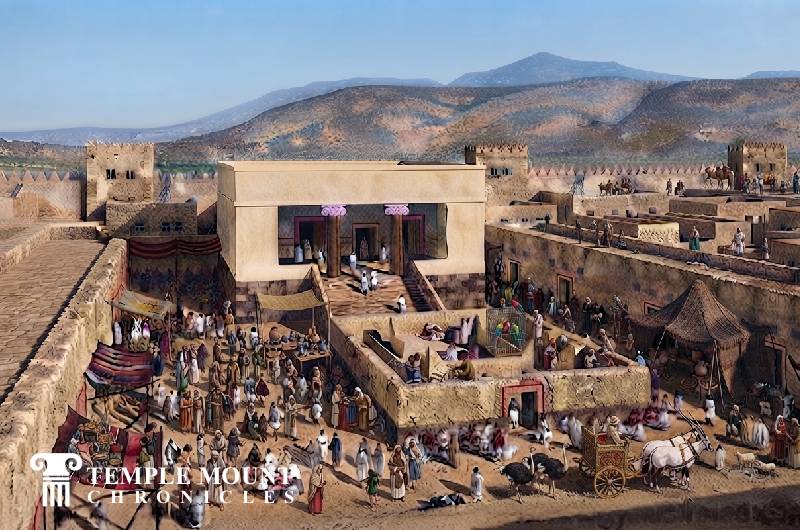
A festival at the Danite temple complex.
The sanctuary’s religious system was not limited to the calf itself. The same passage describes new priests, sacrificial worship, and a royal festival calendar. Jeroboam established a festival on the fifteenth day of the eighth month, deliberately corresponding to the festival celebrated in Judah on the fifteenth day of the seventh month (1 Kings 12:32–33). Although verses 32–33 describe Jeroboam’s observance at Bethel rather than giving a separate description of a festival at Dan, they reveal the character of the wider cultic system to which Dan belonged. Jeroboam had not merely provided an alternative place to sacrifice; he had altered the personnel, calendar, and institutions through which the northern Israelites approached God.
The Torah had already established a radically different principle in Deuteronomy 12:5–14: Israel was to bring offerings to the place that the LORD would choose, rather than establishing independent sacrificial centers according to royal preference. That's why the biblical presents Jeroboam’s actions as a fundamental religious breach. The repeated formula in the Books of Kings—“the sins of Jeroboam son of Nebat, by which he caused Israel to sin”—makes the point even sharper. Dan became one of the enduring symbols of that breach, not because the biblical text gives us a detailed architectural description of the sanctuary, but because it records the deliberate creation of a competing cultic institution.
Later Jewish tradition interpreted Jeroboam’s sanctuary through the earlier episode of the Golden Calf and through the political circumstances of the divided monarchy. The Mishnah itself does not provide a separate description of the Dan sanctuary, and it is therefore important not to attribute later rabbinic interpretations to the Mishnah. The Babylonian Talmud, however, discusses Jeroboam at length in Sanhedrin 101b–102a. There the Sages connect his decision to prevent the people from going up to Jerusalem with his political position as king of Israel. The Gemara imagines Jeroboam reasoning that if the people saw Rehoboam sitting in the Temple courtyard while Jeroboam stood, they would recognize the Davidic king as the legitimate ruler and follow him. The Talmud consequently presents the golden calves at Bethel and Dan as instruments in a deliberate separation of Israel from Jerusalem. It also preserves a striking chronological interpretation: Rabbi Oshaya teaches that before Jeroboam, Israel had been “suckling” from one calf—the Golden Calf of the wilderness—but from Jeroboam onward, from two and three calves, referring to the calves established at Bethel and Dan (Sanhedrin 102a).
This is a rabbinic interpretation, not an additional historical account of the sanctuary, but it shows how deeply Dan was incorporated into Jewish memory as a continuation of the sin described in Exodus 32.
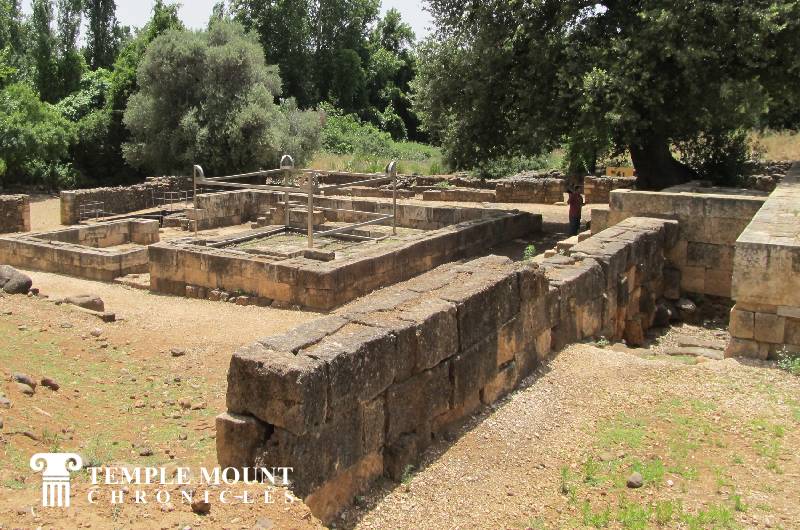
Archaeolgical ruins at the ancient Tel Dan.
The biblical judgment on Dan ultimately rests on a deeper issue than the physical presence of a calf. Jeroboam had created a sanctuary in which the northern kingdom could conduct its worship independently of the sanctuary chosen for Israel in Jerusalem, and he supported that system with a priesthood and cultic institutions of his own making. The prophetic episode that follows in 1 Kings 13 reinforces the biblical distinction: the man of God from Judah condemns the altar at Bethel and prophesies its destruction, while the Books of Kings subsequently use Jeroboam’s religious innovation as the standard against which northern kings are judged.
This is precisely the reason the Dan sanctuary is best understood in Jewish textual tradition as one part of Jeroboam’s attempt to establish a religious order for the northern kingdom that did not depend upon Jerusalem. Its precise physical form remains largely undescribed by the biblical text, but its place within the narrative is unmistakable: Dan was one of the two sanctuaries created by Jeroboam, it housed one of his golden calves, and it became permanently associated in the biblical and rabbinic tradition with the religious rupture that followed the division of Solomon’s kingdom.