Nicanor Gate: Temple's Great Inner Gate
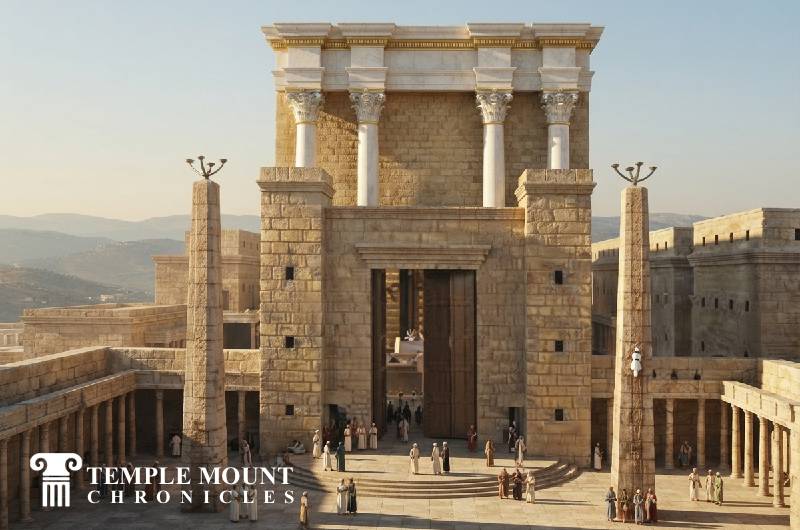
Conceptual illustration of the Nicanor Gate, during the Herodian period.
The Nicanor Gate was one of the most remarkable entrances within the Herodian Second Temple. It was not the great outer entrance through which pilgrims first approached the Temple precinct, but an inner gate leading deeper into the sacred courts. The Mishnah places it on the eastern side of the Temple Court, where it stood between the Court of the Women and the more restricted areas of the Temple. From there, the worshipper passed toward the Court of the Priests and, beyond it, the sanctuary itself.
The gate took its name from Nicanor, remembered in rabbinic tradition as a wealthy Jew from ancient Alexandria who commissioned its bronze doors. These were extraordinary doors. Unlike the other Temple gates, which were eventually covered with gold, the doors of Nicanor remained bronze. The Mishnah gives two explanations: either because a miracle had occurred in connection with them, or because their bronze was of such exceptional quality that it shone like gold.
The Talmud, in Yoma, preserves the story behind the miracle. Nicanor had gone to Alexandria in ancient Egypt to obtain the doors, and on the return voyage a violent storm threatened to destroy the ship. One of the doors was thrown into the sea to lighten the vessel. When the storm continued, the sailors prepared to throw the second door overboard as well, but Nicanor refused, declaring that if it had to be cast away, he himself should be cast away with it. The storm then subsided. When the ship reached the harbor, the lost door was said to have appeared beneath the vessel. Another version relates that a sea creature swallowed it and later brought it back to shore.
For the rabbis, this was not merely an interesting tale attached to an old piece of architecture. The miracle explained why the Nicanor doors were treated differently from the other gates. Even when the Temple's other gates were covered with gold, these remained bronze. Yoma also preserves a striking interpretation of the biblical Song of Songs, reading berotim—normally understood as cypress wood—in connection with the sea. In this rabbinic reading, the doors of Nicanor had passed through the sea and been returned to their appointed place.
The physical position of the gate is described with unusual precision in Middot. The Temple Mount had seven principal gates: three on the north, three on the south, and one on the east—the Gate of Nicanor. The Mishnah also describes Nicanor's Gate as being reached by a flight of steps and standing at the threshold between the Court of the Women and the inner courts. Its position made it an important passage between increasingly restricted sacred spaces. The rabbinic Temple was therefore not simply a single sanctuary surrounded by walls, but a carefully ordered sequence of courts, gates, steps, and degrees of holiness.
The gate is also associated with the Corinthian Gate mentioned by Josephus. Josephus describes a magnificent gate of Corinthian bronze that surpassed the others in workmanship and value. He says that the other gates were covered with gold and silver, while this particular gate was made of Corinthian bronze and was extraordinarily large and impressive. Modern scholarship has generally connected Josephus's Corinthian Gate with the rabbinic Nicanor Gate, although the precise identification and location have been debated.
There is another tantalizing identification. The Beautiful Gate mentioned in Acts 3, where Peter and John encountered the lame man, has often been identified with the Nicanor Gate or Josephus's Corinthian Gate. The identification is plausible because the ancient descriptions emphasize the gate's exceptional beauty and costly bronze, but it is not certain. The disagreement is a reminder that even when Jewish, Roman, and Christian sources appear to describe the same monument, their terminology and geographical perspectives do not always line up neatly.
Archaeology gives us one further glimpse of the man behind the name. An ossuary discovered on the Mount of Olives bears a Greek inscription referring to Nicanor of Alexandria, who made the doors. The identification of this Nicanor with the benefactor remembered by the rabbinic sources has been discussed by scholars, although the inscription itself cannot establish every detail of the later rabbinic tradition. It does, however, provide striking evidence for a real Alexandrian Jew named Nicanor who was associated with doors made for the Temple.
The Nicanor Gate occupies a very an unusual place in the collective memory of the Temple. Its importance came not from being the most accessible entrance, but from what lay beyond it: the increasingly sacred heart of the Temple precinct. Its bronze doors were remembered as exceptional, its donor was remembered by name, and the rabbis preserved a miracle to explain why these doors alone escaped replacement with gold. In the surviving descriptions of the Temple, the Nicanor Gate is one of the places where architecture, Jewish memory, ritual geography, and the history of a particular object meet.