Hezekiah’s Temple Mount: First Temple Period
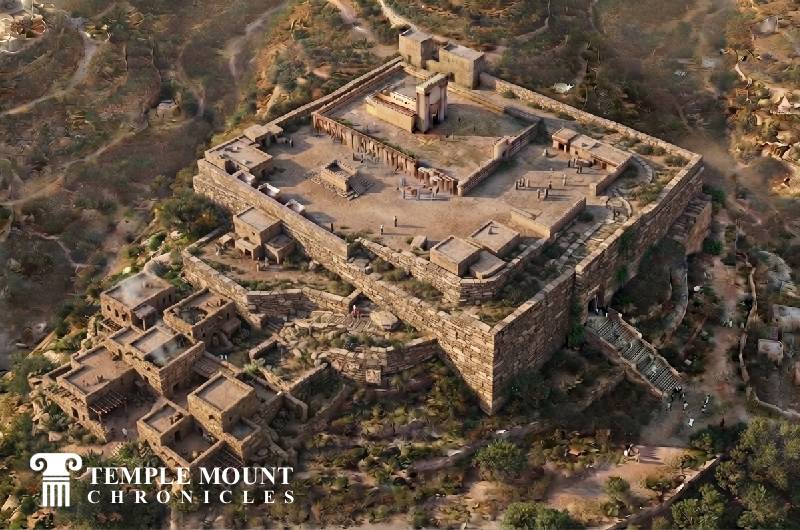
Artistic reconstruction of Jerusalem’s Temple Mount during Hezekiah’s reign (c. 715–686 BCE), depicting the First Temple and its Iron Age surroundings before the later expansions of the Second Temple and Herodian periods.
By the reign of Hezekiah, the Temple of Yahweh in Jerusalem was already an ancient royal sanctuary. If the biblical chronology is broadly followed, Solomon's Temple had stood for roughly three centuries when Hezekiah came to the throne around 715 BCE. It should therefore not be imagined as a completely untouched tenth-century BCE structure. The biblical accounts describe repairs under earlier rulers, most explicitly under Joash in the ninth century BCE. In 2 Kings 12:4–16, Joash ordered the repair of damage to the Temple and paid carpenters, builders, masons, and stonecutters to restore its fabric. The account even mentions the purchase of timber and dressed stone. Whatever the precise extent of those works, the passage establishes an important historical point: the Temple inherited by Hezekiah had already been repaired during its lifetime. It was a continuing institution and a continuing building, not a preserved archaeological specimen from Solomon's reign.
The reign of Ahaz introduced another stage of alteration. According to 2 Kings 16:10–18, Ahaz ordered changes to Temple furnishings and arrangements after his encounter with the Assyrian king Tiglath-pileser III at Damascus. The text describes modifications to the bronze altar, the stands, the bronze “Sea”, and an entrance used by the king. It also records that Hezekiah's father had removed or altered sacred equipment rather than simply maintaining the inherited sanctuary. By the time Hezekiah began his reforms, therefore, the Temple represented the accumulated physical history of several Judean reigns. The core sanctuary traditionally associated with Solomon could have remained substantially recognizable while its doors, furnishings, decorative elements, and subsidiary arrangements had changed. The evidence does not allow us to say precisely which walls or rooms remained from Solomon's construction, nor does it justify reconstructing every eighth-century feature as though it were archaeologically known.
Hezekiah's own intervention was both physical and religious. 2 Chronicles 29:3 says that in the first month of his first year he opened the doors of the Temple and repaired them. The account then describes priests and Levites cleansing the sanctuary of objects and impurities associated with the religious policies of Ahaz; the priests gathered in the eastern square, and the sanctuary's doors and lamps were restored to use (2 Chronicles 29:4–19). This is consistent with 2 Kings 18:4–6, which portrays Hezekiah as removing cultic objects and suppressing practices he regarded as illegitimate. The evidence is therefore strongest for restoration, purification, and renewed operation of an existing Temple. Hezekiah was not building a new temple in the manner of Solomon, nor does the biblical record suggest that he replaced the fundamental sanctuary. His reign instead marks another significant phase in the history of the First Temple.
The architectural question is much less certain. The biblical description of Solomon's Temple in 1 Kings 6–7 provides the traditional framework of a porch, main hall, and inner sanctuary, together with side chambers and associated courts. There is good reason to regard this as the basic architectural tradition inherited by Hezekiah, but there is no surviving eighth-century plan that allows the building to be drawn with precision. The Temple Mount itself has not been archaeologically excavated in a manner that would expose the Iron Age sanctuary beneath the later construction. Consequently, proposed reconstructions depend on a combination of biblical descriptions, surviving topography, archaeological remains around the Mount, comparative ancient Near Eastern architecture, and later evidence. Leen Ritmeyer's reconstruction of an earlier square Temple Mount is one influential scholarly proposal, based in part on architectural features preserved beneath or within the later platform, but the interpretation remains a reconstruction rather than an excavated plan of Hezekiah's Temple.
The wider setting of Hezekiah's Temple also needs to be separated from the monumental Temple Mount familiar from later history. Jerusalem was undergoing major defensive and urban development in the late eighth century BCE as Assyria became the dominant power in the region. Hezekiah strengthened the city's fortifications and secured its water supply, measures associated in the biblical sources with the threat of Assyrian attack; the campaign of Sennacherib followed in 701 BCE. The Temple stood within this Iron Age city, whose buildings, walls, terraces, and approaches would have been considerably more irregular than the enormous Herodian platform seen today. There is consequently no good reason to reproduce the massive retaining walls, vast paved courts, and monumental gateways of Herod's Temple Mount in a reconstruction of Hezekiah's Jerusalem. Herod's rebuilding began only in the late first century BCE, roughly seven centuries after Hezekiah.
An image of “Hezekiah's Temple” should therefore show neither a pristine replica of Solomon's original building nor a miniature version of Herod's later complex. The most defensible reconstruction is an eighth-century BCE First Temple whose fundamental sanctuary belonged to the Solomonic tradition but whose fabric and furnishings had accumulated repairs and alterations under successive kings. A modest eastern approach is possible: 2 Chronicles 29:4 explicitly places the priests and Levites in a square on the east side of the Temple during Hezekiah's purification, although this does not establish the precise form or location of a monumental eastern gate. The later Golden Gate should not be projected backward into this period. Likewise, the enormous square platform familiar today should be excluded unless clearly presented as a hypothetical reconstruction. What can be shown with confidence is a functioning royal sanctuary on Jerusalem's sacred hill, embedded in an Iron Age city and restored to active service under Hezekiah; the exact appearance of its surrounding precinct remains a matter of scholarly reconstruction rather than archaeological certainty.