Tel Dan: Jerusalem’s Rival Sanctuary
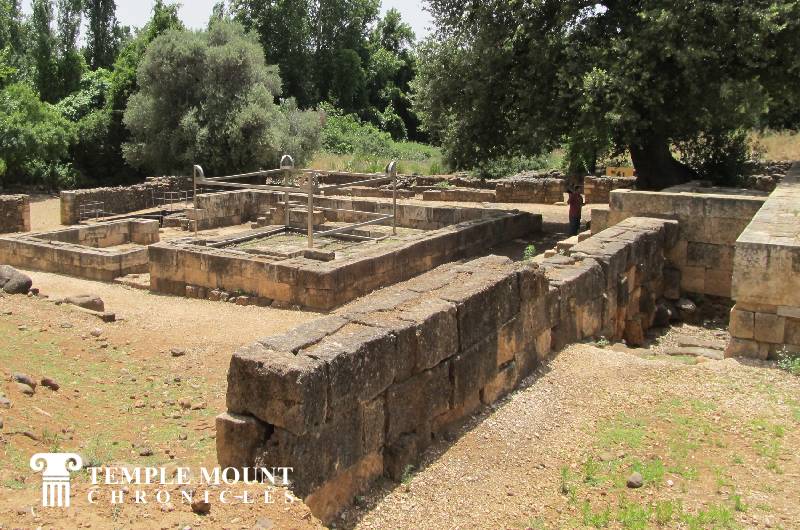
Archaeolgical ruins at the ancient Tel Dan.
After the kingdom divided following Solomon’s reign, Jeroboam I faced a political problem: the people of the northern kingdom were still expected to travel south to Jerusalem to sacrifice at the Temple of the LORD. According to 1 Kings, Jeroboam feared that these pilgrimages would restore their loyalty to the Davidic monarchy. He therefore established alternative sanctuaries at Bethel and Dan. “If these people go up to offer sacrifices at the temple of the LORD in Jerusalem,” he reasoned, “they will again give their allegiance to their lord, Rehoboam” (1 Kings 12:27). The sanctuary at Dan was consequently more than a local shrine. It formed part of Jeroboam’s attempt to create a northern religious system independent of Jerusalem.
The biblical account explicitly connects Dan with the golden calf: “One he set up in Bethel, and the other in Dan” (1 Kings 12:29). Jeroboam then declared, “Here are your gods, Israel, who brought you up out of Egypt” (1 Kings 12:28), language that deliberately recalls Aaron’s golden calf in Exodus 32. The Jerusalem Temple represented the religious center of the Davidic kingdom; Dan offered the northern tribes a sanctuary within their own territory. Deuteronomy had emphasized the importance of bringing sacrifices to the place that the LORD would choose: “There you shall bring your burnt offerings and sacrifices” (Deuteronomy 12:5–6). Jeroboam’s policy therefore confronted the religious centrality of Jerusalem as well as its political authority. The biblical historian calls the result “the sin of Jeroboam” (1 Kings 12:30), a phrase that becomes a recurring indictment of the kings of the northern kingdom.
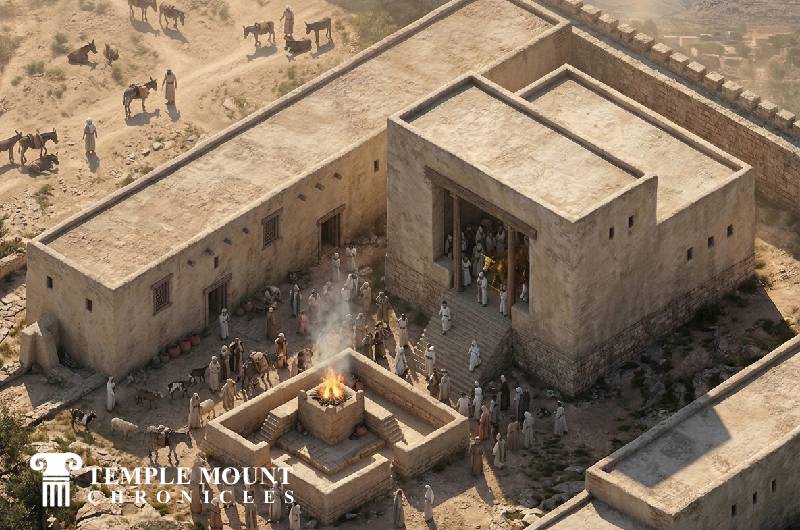
Jeroboam's rival temple in Dan (illustration).
Archaeology gives physical substance to the biblical picture, although it does not allow every detail of Jeroboam’s sanctuary to be reconstructed with certainty. Excavations at Tel Dan uncovered a substantial sacred precinct with a large raised stone platform, monumental steps, sacrificial areas, associated chambers, and cultic equipment. A horn from a large altar and other ritual objects demonstrate that animal sacrifice and incense were performed there. Earlier archaeological reconstructions attributed the principal bamah, or high place, to the tenth century BCE and associated it directly with Jeroboam I. The excavated platform was later enlarged, and parts of the complex continued to be used in subsequent periods. The physical scale of the precinct is important: this was not merely a small rural altar but a formally organized cultic installation capable of serving a major population.
At the same time, the Tel Dan reconstruction should distinguish what the Bible says from what archaeology can actually demonstrate. No golden calf has been recovered, and the surviving remains do not preserve the complete superstructure of the sanctuary. Earlier scholarship assigned much of the monumental precinct to the Iron Age kingdoms of Jeroboam I, Ahab, and Jeroboam II, but a 2025 study has argued that several features traditionally dated to the Iron Age should instead be reassigned to the Persian, Hellenistic, and Roman periods. This does not erase the biblical connection between Dan and Jeroboam, nor does it remove the evidence for cultic activity at the site; it means that a historically responsible illustration should avoid presenting every surviving wall as part of Jeroboam’s original sanctuary. What can be stated firmly from the biblical text is that Dan became one of Jeroboam’s principal northern sanctuaries precisely because Jerusalem and its Temple represented a political and religious center that the new northern kingdom could no longer accept as its sole place of national worship.