
Robinson’s Arch: The Monumental Stairway to the Temple
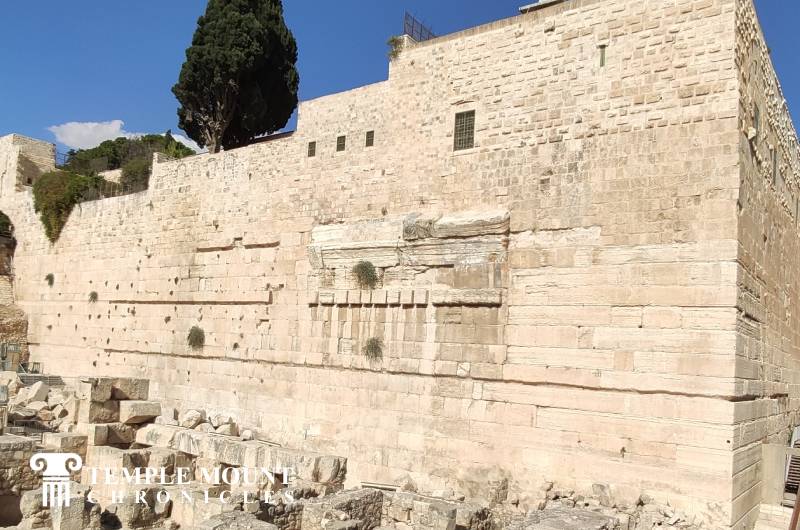
Remains of the monumental archway in the western wall.
Robinson’s Arch was part of the enormous expansion of Jerusalem’s Temple Mount during the Second Temple period, particularly the Herodian rebuilding project. Located near the southwestern corner of the Temple Mount, the massive stone arch projected outward from the western retaining wall over the ancient Tyropoeon Valley. The surviving remains were first identified in 1838 by the American scholar Edward Robinson, after whom the structure was later named.
The arch was not simply a bridge. Archaeological excavations revealed that it formed part of a monumental system of vaulted structures supporting a broad staircase that connected the lower city with the Temple Mount. A gate was positioned above the arch, allowing pilgrims and other visitors to ascend directly from the street below into the Temple precinct. Josephus describes this western entrance as leading down by a great number of steps toward the valley and then upward toward the other part of the city.
At street level below the arch ran a substantial paved thoroughfare along the western side of the Temple Mount. Excavations have uncovered the ancient pavement, drainage channels, shops, and other structures associated with this busy urban environment. The surviving arch itself is enormous: approximately 15.2 meters long, 12.9 meters wide, and 17.5 meters high, while the street beneath it was roughly eight meters wide. The scale of the construction reflects the extraordinary engineering required to transform the steep terrain surrounding the Temple Mount into a monumental architectural complex.
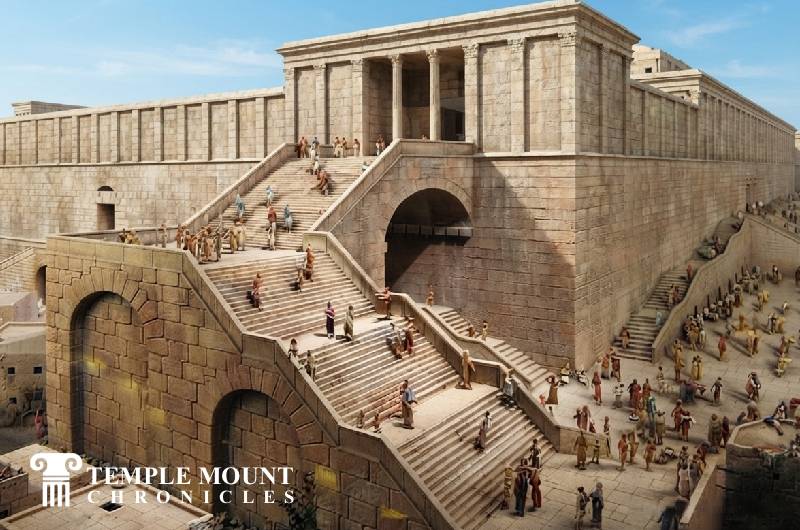
Artistic reconstruction of the so-called Robinson's archway and the monumental stairway leading up to the Herodian Temple espalnade.
The structure belonged to the world of Herodian Jerusalem, when the Temple Mount was being dramatically enlarged and transformed into one of the most imposing religious complexes of the ancient Mediterranean. Although Herod began the rebuilding of the Temple and its platform in the late first century BCE, archaeological evidence indicates that construction in the Robinson’s Arch area continued into the first century CE. Coins and other finds beneath the adjacent street indicate that portions of the western wall and arch were constructed after the beginning of the first century CE.
When Jerusalem fell to the Romans in 70 CE, the Temple and much of the surrounding monumental architecture were destroyed. The arch collapsed, sending its enormous stones onto the street below; portions of the fallen masonry remain visible today. What survives at Robinson’s Arch therefore preserves not merely a fragment of the Temple Mount wall, but a remarkable piece of the infrastructure through which pilgrims entered one of the most important Jewish sacred spaces of the ancient world.