Models of the Temple Mount
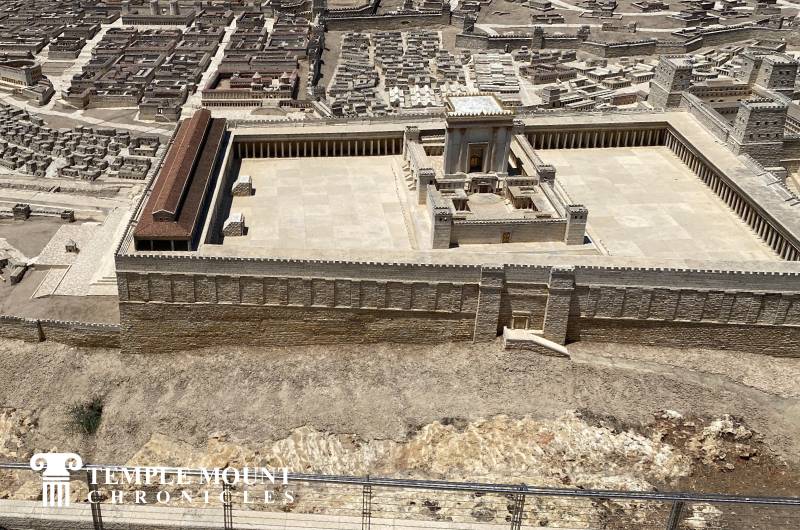
Illustration of the Second Jewish Temple situated over the Ophel area.
Few places in the ancient world have been reconstructed in as many different forms as the Temple Mount in Jerusalem. Because the Herodian Temple itself has been absent for nearly two millennia, models have become an important way of visualizing the buildings, courts, gates, walls, and surrounding city that once formed the center of Jewish worship. Some models are based closely on archaeological evidence and ancient descriptions, while others reflect particular scholarly reconstructions or artistic interpretations. Together, they reveal not only how the Temple Mount may have looked, but also how successive generations have understood and attempted to reconstruct the sacred landscape of the Beit HaMikdash (Holy Temple).
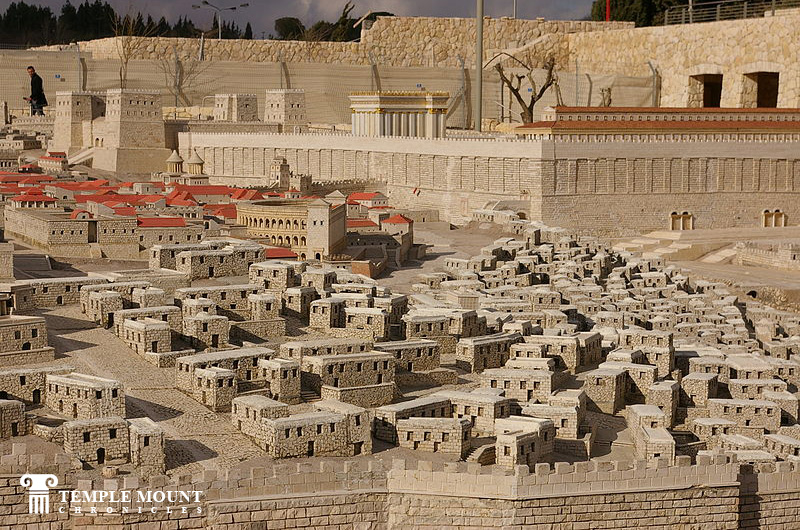
View of the Second Temple period Jerusalem with the Temple Mount in the background. View from the south-west.
Holyland Model of Jerusalem
The Second Temple model, originally commissioned for the Holy Land Hotel before its meticulous relocation, this massive 1:50 scale model of Jerusalem is now famously displayed as the Israel Museum model of Jerusalem next to the Shrine of the Book. Designed by archaeologist Michael Avi-Yonah, the sprawling reconstruction of the ancient city of Jerusalem captures the exact layout of the metropolis in 66 CE, just years prior to the historic Roman destruction. Visitors come to study what the city of Jerusalem in Jesus' time looked like, pinpointing the model of the Western Wall of Jerusalem, the massive Jerusalem Temple Mount, and the imposing Antonia Fortress. Whether you are looking for an educational old city model map of Jerusalem or want to stand over a highly detailed miniature replica of the Second Temple of Jerusalem, this outdoor exhibit stands as the definitive visual anchor for ancient Judean history.
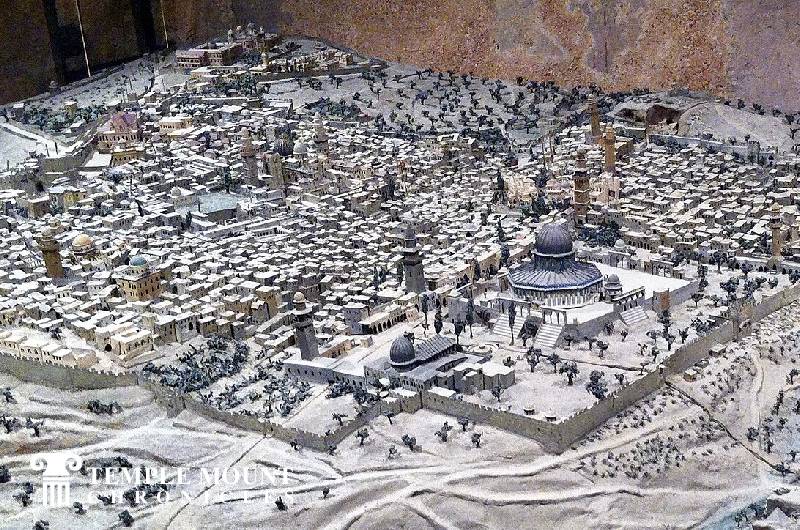
Elevated view of the so-called Illes Relief as seen from the south-east.
Illes Relief
Created by Hungarian bookbinder Stefan Illés for the Ottoman Pavilion at the 1873 Vienna World's Fair, this extraordinary 1:500 scale model of Jerusalem captures the Holy City during the twilight of the Ottoman rule before the British Mandate. Constructed from thousands of pieces of hand-painted, melted zinc, the zinc relief map of Jerusalem offers an invaluable, pre-modern aerial simulation. It provides an irreplaceable topographic record of the Mughrabi Quarter prior to its 1967 demolition, alongside meticulously rendered details like the newly installed telegraph poles outside Jaffa Gate. Grounded heavily in the Ordnance Survey of Jerusalem and the precise fieldwork of Conrad Schick, the historic artifact was famously lost for decades in Geneva before its 1980s rediscovery and relocation to the Tower of David Museum, where it remains the premier target for modern 3D photogrammetry recording of historical maps.
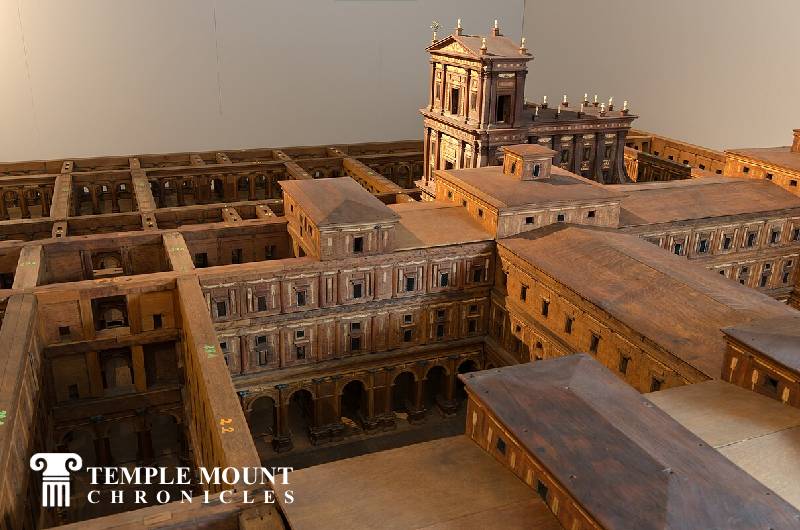
View of the Hamburg Model of the Jewish Temple.
Hamburg Temple Model
Commissioned between 1692 and 1698 by Hamburg senator and opera director Gerhard Schott, this massive, 12-square-meter architectural wood model of Solomon's Temple is structurally grounded in the highly influential 1604 divine geometry interpretation of Ezekiel’s Third Temple by Spanish Jesuit Juan Bautista Villalpando. Featuring four wings, nine courtyards, and a vast square layout, the Schott temple model represents a unique intersection of sacred scholarship and theatrical spectacle, likely originating as a stage piece for the Oper am Gänsemarkt production of The Destruction of Jerusalem. After an extensive European exhibition itinerary including London and Dresden throughout the 18th century, the historic artifact was permanently acquired by the Museum for Hamburg History (Hamburg Museum) in 1910. Today, it remains a prime subject for material culture analysis, recently undergoing complex conservation efforts to address historic toxic wood preservatives, and stands as a definitive benchmark for studying Replicas of the Jewish Temple in Western art history.
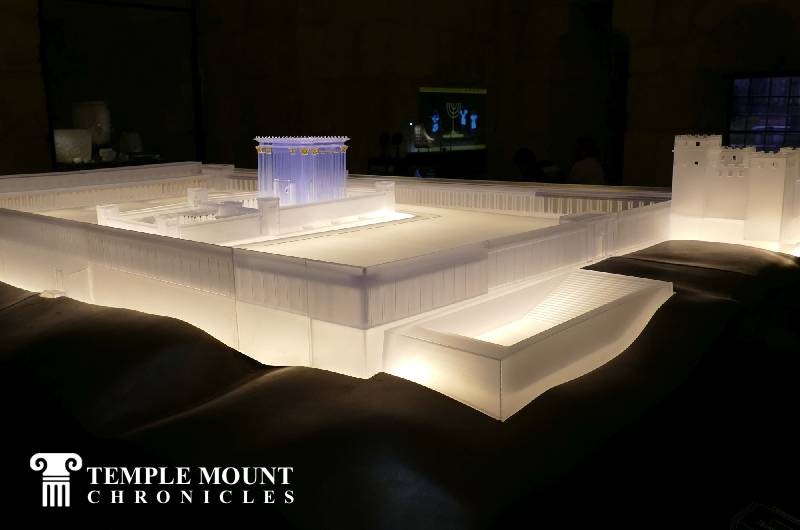
Functional model at the Western Wall exhibitions in Jerusalem.
Western Wall Exhibition Model
Placed deep within the subterranean archaeological matrix of the Old City, the electromechanically driven Second Temple model in the Western Wall Tunnels exhibition serves as a vital pedagogical and ideological apparatus for public history reception. Positioned within the Great Hall adjacent to Wilson’s Arch, this kinetic three-dimensional architectural replica functions as an interactive subterranean Temple Mount site simulation, utilizing an automated mechanical lift system to dynamically illustrate the distinct Herodian, Hasmonean, and post-destruction architectural stratigraphy of Mount Moriah. Managed under the auspices of the Western Wall Heritage Foundation, the spatial layout of this Kotel Tunnels exhibition model deliberately aligns the physical, in situ monumental masonry—such as the massive 570-ton Master Course—with a stylized visual representation of the sanctified precinct. By anchoring the tourist gaze directly opposite the historical location of the Holy of Holies, the device operates not merely as an educational ancient Jerusalem topography mapping tool, but as a powerful spatial mechanism that collapses chronological distance, synthesizing empirical archaeological data with contemporary collective memory and theological nationalism.