
Gog and Magog: The War That Comes Against Jerusalem
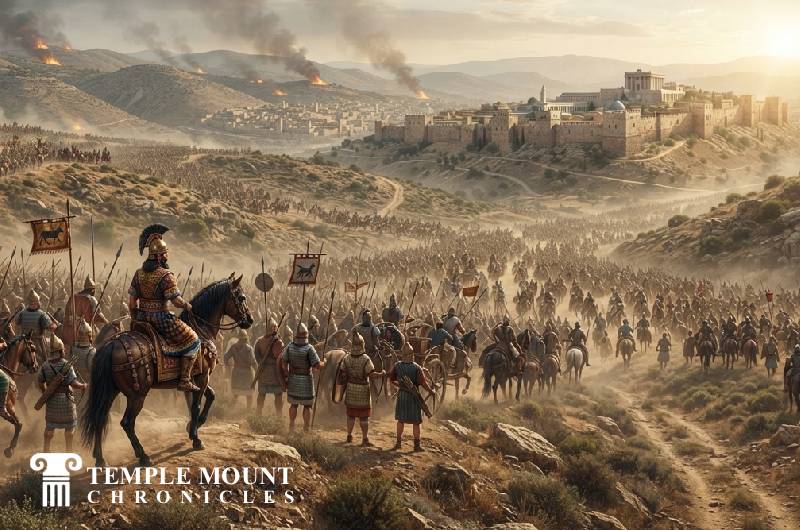
Conceptual illustration of the Gog and Magog War.
Ezekiel 38–39 presents one of the Hebrew Bible's most elaborate visions of a final assault upon Israel. The prophet is commanded to turn his attention toward Gog, of the land of Magog, described as a ruler associated with Meshech and Tubal (Ezekiel 38:2). Gog gathers a formidable coalition that includes Persia, Cush, Put, Gomer, and Beth-togarmah, bringing with them horses, horsemen, shields, bucklers, bows, arrows, and swords (Ezekiel 38:4–6). The text portrays them as human armies rather than supernatural creatures. Their enormous force advances against a restored Israel, whose inhabitants are described as having returned from devastation and dwelling in relative security (Ezekiel 38:8–12).
Ezekiel's geography is deliberately connected to the land of Israel, although the prophet does not describe the battle as taking place specifically inside Jerusalem. Gog comes “against the mountains of Israel”, and the invasion is compared to a cloud covering the land (Ezekiel 38:8–9). The objective is presented in terms of plunder and conquest: Gog sees a land whose people have accumulated livestock and possessions and determines to attack it. Jerusalem therefore belongs to the wider geographical and theological setting of the prophecy rather than serving as the sole battlefield. This distinction is important because later Jewish and Christian traditions often combined Ezekiel's Gog prophecy with other biblical passages concerning a final assault upon Jerusalem, particularly Zechariah 14.
The extraordinary force in Ezekiel's account is ultimately divine rather than military. When Gog enters the land, God declares that a great trembling will occur, while sword, pestilence, torrential rain, hailstones, fire, and sulfur descend upon the invading forces (Ezekiel 38:18–23). Gog's coalition collapses not because Ezekiel describes an opposing Israelite army defeating it, but because the invasion becomes the occasion for a manifestation of divine judgment. The stated purpose is equally significant: through the destruction of Gog, God will make himself known among Israel and the nations. The prophecy therefore functions within Ezekiel's larger concern with the restoration of Israel and the public vindication of the holiness of Israel's God.
The aftermath receives an unusually detailed treatment. The defeated forces fall upon the mountains of Israel, and the people of the land are said to burn the invaders' weapons for seven years (Ezekiel 39:4–10). A burial operation lasting seven months is then described to cleanse the land, with search parties marking the places where human remains are discovered (Ezekiel 39:11–16). Ezekiel names the burial place the Valley of Hamon-gog, “the Valley of the Multitude of Gog” (Ezekiel 39:11). The prophecy ends not with a description of a ruined Jerusalem, but with Israel's restoration and the recognition of God's sovereignty: the defeat of Gog becomes the means by which Israel and the nations come to know who has acted. Later traditions made Gog and Magog a central designation for the enemies of the end of days, but Ezekiel's own vision is more precise: a human ruler, an international coalition, an invasion of the restored land, and a divinely imposed defeat upon the mountains of Israel.